

Calls for a fundamental rethink of Ghana’s approach to economic management and development financing dominated a high-level forum organised by the Integrated Social Development Centre (ISODEC), as economists and policy experts challenged conventional approaches to monetary policy and urged greater use of domestic resources to drive national development.
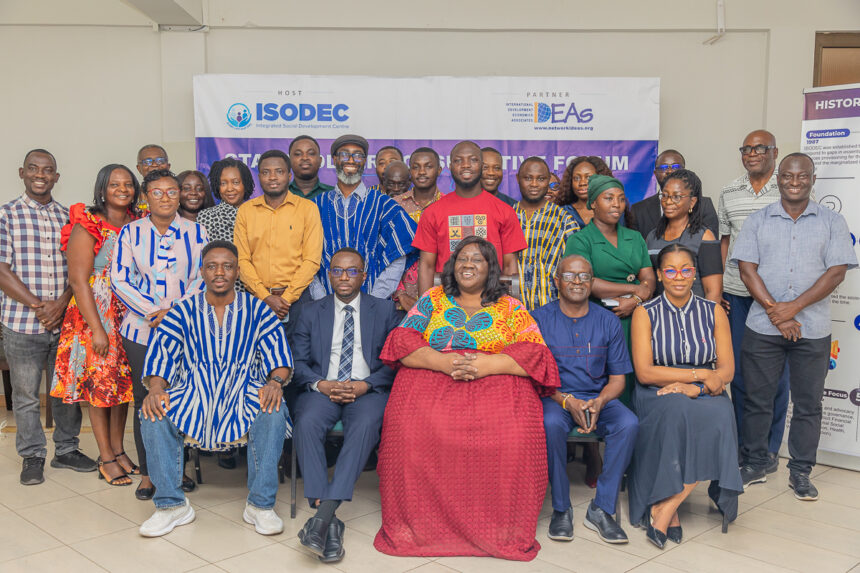
The forum, which brought together economists, policymakers, civil society actors, development practitioners, the media and other stakeholders, provided a platform for participants to examine alternative, evidence-based approaches to Ghana’s macroeconomic management and financing of development.
Opening the forum, the Executive Director of ISODEC, Mr. Sam Salifu Danse, said the initiative was aimed at opening up Ghana’s macroeconomic policy debate to alternative approaches and creating a platform where such ideas could be presented, scrutinised and tested by institutions responsible for shaping economic policy.
More Read

He said ISODEC’s broader objective was to demystify what he described as the “black box” of fiscal and monetary rules and broaden public participation in decisions that have far-reaching implications for Ghana’s development.
According to him, “citizens, Parliament, civil society organisations and the media must have greater opportunities to understand and participate in discussions on the policies that determine the country’s economic future.”
He thanked Ford Foundation, STAR- Ghana Foundation and West Africa Civil Society Institute (WACSI) for their support.
Setting the context for the forum, the Executive Director of International Development Economics Associates, (IDEAs), Mr. Charles Akelyira Abugre, challenged stakeholders to take a fresh look at how Ghana finances its development and who controls the key instruments through which that financing is mobilised.
Using the establishment of the Ghana Gold Board (GoldBod) as a case study,Mr. Abugre argued that the initiative demonstrated how domestic institutions and resources could be mobilised to support economic stability and productive activity.
He noted that building gold reserves could strengthen Ghana’s ability to generate foreign exchange, meet external obligations and influence exchange-rate expectations.
However, he said the most significant aspect of the GoldBod initiative was not merely its eventual contribution to lower inflation and interest rates, but the source of the financing.
According to him, the financing came from the central bank rather than the Treasury, a development which, he argued, “opens the door for a serious conversation about the role of the central bank.”
Mr. Abugre said the development challenged conventional assumptions about the boundaries of central-bank intervention and provided an opportunity for Ghana to reconsider the role of its monetary authorities in national development.
He further called for Ghana’s economic reset agenda to go beyond policy adjustments and address the fundamental question of how the country finances its development.
He argued that disruptions to external financing, including changes in international development assistance, had exposed the vulnerability of an economic system heavily dependent on external sources of finance.
He stressed that reducing dependence on external financing did not mean rejecting foreign investment, development assistance or international capital flows.
Rather, he said, the critical instruments for financing Ghana’s development should increasingly be under Ghanaian control.
He also cautioned that changes in the country’s financing model must be accompanied by a deliberate strategy to increase domestic production, particularly in the areas of food and energy.
Such a strategy, he said, would reduce import dependence, strengthen foreign-exchange resilience and make the economy less vulnerable to external shocks.
“Policies must drive production,” he stressed, arguing that Ghana could not simply depend on a “magical private sector reallocation” to transform the productive structure of the economy.
In a presentation on ‘Reconsidering Monetary Policy in Ghana’, Dr. Adamu Braimah Abille, Policy Analyst at ISODEC questioned the conventional reliance on interest rates as the principal instrument for achieving economic growth and price stability.
Drawing on a credit-creation perspective, he proposed a shift towards managing the quantity and quality of credit available to the economy.
He recommended that Ghana move away from an exclusive focus on inflation targeting through interest-rate manipulation and instead pay greater attention to ensuring that credit flows into productive sectors of the economy.
Among his recommendations was the introduction of stronger regulation of credit allocation, including minimum lending requirements for sectors such as agriculture, manufacturing and agro-processing.
He also called for measures to discourage speculative and unproductive lending while promoting what he described as quantitative credit guidance.
Dr. Abille further advocated the development of local and community-based banks to decentralise credit creation and improve access to finance for businesses operating outside Ghana’s major commercial centres.
He also urged the Bank of Ghana to ensure that its emerging macro-prudential framework places greater emphasis on directing credit towards sectors capable of generating sustainable and inclusive economic growth.
Presenting his paper, Dr. Isaac Abotebuno, an economist at IDEAs examined the evolution of the Bank’s legal mandate and argued that successive legislative and policy changes had progressively narrowed its role towards price stability and the use of market-based monetary instruments.
He said these changes had created legal, institutional and policy constraints that limited the Bank’s ability to play the broader developmental role it had performed in earlier decades.
Dr. Abotebuno therefore called for a reconsideration of the Bank’s developmental mandate and explored how monetary policy could be better aligned with Ghana’s productive transformation agenda.
One of the most striking proposals emerging from his presentation was a call for the Bank of Ghana to consider applying a GoldBod-type financing model to the National Food Buffer Stock Company (NAFCO).
Under the proposal,Dr Abotebonu noted that the central-bank-backed financing could enable NAFCO to purchase surplus agricultural produce during periods of high production, store the commodities as strategic reserves and release them during lean seasons.
The forum was moderated by Dr. Esther Ofei-Aboagye, Board Chair of ISODEC and former Director of the Institute of Local Government Studies. She guided the presentations and plenary discussions, ensuring that the deliberations remained focused on evidence, practical policy options and the responses of relevant institutions.
Publicagenda.news