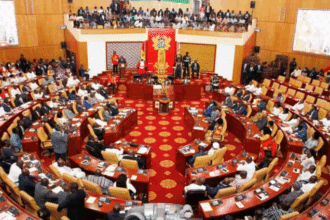
For well over four weeks and counting, Goldbod and the Bank of Ghana (BoG) have dominated the headlines like never before. The $1.7 billion (GH¢22 billion) loss flagged in the International Monetary Fund’s (IMF) 2025 report is being presented in ways that have raised serious concerns, with Parliament now expected to investigate the matter.
The Gold for Oil Programme the establishment of GoldBod under Act 1140, and the Domestic Gold Purchase Programme (DGPP) represent major policy shifts in Ghana’s economic history, introduced by both the previous and the current governments. Yet, both administrations appear to blame each other over the outcomes and implications of these policies.
And while there are good reasons for being skeptical about the operations of Gold for Oil and the Goldbod programmes, sometimes the political points scoring get over flogged. This threatens what could be a healthier nationalistic debate about how to wrestle our country from the reigns of a neoliberal bondage.
More Read

The idea of circumventing the geopolitical turmoil by increasing the country’s gold reserves cannot be a bad policy especially when Ghana is home to abundant gold. While prominent economists lead the debate, the tendency to play with words other than figures often worsens the situation, allowing dogma to take hold of the mind.
WHAT REALLY HAPPENED?
As often said, necessity is the mother of invention. The previous government attempted to curtail the dollar cost of fuel by going for what they termed “Gold for Oil”. The idea was to circumvent the “yolk” of the petrodollar by using what we have, i.e., gold, to directly exchange for oil importation. This idea, whatever it flaws, opened our minds about some possibilities. The BoG suddenly discovered that we had Gold which is almost equivalent to the dollar and in abundance and if only we controlled it, we would do better. So, to cut a long story short, Goldbod eventually came into being, what a discovery!
BANK OF GHANA
Under its Domestic Gold Purchase Policy (DGPP), the BoG asked Goldbod (a special purpose vehicle in this case) to purchase gold on its behalf, with the intent to shore up its gold reserves and by extension to increase its dollar holding. This was expected to dampen foreign currency volatility, and of course any forward-looking policy maker will do it, for God’s sake! The BoG didn’t buy gold directly, it used the Goldbod as its purchasing agent and Goldbod charged fees for:
- Assaying (testing purity)
- Transportation and storage
- Commission fees
According to the IMF, the total transaction costs for the programme reached 14.5% of the value of the Gold purchased. That means for every $1 million of gold purchased, the central bank paid $145,000 in fees and costs to Goldbod. However, the exchange rate differential at the time was the critical factor. In 2025, the Ghanaian cedi appreciated by 40.7% against the US dollar. This was a dramatic reversal from the cedi’s collapse in 2022.
HOW THIS CREATED A LOSS
The BoG holds assets in foreign currencies (US dollars, gold, etc.). On its balance sheet, these assets are valued in cedi terms. When the cedi appreciates sharply, the cedi value of dollar-denominated assets falls:
This is not a cash loss. No money actually left the central bank. It’s an accounting revaluation loss; the value of the asset in local currency terms reduced because the Cedi got stronger.
This accounting loss explains why the BoG’s reported loss was so large ($1.7 billion) while Goldbod itself reported a profit of 900 million Ghana cedis in the same period.
So, in 2025, the BoG recorded a negative equity of 6.7% of GDP (ie liabilities>assets). But a central bank can function with negative equity because it can always create money. However, it does raise questions about:
- Independence (the government may need to recapitalize it)
- Credibility (markets may lose confidence)
- Policy flexibility (pressured to generate profits rather than fight inflation)
The BoG views the loss as accounting-driven loss (exchange rate revaluation). And believes the DGPP program achieved its strategic goals. However, the Goldbod made a profit of 900 million cedis, and sees the loss is a BoG problem. But critics generally think it was a poorly designed program that cost taxpayers billions. Maybe the lessons should suffice, but no, the debate raged on!
STRATEGIC OBJECTIVE?
Let’s revisit the BoG’s view of the situation. The BoG says, the $1.7 billion loss was not a mistake but a calculated cost of achieving strategic objective. Ok, if it was a strategic objective, what did the taxpayer gain:
- Increase foreign reserves. Ghana’s international reserves rose to $13.83 billion, covering 5.7 months of imports, wow!
- Stabilize the cedi. The cedi became one of the best-performing currencies globally in 2025.
- Reduced reliance on volatile commodity exports. Gold reserves provided a hedge against oil price shocks.
- Support the mining sector. The program provided a guaranteed buyer for small-scale miners. And the Galamseyers?
Well, these gains look substantive to dismiss. But why are Ghanaians still not letting the dogs lie? Maybe the trade-offs do not match:
- Lost $1.7 billion in the balance sheet but gained $13.83 billion in reserves.
- Recorded a negative equity at 6.7% of GDP but the Cedi appreciated at 40.7%
- Recorded high transaction costs (14.5%) but reduced import inflation (inflation fell from 23.8% to 3.4%)
- Potential erosion of central bank credibility but increased investor confidence (Ghana regained some market access).
Essentially, the BoG traded a balance sheet loss for macroeconomic stability and on the balance of it, one will guess that, the gains far outshine the losses.
In addition, the DGPP prevented new debt by reducing the cost of existing debt, rather than directly paying down the principal.
Importantly, the program contributed to the falling of external dollar denominated debt by approximate GH¢6.2 billion (approx. $560 million) i.e., reduction in external debt service payments.
And for emphasis, the reverse scenario without the DGPP is likely to look like this:
- Debt would become much more expensive in local currency terms, raising Ghana’s debt-to-GDP ratio.
- Imported inflation: Imports (fuel, food, machinery) become more expensive, driving up consumer prices.
- Higher debt service costs: As the cedi falls, the cost of servicing dollar-denominated debt in local currency increases.
- Increased external borrowing: To stabilize the currency, the central bank might need to borrow more foreign exchange, creating a vicious cycle.
But this is not to gross over the need for accountability and the voices calling it out. Especially that the 14.5% transaction cost was too steep. But now that the good works of the critics has led to the programme being streamlined and has reduced transaction costs from 14.5% to 7.25% with the aim to lower them further to 3%, must we not cease fire for the time being? No, the Ghana Parliament will also have their say.
But going forward, since the Goldbod has come to stay, must we also not be keen about its success? We now have equity investment of GH¢5 billion (about $429 million) through budgetary allocation to support its activities.
The entity has promised to introduce a blockchain-based track-and-trace system to ensure every gram of gold it purchases can be traced back to its responsible mine of origin. This, they have said it will help combat smuggling, ensure purchases come from licensed sources, and boost investor confidence by guaranteeing supply chain integrity. In short, they too will fight Galamsey!
By moving to a self-financing model, promising to reduce their transaction cost to about 3%, and promised investment into domestic gold standardization and value addition, Goldbod maybe the SOE to keep an eye on. I dare say, this whole saga, despite its sulphureous effusions, perhaps is the kind of remarkable policy shift needed in our quest for resource nationalization and beneficiation.
The Writer, Bernard Anaba ,is a Policy Analyst and Head of Programmes at the Integrated Social Development Centre ( ISODEC)