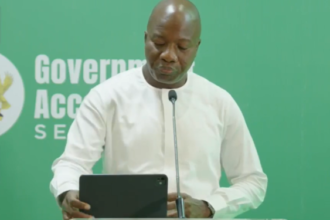



Governor of the Bank of Ghana (BoG), Dr Johnson Pandit Asiama has said that it is normal for the Cedi to occasionally experience short-term depreciation.
He mentioned that a number of factors, such as speculation and noise in the market, affect the behaviour of the local currency.
“What we have is a managed floating system, what that means that you allow the exchange rate to adjust to shocks, it is part of the process. The Cedi may move up, but then it must move down. Our objective is to ensure that the volatilities are not excessive, and so don’t get worried if you see the Cedi moving a little bit; it is normal.
“A number of factors impact the Cedi at any time, there are short-term factors, uncertainty of any kind, speculative behaviours, some noise in the market, which can just move the rate, not because of anything is wrong. if those movements become persistent that you will be [concerned]. But it will fall in line. We are observing the trends, the final market is on top of the job, and we announced a number of reforms in the financial markets,” he said during the 128th Monetary Policy Committee (MPC) press conference in Accra.
Fresh data from the Bank of Ghana’s latest Economic and Financial Data for January 2026 reveals the Cedi is back under fire, losing ground against major global currencies at the start of the year.
The data show that on the interbank market, the cedi traded at GH¢10.88 to the US dollar in January 2026, compared with GH¢10.45 at the end of December 2025, representing a depreciation of about 4 per cent.
The local currency also weakened against other major currencies, losing 4.9 per cent to the British pound and 4.1 per cent to the euro. During the period under review, the cedi traded at GH¢14.77 to the pound and GH¢12.80 to the euro on the interbank market.
Across segments of the foreign exchange market, the cedi recorded mixed performance over the past two weeks. In the retail market, it exchanged at about GH¢12.00 to the dollar, reflecting lingering demand pressures.
The dollar traded within a narrow band, slipping modestly against the cedi from GH¢11.90 to GH¢12.15, while the pound and the euro strengthened, closing at around GH¢16.30 and GH¢14.20 respectively.
According to analysts, the January depreciation reflects a combination of seasonal foreign exchange demand, portfolio adjustments typical at the start of the year, and the cedi’s underlying sensitivity to global financial conditions.
However, the scale of the decline remains modest when set against the exceptional gains recorded in 2025.
The early-year weakness marks a sharp contrast to developments last year, when the cedi staged a dramatic turnaround. After depreciating by 3.9 per cent in January 2025 and extending losses through February and March, the currency reversed course in April.
By May 2025, the cedi had appreciated by about 43 per cent against the dollar since the start of the year, supported by improved investor confidence, stronger foreign exchange inflows and tighter policy coordination. The rally was sustained through the rest of the year, with the cedi closing 2025 with a year-to-date gain of 40.7 per cent.
Beyond exchange rate developments, the Bank of Ghana’s data also point to improving debt dynamics. Ghana’s public debt trajectory showed further signs of stabilisation in November 2025, offering cautious optimism to investors and the business community after years of fiscal strain. Total public debt stood at GH¢644.6 billion as at November 2025, equivalent to 45.5 per cent of GDP.
The debt stock declined by about GH¢40 billion between September and November 2025, reflecting reduced borrowing and improved cash management. In dollar terms, public debt eased to US$57.2 billion in November, with fluctuations largely driven by valuation effects rather than fresh borrowing. External debt also moderated, falling to US$29.3 billion, or 23.3 per cent of GDP.