
Public Agenda NewsPaperPublic Agenda NewsPaper
  • General News
  • Politics
  • Business
  • Health
  • Development Agenda
  • World News
  • Features & Opinions
  • Election watch
  • Editorial
Font ResizerAa
Public Agenda NewsPaperPublic Agenda NewsPaper
Font ResizerAa
  • General News
  • Politics
  • Business
  • Health
  • Development Agenda
  • World News
  • Features & Opinions
  • Election watch
  • Editorial
Search
  • General News
  • Politics
  • Business
  • Health
  • Development Agenda
  • World News
  • Features & Opinions
  • Election watch
  • Editorial
Follow US
Breaking NewsFeatures & Opinions

What is Ghana’s economy?

Latifa Carlos
Last updated: September 20, 2018 2:39 pm
Latifa Carlos
Share
4 Min Read
SHARE

I making these emphatic statements not based on any personal hatred against the NPP and the NDC as political parties but I do so on the basis of what history has proven on the issue of the Ghanaian economy and by extension the African economy. These two parties deviate from the valid principles that can salvage us.

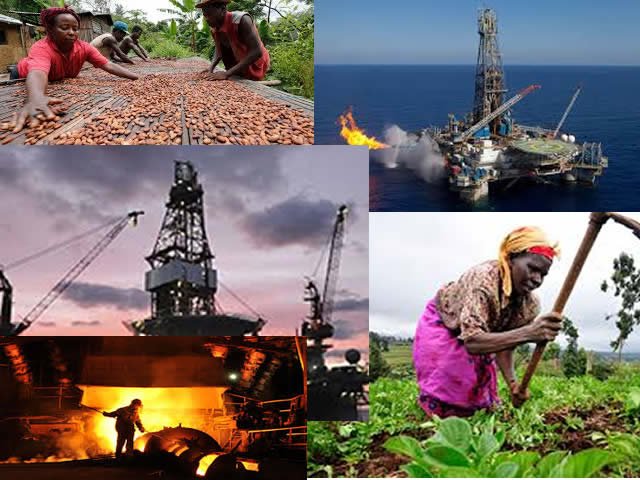
It must be noted that the Ghanaian economy is a “Neo-colonial economy”. There is no two ways about this. Without defining what is neo-colonial, examples will help us at the end know what is it. And so we candidly say neo-colonial is our economy, firstly, because the structure of the economy is largely dependent on a mono cash crop, Cocoa. The economy is not diversified. Other products exist but remain on the periphery whiles a lot are imported. The recent discovery of oil reveals that its shared formula has largely been a foreign controlled one. Inputs of production are largely imported and consumption is heavily dependent on import commodities.

Secondly, the economy as a neo-colonial economy means that large capital formation and flow is in the hands of foreign private and multinational corporations. The Banking, Telecom, Mining and Light industries are dominated by shareholders who are not nationals but hold allegiance to metropolitan economies.

More Read

From Trauma to Recovery: Strenthening Support for Victims of Torture
Drug networks infiltrating schools – NACOC warns
NDC renames National Headquarters after J. J Rawlings
GTMO Condemns Attack on Forestry Commission Checkpoint in Bono East Region
World leaders converge in Accra for high-level reparatory justice conference

Thirdly, there is low productivity in this country. Records revealed in studies of the economy of Ghana – check Walter Birmingham, and E.N. Omaboe on ” A Study of Contemporary Ghana: The Economy of Ghana”, where they provided vivid analysis on economic data compiled from 1957 to 1964 indicating that Ghana, since 1963, has not recorded high productivity relative to the World Economy.

Fourthly, it is a neo-colonial economy because key policies, as a country, are imposed and dictated by Briton Woods Institutions and donor-agencies of developed economies such as USAID, DANIDA, SNV, etc.. For instance, the Structural Adjustment Programme (SAP), PAMSCAD, Ghana Poverty Reduction Strategy (I)(II), Ghana Growth and Poverty Reduction Strategy, IMF External Credit Programme, etc, are all engineered, imposed and financed by outsiders.

Lastly, our economy is neo-colonial because production in Ghana is centred on Capitalist thinking, which is to extract surplus value from the labour of others and at the end pay wages that not commensurate with labour expended in the production process. Excessive capital is therefore accumulated in this process as a result of the alienation of capital from labour. This mechanical framework governs all production in Ghana and has therefore rendered millions of people jobless, poor and sick.

Our conversation should centre around some of these issues. They should shape our choices when it comes to political decisions. I suppose my opinion will be useful to the soon-to-be movement, PDM, which will be announced on the 28th September 2018 at the International Press Centre. I wish them well!


Source: Isaac WinfulDadzie
Researcher, Activist, Pan Africanist

Share This Article
Facebook Whatsapp Whatsapp Email Copy Link Print

Recent Posts

  • From Trauma to Recovery: Strenthening Support for Victims of Torture
  • Drug networks infiltrating schools – NACOC warns
  • NDC renames National Headquarters after J. J Rawlings
  • GTMO Condemns Attack on Forestry Commission Checkpoint in Bono East Region
  • World leaders converge in Accra for high-level reparatory justice conference
  • Mining, water supply and transport emerge biggest drivers of Producer Price Inflation
  • “Men’s Mental Health: Breaking the Silence, Saving lives
  • NADeF Micro-Credit beneficiaries seek increased funding amid business growth
  • Gbetsile: Six-year-old girl drowns in septic tank while searching for water
  • Recurring Floods Continue to Threaten Lives and Property in Oyibi Community
  • Africa poised to lead global digital finance evolution — MTN CEO
  • Ghana risks outsourcing economic sovereignty under IMF PCI deal — ISODEC
  • Accountability Labs Engage Birim North Assembly on Development Needs
  • How Africa can escape the debt trap
  • US lists travel, visa requirements for World Cup fans
  • Mahama to lead decisive Cabinet meeting over Constitution Review today
  • Ghana’s economy expands by 7.7% in February 2026 – GSS
  • President Mahama urges African leaders to unite in tackling healthcare challenges

You Might Also Like

Breaking NewsBusiness

Mining, water supply and transport emerge biggest drivers of Producer Price Inflation

June 18, 2026
Breaking NewsHealth

“Men’s Mental Health: Breaking the Silence, Saving lives

June 15, 2026
Breaking NewsBusinesstop stories

NADeF Micro-Credit beneficiaries seek increased funding amid business growth

May 31, 2026
Breaking NewsGeneral Newstop stories

Gbetsile: Six-year-old girl drowns in septic tank while searching for water

May 25, 2026

About Us

Public Agenda is fou­nded and owned by Pu­blic Agenda Communic­ations.

Public Agenda was founded as a public interest Me­dia entity. Its Visi­on is to contribute to building a well-i­nformed society where accurate informati­on dissemination is the cornerstone of a democratic, just and equitable society.

Its mission is to inform, guide and bui­ld responsible citiz­enship and accountab­le decision making and strive for excell­ence in the media in­dustry. Public Agenda Communications is managed by a Board of Directors.

  • Contact us
  • Advertise with us
Welcome Back!

Sign in to your account

Username or Email Address
Password

Lost your password?