

The Executive Director of the Integrated Social Development Centre ( ISODEC), Mr Sam Salifu Danse has stated that the pervasive poverty and widening inequality in Nigeria can be addressed if natural resource wealth in the West African country is used prudently by successive governments.
According to Mr Danse, Nigeria, unlike other countries is blessed with abundance of natural resources, including oil, gas, minerals and arable land. However, the management of these resources has long been plagued by misgovernance, corruption and a failure to equitably distribute the wealth they generate. As a result, Nigeria has experienced widening socioeconomic disparities, with a small elite capturing the lion’s share of the profits while the majority of the population languishes in poverty.
He noted that, rather than investing resource revenues in sustainable economic development and public services, successive governments have often squandered or misallocated these funds, leaving the country heavily indebted and vulnerable to external shocks.
More Read

The narrative, according to him cannot continue, asserting that, “We must all come together to chart a new course, one that places the well-being of all Nigerians at the heart of natural resource governance. This will require fundamental reforms to increase transparency, accountability, and community participation in decision making processes regarding the governance of this country’s natural resources.”
Mr Danse made the call while addressing participants at a National Roundtable Conference on Natural resource governance last week in Abuja, Nigeria.
The conference was organized by Global Rights and ISODEC with support from Ford Foundation. It was held on theme,“Addressing Natural Resource Governance And Inequalities In Nigeria.”
Mr Danse stated that the time has come for a greater focus on using natural resource wealth to address poverty, inequality, and the delivery of essential public services.
Mr Danse observed that Nigeria country faces significant economic challenges, with rising debt levels, high inflation and growing inequality.
According to the Debt Management Office, Nigeria’s current total debt stands at $91.463bn. Paradoxically, Nigeria raked in $20.98bn in 2017, $32.63bn in 2018 and $34.21bn in 2019 from oil revenue only. These issues are inextricably linked to the governance of Nigeria’s vast natural resources and the distribution of the benefits they generate.
He used the occasion to acknowledge Ford Foundation for supporting the conference and its continuous commitment to addressing inequalities and injustices all over the world.
“Ford Foundation has over the years demonstrated commitment to challenging convention and contributing to reshaping sustainable development for equity,” Mr Danse added.

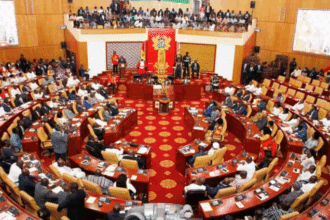
A cross section of participants at the Natural Resource Governance Conference in Abuja, Nigeria.
The conference brought together diverse range of stakeholders, including government officials, CSOs, academic experts, and community representatives to explore innovative solutions and develop a roadmap for transforming natural resource governance in Nigeria.
The convening was also to contribute to shaping the future of Nigeria and the livelihoods of millions of citizens and to ensure that the country’s natural resource wealth is managed in a way that benefit all and not just a privileged few.
In his welcome address, Mr. Abiodun Baiyewu, Executive Director of Global Rights said, with more than 40 minerals in commercial quantities strewn across the country, paradoxically the solid mineral sector contributes less than 1% to the national GDP.
Mr Baiyewu stated that more than 80 percent of the sector ,in particular artisanal mining is unregulated and its revenue unaccounted for.
“We live with the environmental and socio-economic consequences of lax oversight, and worse still, our children will pay for them, while these minerals pave the path to economic greatness for the countries to which they are illegally ferried. Mining host communities inordinately bear the burden of the resource curse with seemingly little or no benefits from the wealth that is harnessed from their vicinity. With the burst in the hydrocarbon sector and a dwindling economy, minerals and mining have understandably become one of the core economic focus of the Nigerian government because of their inherent potentials.
“ At various times, this administration has shared its agenda of growing the nation’s economy and overall development from mining. Impressive plans. But the big question that we are taking a pause to answer in the next two days is: are we connecting the right dots for the fulfilment of Nigeria’s economic growth and development through solid minerals development”?
He said the conference was the seventh part in a series of dialogues aimed at strengthening and increasing engagements between civil society actors and the government on solid mineral governance in Nigeria.
By : Mohammed Suleman/Publicagenda.news