
Public Agenda NewsPaperPublic Agenda NewsPaper
  • General News
  • Politics
  • Business
  • Health
  • Development Agenda
  • World News
  • Features & Opinions
  • Election watch
  • Editorial
Font ResizerAa
Public Agenda NewsPaperPublic Agenda NewsPaper
Font ResizerAa
  • General News
  • Politics
  • Business
  • Health
  • Development Agenda
  • World News
  • Features & Opinions
  • Election watch
  • Editorial
Search
  • General News
  • Politics
  • Business
  • Health
  • Development Agenda
  • World News
  • Features & Opinions
  • Election watch
  • Editorial
Follow US
Breaking NewsHealthtop stories

WHO calls for action to halt rise in hearing loss in Africa

Suleman
Last updated: October 8, 2024 9:56 am
Suleman
Share
4 Min Read
SHARE

The number of people in Africa living with hearing loss could rise to 54 million by 2030, up from 40 million today, unless urgent measures are taken, the World Health Organization (WHO) said in a report published on Monday. 

Contents
Children at a lossShortage of professionalsNewborn screening lackingAdvocacy, integration and financing

Hearing loss already costs the continent $27 million annually, exacting profound impact on lives and economies, according to the report, which was launched at the African Summit on Hearing Impairment in Nairobi, Kenya.

Widespread hearing loss disproportionately affects poor and vulnerable populations. WHO warned that without urgent interventions it will continue to escalate, amplifying existing inequalities in access to health services.

More Read
NDC renames National Headquarters after J. J Rawlings
GTMO Condemns Attack on Forestry Commission Checkpoint in Bono East Region
World leaders converge in Accra for high-level reparatory justice conference
Mining, water supply and transport emerge biggest drivers of Producer Price Inflation
“Men’s Mental Health: Breaking the Silence, Saving lives

Children at a loss

The UN agency said hearing loss has far-reaching consequences for children, including delays in language development, thus increasing the risk of poor educational outcomes and limited career prospects in the future.

Meanwhile, adults with untreated hearing loss often face isolation, loneliness and increased risk of depression and dementia.

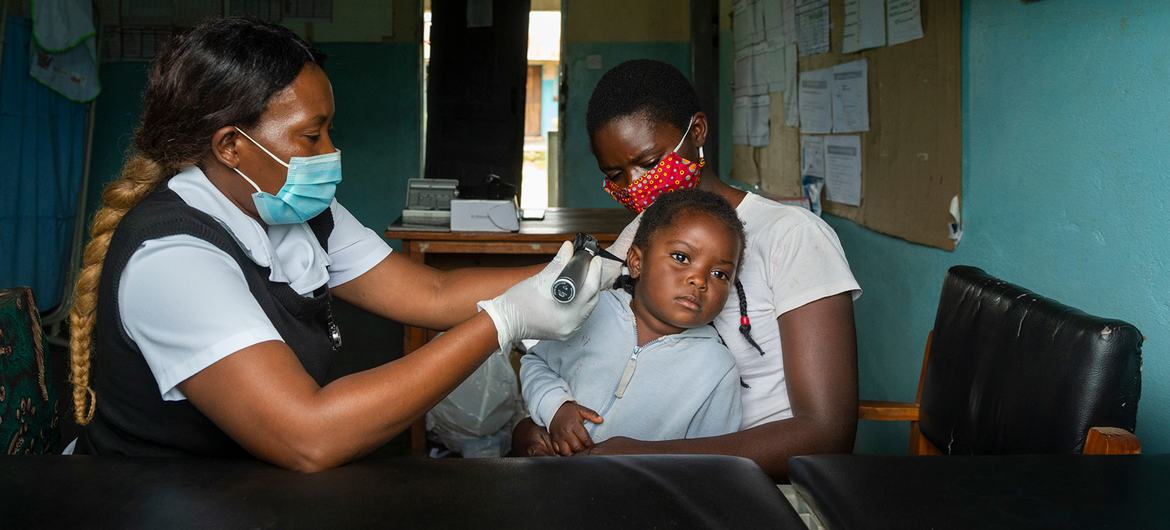
The report details numerous factors driving the surge in hearing loss in WHO’s Africa Region which covers 47 countries. Chief among them is the acute shortage of ear and hearing care (EHC) specialists as well as uneven distribution of the available workforce, which is mainly in urban areas.

Shortage of professionals

For example, more than 56 per cent of African countries have just a single ear, nose and throat (ENT) specialist for every million people, whereas in Europe it is roughly 50 per million.

Meanwhile, more than three-quarters of countries have fewer than one audiologist and one speech and language therapist for every million people.  

And although 33 million Africans could benefit from a hearing aid, only around 10 per cent have access due to lack of EHC financing, and consequent high costs.

Newborn screening lacking

The report noted that among children living in low and middle-income countries, up to 75 per cent of hearing loss is due to preventable causes such as infections and common ear diseases as well as birth complications. Yet, most countries do not routinely conduct hearing screening of newborns.

Even in countries with EHC programmes, related interventions are not integrated into school and workplace health programmes, or healthy ageing programmes.  

This challenge is further compounded by lack of national policies and plans for strengthening delivery of EHC, and low implementation even where they exist. Additionally, 35 per cent of countries do not have a budget allocated to EHC activities, meaning patients must bear the entire cost of treatment and care.

Advocacy, integration and financing

The report contains several recommendations. For example, countries should leverage the findings to galvanize action at the highest level, including advocating for policies focused on EHC and related activities. 

EHC should also be urgently integrated into existing programmes to optimize use of scarce resources, while governments should explore public-private partnerships towards strengthening services.

The report also highlighted the need for dedicated financing for EHC, to equip facilities and deliver products and technologies, among other measures.  

Source: UN News Centre

Share This Article
Facebook Whatsapp Whatsapp Email Copy Link Print

Recent Posts

  • NDC renames National Headquarters after J. J Rawlings
  • GTMO Condemns Attack on Forestry Commission Checkpoint in Bono East Region
  • World leaders converge in Accra for high-level reparatory justice conference
  • Mining, water supply and transport emerge biggest drivers of Producer Price Inflation
  • “Men’s Mental Health: Breaking the Silence, Saving lives
  • NADeF Micro-Credit beneficiaries seek increased funding amid business growth
  • Gbetsile: Six-year-old girl drowns in septic tank while searching for water
  • Recurring Floods Continue to Threaten Lives and Property in Oyibi Community
  • Africa poised to lead global digital finance evolution — MTN CEO
  • Ghana risks outsourcing economic sovereignty under IMF PCI deal — ISODEC
  • Accountability Labs Engage Birim North Assembly on Development Needs
  • How Africa can escape the debt trap
  • US lists travel, visa requirements for World Cup fans
  • Mahama to lead decisive Cabinet meeting over Constitution Review today
  • Ghana’s economy expands by 7.7% in February 2026 – GSS
  • President Mahama urges African leaders to unite in tackling healthcare challenges
  • Chinese mining firm targets Ewoyaa lithium takeover in $210m deal
  • Ghana now 8th biggest economy in Africa

You Might Also Like

Breaking NewsBusinesstop stories

NADeF Micro-Credit beneficiaries seek increased funding amid business growth

May 31, 2026
Breaking NewsGeneral Newstop stories

Gbetsile: Six-year-old girl drowns in septic tank while searching for water

May 25, 2026
MTN Group CEO & President, Ralph Mupita
Breaking NewsBusinesstop stories

Africa poised to lead global digital finance evolution — MTN CEO

May 20, 2026
Breaking NewsBusinesstop stories

Ghana risks outsourcing economic sovereignty under IMF PCI deal — ISODEC

May 20, 2026

About Us

Public Agenda is fou­nded and owned by Pu­blic Agenda Communic­ations.

Public Agenda was founded as a public interest Me­dia entity. Its Visi­on is to contribute to building a well-i­nformed society where accurate informati­on dissemination is the cornerstone of a democratic, just and equitable society.

Its mission is to inform, guide and bui­ld responsible citiz­enship and accountab­le decision making and strive for excell­ence in the media in­dustry. Public Agenda Communications is managed by a Board of Directors.

  • Contact us
  • Advertise with us
Welcome Back!

Sign in to your account

Username or Email Address
Password

Lost your password?