

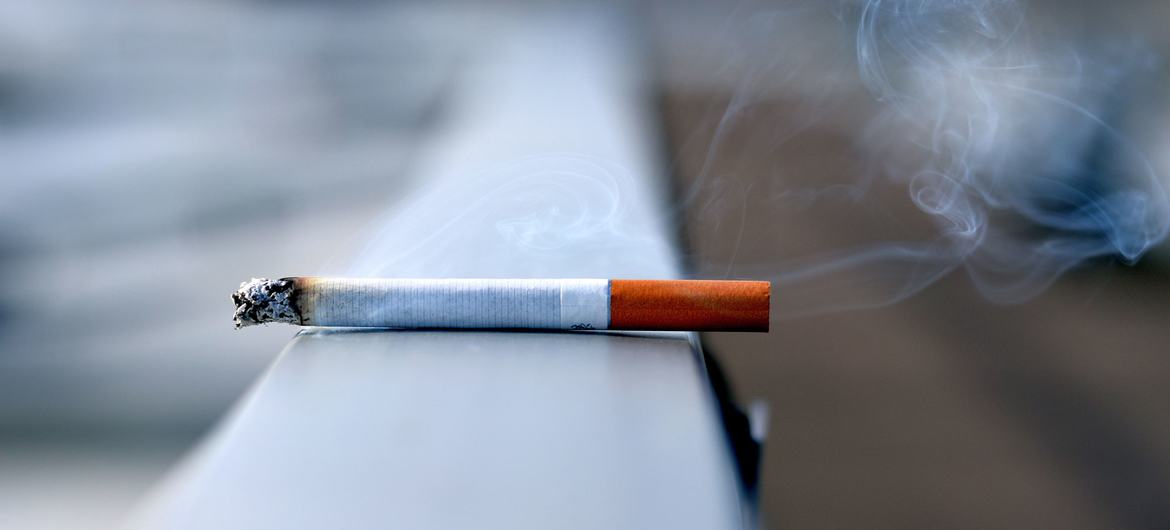
The number of people using tobacco continues to decline despite industry attempts to jeopardize progress towards stamping out cigarettes and other such products, the World Health Organization (WHO) said in a report published on Tuesday.
Trends in 2022 showed that roughly one in five adults worldwide uses tobacco, compared to one in three in the year 2000.
While cigarette smoking is the most common form of tobacco use worldwide, other products include cigars, waterpipe tobacco also known as hookah, and smokeless tobacco products, all of which are harmful.

The “tobacco epidemic” is among the biggest public health threats the world has ever faced, killing over eight million people a year, according to WHO. More than seven million of these deaths are the result of direct tobacco use, but some 1.3 million non-smokers die from exposure to second-hand smoke.
Control measures working
Globally, there are 1.25 billion tobacco users, according to the latest estimates, which revealed that 150 countries are successfully reducing rates among people aged 15 and above.
Examples include Brazil and the Netherlands, which are seeing the benefits of implementing an initiative known as MPOWER, focused on six tobacco control measures including protection, enforcement of advertising and sponsorship bans, raising taxes on tobacco products, and helping people to quit.
As a result, Brazil has made a relative reduction of 35 per cent since 2010 and the Netherlands is on the verge of reaching the 30 per cent target.
Profit over people
Dr. Ruediger Krech, Director of WHO’s Department of Health Promotion, hailed the “good progress” achieved so far while warning against complacency.
“I’m astounded at the depths the tobacco industry will go to pursue profits at the expense of countless lives. We see that the minute a government thinks they have won the fight against tobacco the tobacco industry seizes the opportunity to manipulate health policies and sell their deadly products,” he said.
WHO urged countries to continue putting tobacco control policies in place and to keep fighting against tobacco industry interference, highlighting how it “continues to lie to the public,” including through front groups and third parties, sponsored events, social media influencers, sponsored events and funding scientists and biased research.
Prevalence by region
Southeast Asia currently has the highest percentage of population using tobacco at 26.5 per cent, followed closely by Europe at 25.3 per cent. Tobacco use rates among women in Europe are more than double the global average and are reducing much slower than in all other regions.
The prevalence of tobacco use has changed little since 2010 in some countries, while it is rising in six others: Congo, Egypt, Indonesia, Jordan, Oman, and Moldova.
Missing the goal
WHO said the world is on track to achieve a 25 per cent relative reduction in tobacco use by 2025, short of the voluntary global goal of 30 per cent reduction from the 2010 baseline.
Only 56 countries will reach this goal, down from 60 since the last report three years ago,
With more work still ahead, WHO called for countries to step up action, noting that efforts to protect health policy from increased tobacco industry interference have faltered around the world.
Country surveys consistently show that children aged 13 to 15 years in most nations are using tobacco and nicotine products such as e-cigarettes, the agency said.
Source: UN News Centre