
Public Agenda NewsPaperPublic Agenda NewsPaper
  • General News
  • Politics
  • Business
  • Health
  • Development Agenda
  • World News
  • Features & Opinions
  • Election watch
  • Editorial
Font ResizerAa
Public Agenda NewsPaperPublic Agenda NewsPaper
Font ResizerAa
  • General News
  • Politics
  • Business
  • Health
  • Development Agenda
  • World News
  • Features & Opinions
  • Election watch
  • Editorial
Search
  • General News
  • Politics
  • Business
  • Health
  • Development Agenda
  • World News
  • Features & Opinions
  • Election watch
  • Editorial
Follow US
Breaking NewsGeneral News

Ghana loses out on 2019 Telecoms Maturity Index

Latifa Carlos
Last updated: July 10, 2019 4:31 pm
Latifa Carlos
Share
4 Min Read
SHARE

BuddeComm’s Telecoms Maturity Index for this year indicates that from a second position last year, Ghana has been completely displaced from the top three and even not listed among the market challengers.

The rankings for 2019 showed Mauritius still maintained its lead from last year, as the most matured telecom market on the continent with a 49 score, while Algeria displaced Ghana for the second position with 43 points and South Africa also kicked Tunisia off the third place with a 34-point score.

BuddeComm’s Telecoms Maturity Index analyses the broadband, mobile & fixed line markets of a country on top of a range of economic parameters to rank it on a scale of 1 to 100 and compare it to its region.

More Read

Food prices in Ghana remain largely stable – AGRA report
Mahama convenes high-level meeting to strengthen border security and narcotics control
Minority demands action on unemployment among graduates with disabilities
Mental Health Organisations Seek Improved Social Protection for Vulnerable Women and Girls
GOLDBOD!

The 2019 market leaders: Mauritius remains the top-ranking country in Africa with a Telecoms Maturity Index score of 49, followed by Algeria (43) and South Africa (34).
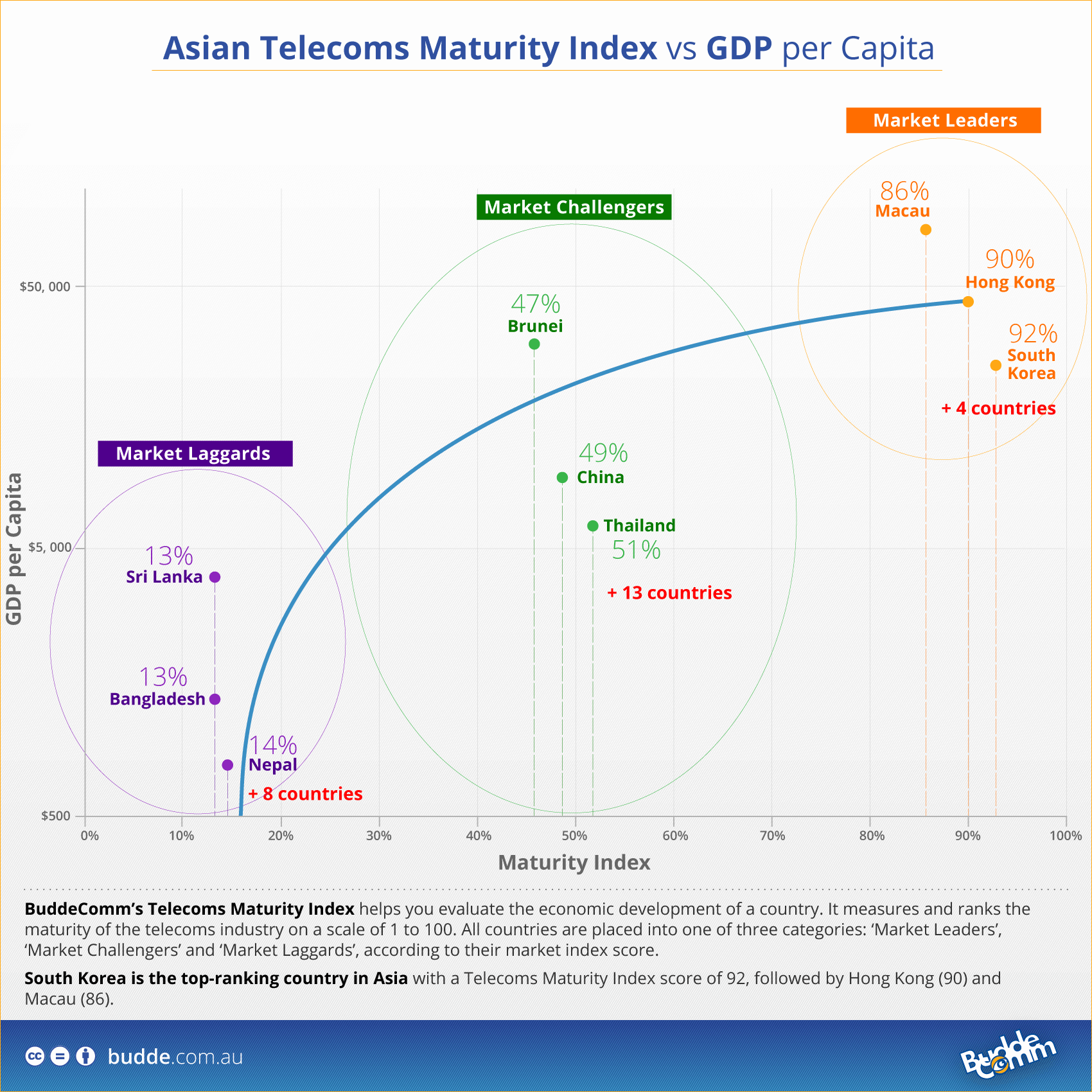
Asian Telecoms Maturity Index example

BuddeComm’s Telecoms Maturity Index measures and ranks the maturity of a country’s telecoms industry on a scale of 1 to 100. All countries are placed into one of three categories: ‘Market Leaders’, ‘Market Challengers’ and ‘Market Laggards’, according to their Market Index score.

In Mauritius, the thriving tourism market has stimulated the broadband sector. There is an extensive DSL infrastructure and operators have deployed fibre-based services in a number of localities. Mauritius Telecom invested Rs5.1 billion to roll out fibre across the island. Fibre is available to about 85% of the company’s fixed broadband customer base.

In Algeria, Mobilis, one of the 3 major mobile operators, has contracted Huawei as a partner for its network migration to 5G. Mobile penetration approaches 116% and mobile internet accounts for about 92% of all internet connections in the country.


 In South Africa, mobile penetration by early 2019 approached 169%, driven partly by the popularity of multiple card use as also by the take-up of mobile broadband services. Mobile internet accounts for about 95% of all internet connections

Market challengers: The top 3 market challengers are Libya with a score of 23, Lesotho (20.5) and Zimbabwe (20.2). Last year, the top challengers were Mauritania (13), Uganda (13) and Kenya (12).

Developing nations: Among the developing markets, the top three countries are Burundi (9.4) Uganda (9.3) and Nigeria (9.1). Last year, the developing markets were Angola (7) Chad (7) and Cameroon (6).

Mobile telephony remains by far the dominant telecom service across Africa, accounting for more than 90% of all telephone lines on the continent. Given the very poor condition of fixed-line infrastructure in most markets, mobile internet access as a consequence also accounts for between 95% and 99% of all internet connections.

The size and range of the diverse markets within Africa have contributed to varied market penetration rates between countries. By early 2018 the highest mobile penetration was found in countries including South Africa (169%), Botswana (160%) and Mauritius (147%). To some degree high penetration reflects the popularity of consumers having multiple SIM cards despite efforts among most regulators to enforce measures by which operators must register SIM card users.


Source:  Adom News

Share This Article
Facebook Whatsapp Whatsapp Email Copy Link Print

Recent Posts

  • Food prices in Ghana remain largely stable – AGRA report
  • Mahama convenes high-level meeting to strengthen border security and narcotics control
  • Minority demands action on unemployment among graduates with disabilities
  • Mental Health Organisations Seek Improved Social Protection for Vulnerable Women and Girls
  • GOLDBOD!
  • Mental Health Groups Demand Criminal Probe into Alleged Sexual Assault of 14-Year-Old at Bolga Girls SHS
  • Mental Health Authority to shut Kumasi spiritual centre housing 2,000 mentally ill persons
  • Karpowership Ghana trains fisherfolk on fire safety, hygiene and financial management
  • Unforced Error! Contradictions of the Government’s PCI Decision
  • 14 clandestine miners killed in disused South Africa mine
  • NAIMOS launches major operation to clear illegal mining along Birim River
  • IMF urges Ghana to sustain quarterly electricity tariff adjustments‎
  • Oil prices fall on hopes Strait of Hormuz could reopen
  • Bekwai residents give Chinese quarry firm one-week ultimatum over blasting, environmental concerns
  • Veteran Nigerian Environmental Journalist Tunde Akingbade Dies at 67
  • AWSP Welcomes Government Decision to Restore Achimota Forest Reserve
  • Finance Minister presents mid-year budget review today
  • ECOWAS reaffirms plans to launch single currency in 2027

You Might Also Like

Breaking NewsHealthtop storiesUncategorized

Mental Health Groups Demand Criminal Probe into Alleged Sexual Assault of 14-Year-Old at Bolga Girls SHS

August 24, 2026
Breaking NewsHealthtop stories

Mental Health Authority to shut Kumasi spiritual centre housing 2,000 mentally ill persons

August 20, 2026
Breaking NewsGeneral Newstop stories

Karpowership Ghana trains fisherfolk on fire safety, hygiene and financial management

August 12, 2026
Breaking NewsFeatures & Opinionstop stories

Unforced Error! Contradictions of the Government’s PCI Decision

August 13, 2026

About Us

Public Agenda is fou­nded and owned by Pu­blic Agenda Communic­ations.

Public Agenda was founded as a public interest Me­dia entity. Its Visi­on is to contribute to building a well-i­nformed society where accurate informati­on dissemination is the cornerstone of a democratic, just and equitable society.

Its mission is to inform, guide and bui­ld responsible citiz­enship and accountab­le decision making and strive for excell­ence in the media in­dustry. Public Agenda Communications is managed by a Board of Directors.

  • Contact us
  • Advertise with us
Welcome Back!

Sign in to your account

Username or Email Address
Password

Lost your password?