


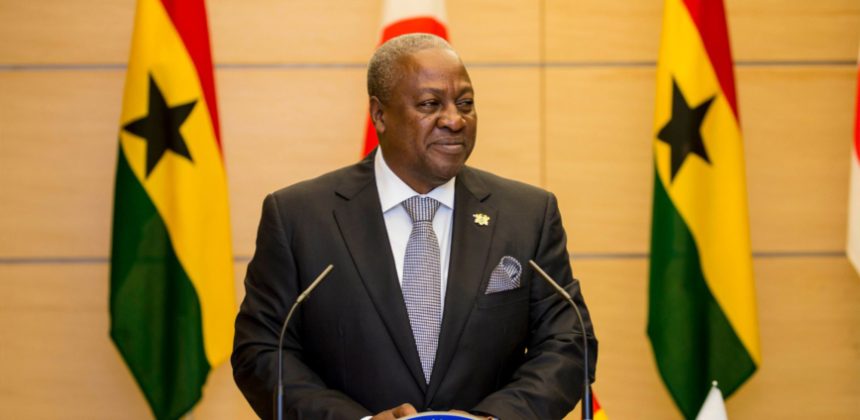
President John Mahama has declared that the Ghanaian cedi is the best-performing currency in the world this year, as he urged Japanese businesses to seize new investment opportunities in Ghana.
Speaking at the Ghana Presidential Investment Forum on the sidelines of the 9th Tokyo International Conference on African Development (TICAD IX) on Wednesday, he said Ghana has restored macroeconomic stability and improved investor confidence.
“For those of you who know the history of the Ghanaian cedi, it’s been one of the most volatile currencies in Africa, and a few years back, we were said to be the worst-performing currency.
More Read

“I’m happy to announce that this year, the Ghana cedi has been the best-performing currency in the world,” he stated.
He pointed to falling inflation, recent sovereign credit upgrades, and wide-ranging reforms aimed at lowering the cost of doing business as clear signs of Ghana’s turnaround.
“Inflation rose to a high of almost 23% in 2024 and it’s currently down to 13.7% and we expect that by the end of the year to hit single digit.
“And as Simon said, we’ve been upgraded from junk status to B minus with a stable outlook, and I’m certain that in the next review, we’re going to be upgraded again,” he said.
Mahama positioned Ghana as a stable, democratic, and business-friendly hub in West Africa, stressing its role as host of the African Continental Free Trade Area (AfCFTA).
“So far, almost 50 African countries have signed agreements that allow us to export duty-free, tariff-free into each other’s markets. And once you register your product and it meets all the standards, you can export duty-free and tariff-free into each other’s markets,” he explained.
He added that Japanese investors could access a potential continental market of 1.4 billion people.
The president highlighted recent reforms to attract more foreign investment, including changes to the Ghana Investment Promotion Centre Act.
“Some barriers were put to foreign investment. You had to prove that you had brought in a certain amount of money to be classified as a foreign investor. In the reviewed Ghana Investment Promotion Centre Act, we are removing those minimal capital investments.
“This will enable any investor, however little money you have, $100,000 or $50,000, to be able to come in and set up a business in Ghana,” he announced.
Mahama also underscored opportunities in priority sectors such as automobile assembly, agribusiness, energy, and manufacturing.
“Japan has a comparative advantage when it comes to automobile manufacturing. Using the opportunity to be able to export into not only our sub-region, but also into Africa, Ghana becomes a good place for the local assembly of automotive products.
“Already, we have Japanese companies that are based in Ghana and assembling for the local market and also for exporting to the sub-region,” he noted.
On agriculture, he outlined plans for the Volta Economic Corridor, which would use the Volta Lake to irrigate vast lands and host industrial parks for agro-processing.
“We have millions of hectares of land that border that huge lake, and the water can be used to bring about 2 million hectares of land under irrigation.
“But also we intend to establish industrial parks, so that we can process agri products. We can invest in textile manufacture for export into the EU markets, into the American market and other places,” he said.
Mahama further pointed to Ghana’s energy potential, port infrastructure, and growing digital economy as additional incentives for Japanese businesses.
“We also have an important area, which is the digital economy and skills. Ghana has a very young population, English-speaking, and they’re very smart, and quick to upskill in any areas, robotics, AI, fintechs. The FinTech sector is one of the fastest growing in Ghana than in any other African country,” he told investors.
He concluded with a direct call for stronger Ghana-Japan partnerships.
“Africa is the next frontier for investment. Most parts of the world are saturated when it comes to investment. Africa is opening up, growing, and is a place that Japan should be looking at.
“And so let us marry Japanese position with Ghanaian potential and create a win-win situation for ourselves,” Mahama said.