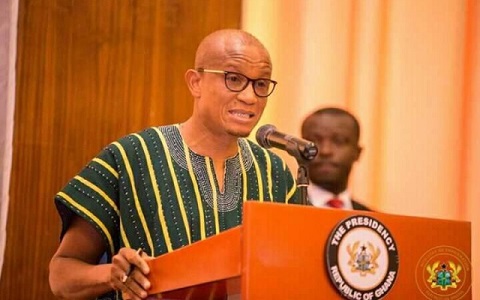
The Minister of Inner Cities and Zongo Development, Dr Mustapha Abdul-Hamid, has stated that the government’s agenda to bridge the development deficit in inner cities and Zongos is on course.
He said to ensure efficiency and coordination, the ministry had segmented its development agenda into sectors, including health, water and sanitation, education, livelihood empowerment, peace and security.
More Read

Apart from the projects that were being carried out, he said, the ministry had also set up an Inner City Development Council to coordinate and ensure fair distribution of development projects in the communities.
At his turn at the meet-the press series in Accra yesterday, Dr Abdul-Hamid said the setting up of the Zongo Development Fund was a demonstration of the government’s commitment to the inner cities development agenda.
While he agreed that it would take many years to achieve the desired impact the government perceived for inner cities and Zongo communities, he nonetheless gave an assurance that by the end of the four or eight years of the government, a significant impact and a good foundation would have been laid to accelerate the process.
Water and sanitation
Highlighting projects that had been undertaken by the ministry, Dr Abdul-Hamid said in the area of water and sanitation, it had collaborated with some private partners to provide water systems with 2,000 overhead storage capacities and five standpipes for about 15 communities in the Eastern Region.
He named the beneficiary communities to include Gyankrom Zongo in Nsawam, Kotokoli Zongo in Suhum, Old Zongo in Asamankese, Kade Zongo and Begoro Zongo.
He said the project would be scaled up to benefit other regions.
On sanitation, Dr Abdul-Hamid said the ministry planned to scale up a programme known as Operation clean inner cities and Zongos which sought to encourage the habit of collective and periodic cleaning in the communities.
He also mentioned a project to help segregate waste at home to make for the recycling of recyclable ones for profitable use.
“We have, therefore, rolled out a programme to financially reward households that are able to do waste segregation at home to encourage waste segregation and proper disposal,” he added.
Dr Abdul-Hamid said the ministry had also rolled out a project, in collaboration with a private partner, to help households get their exclusive toilet facilities.
Livelihood empowerment
He announced that to ensure poverty alleviation and human resource development, the ministry had initiated a programme that aimed at improving the livelihoods of women in Zongo communities through the promotion of Zongo cuisines at the international level.
He said the programme, which is currently in the preparatory stage and has been advertised for interested persons to register to be part of its pilot in Accra, sought to build the capacities of caterers of Zongo cuisines to international standards, especially in the areas of preparation, packaging, preservation, storage and branding, to access local and international market opportunities.
Others
Dr Abdul-Hamid said other initiatives included the engagement of 3,000 Islamic teachers to enhance education in Zongo communities, a project to provide libraries in those communities, capacity building of the youth in software application development and the renovation of school buildings.
He mentioned other projects to include the construction of Astro turfs and green parks to be used for multiple purposes in the communities.
Meanwhile, he called on managers of health facilities to stop harassing Muslim nurses who wore the hijab at their workplaces.
He pointed out that the wearing of the hijab at the workplace did not breach any law of the land and so such interferences were discriminatory and unlawful.
Dr Abdul-Hamid made reference to Article 21 Clause (1c) of the 1992 Constitution and explained that the law gave all persons the right and freedom not just to practise any religion of their choice but also to freely manifest such practice without boundaries.
He explained that the hijab, which had religious significance, provided one of the means by which Muslim ladies visibly manifested their Muslim identity.
Source: Graphic.com.gh