Africa is both the world’s least electrified continent and the most vulnerable to climate change.
And as the continent with the world’s fastest growing population, the decisions that African politicians make to boost power supplies could have an impact both locally and globally.
The conundrum is how to meet the demand for energy without making the climate situation worse.
More Read
There is a large amount of investment, much of it from overseas, going into renewable sources. But the continent also has untapped reserves of oil and natural gas, which it aims to exploit.
Powering Africa
Major sources of electricity in 2017

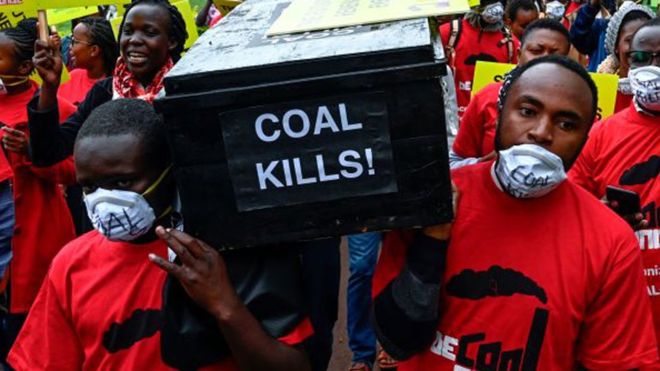
Africa’s largest power producer, South Africa, faces an additional dilemma of moving away from coal-fired power stations, which produce nearly all of its energy. It is one of the dirtiest fuels, and is damaging the health of some of the people living near where it is burnt.
More than two thirds of the population of sub-Saharan Africa, more than 600 million people, lack access to electricity. But electrification on the continent is still growing more slowly than anywhere else in the world, despite pledges to light up Africa in the next few decades.
Rise of renewable power
Investment is going into solar power, wind power and hydropower projects across the continent as part of efforts to change the energy mix.
Last year, Kenya unveiled Africa’s largest wind farm near Lake Turkana. More than 350 turbines can produce up to 310 MW, which is about 17% of the country’s current daytime energy demand, the company behind the wind farm says.
Powering Kenya
Major sources of electricity 2017

Kenya hopes to produce all its energy through renewable sources by the end of this year.
But a Chinese firm also aims to build a coal-fired power station on Kenya’s coast, highlighting the country’s plans to have an energy mix. The construction of the plant in Lamu is currently on hold following legal action.
People in Nigeria, Africa’s largest oil-exporting country, are faced with daily power cuts and, to make up the shortfall, many supply their own electricity through diesel generators. But these are the lucky ones as more than half Nigeria’s 200 million citizens have no access to electricity at all, according to the International Monetary Fund.
The country is experimenting with boosting solar power.
Last year, Banyero University, in the northern city of Kano, began generating power for its 58,000 students and staff through a solar plant that is backed up by generators.
This is part of a $75m (£58m) fund with solar panel manufacturer Lumos aimed at electrifying one million households over the next five years.
Nigeria aims, by 2030, to generate 30% of its energy needs from renewable sources, which still implies a huge reliance on fossil fuels.
By the end of this year, West Africa’s largest solar farm, with a 50 MW capacity, is due to start producing power in Mali.
Meanwhile, on the other side of the continent, Ethiopia is building the Grand Ethiopia Renaissance Dam on the Blue Nile that is expected to produce 6,000 MW of electricity.
Ethiopia would like it to start producing power at the end of this year. But the row with Egypt over how fast the dam can be filled up highlights the political difficulties that can come with large-scale energy projects.
Angola and the Democratic Republic of Congo are also looking towards renewable energy sources to supply a significant amount of their power needs.
The African Development Bank, as well as investors from outside the continent, especially China, are supporting a lot of these projects.
There is also the US’ Power Africa initiative, which encourages private companies to partner with African countries to boost the power supply. It aims to produce about 30,000 MW of cleaner energy by 2030.
Launched in 2013, the initiative already boasts 56 successful projects producing almost 3,500 MW of power – just over a tenth of its target.
But all these projects are unlikely to be enough to satisfy Africa’s rapidly growing population.
South Africa’s dilemma
Not every country on the continent is able to boast about its successes.
South Africa, the continent’s most developed economy, has been labouring through crippling power cuts for several years. It is also struggling to move away from its dependence on coal, which is a cheap source of energy for the country.
Powering South Africa
Major sources of electricity in 2017

There are wind and solar power projects, but these are not producing nearly enough energy to diminish the woes of the state-owned power company, Eskom.
The problem for the government is the need to preserve employment in the coal mining sector while also decommissioning the ageing coal-fired power stations.
Coal will provide the bulk of South Africa’s energy needs for at least the next decade, according to a government plan. It hopes that “clean coal” technologies could help reduce emissions, but the country does not yet have access to the technology to make this work.
There are actually a variety of potential technologies to produce cleaner coal, the most common being carbon capture and storage. This is essentially capturing carbon emissions from burning coal and storing it underground.
It sounds easy, but the process of developing this technology and retrofitting it at old power stations is time-consuming and expensive.
Processing plants are also very expensive and difficult to maintain in the long-term.
While dozens of African countries are moving ahead with plans to boost renewable energy resources they are not enough to fill the gap in their electricity supplies.
The solution to the conundrum of how to maintain economic growth and minimise carbon dioxide emissions lies in applying newer carbon-efficient technologies alongside existing energy production systems.
Source: BBC