
Public Agenda NewsPaperPublic Agenda NewsPaper
  • General News
  • Politics
  • Business
  • Health
  • Development Agenda
  • World News
  • Features & Opinions
  • Election watch
  • Editorial
Font ResizerAa
Public Agenda NewsPaperPublic Agenda NewsPaper
Font ResizerAa
  • General News
  • Politics
  • Business
  • Health
  • Development Agenda
  • World News
  • Features & Opinions
  • Election watch
  • Editorial
Search
  • General News
  • Politics
  • Business
  • Health
  • Development Agenda
  • World News
  • Features & Opinions
  • Election watch
  • Editorial
Follow US
Breaking NewsBusinesstop stories

Middle East tensions could disrupt trade, spike energy prices – IMF

Suleman
Last updated: March 9, 2026 7:57 am
Suleman
Share
2 Min Read
SHARE

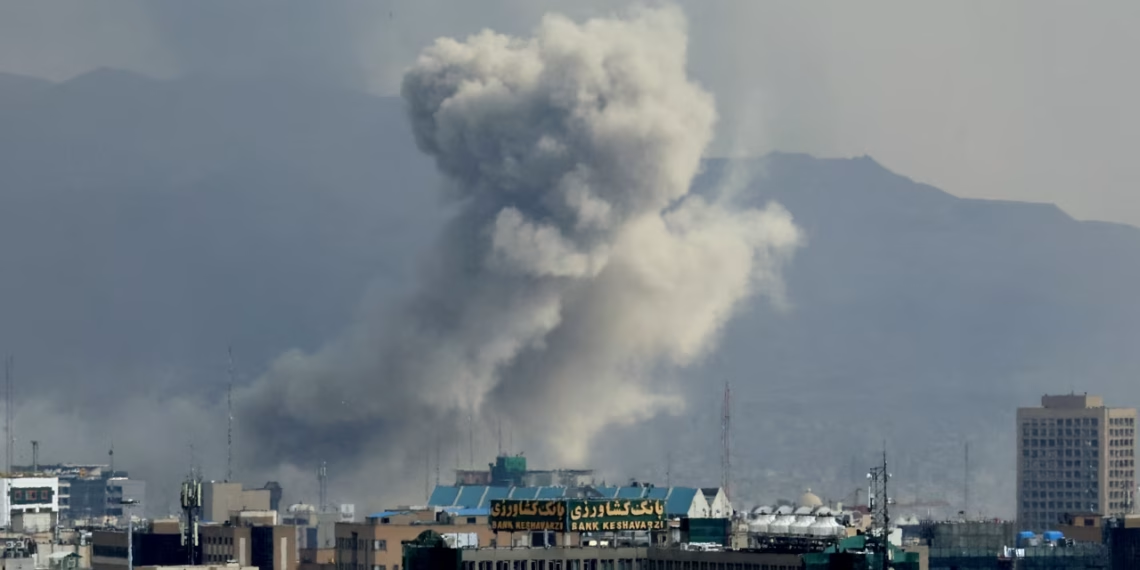
Rising tensions in the Middle East are already disrupting trade flows, pushing up global energy prices and triggering volatility in financial markets, the International Monetary Fund (IMF) has warned.

In a press release, the Fund said, it is closely monitoring developments in the region as the evolving situation adds further uncertainty to an already fragile global economic environment.

According to the IMF, early signals from global markets show disruptions to economic activity and trade routes, alongside rising oil and gas prices, which could potentially place additional pressure on inflation and economic growth across several economies.

More Read
Ghana walks away from US health agreement over sensitive data concerns
Mali at risk of splintering after jihadi and separatist attacks
Create ‘water markets’ to fix Ghana’s supply challenges — Former GWL MD
National Water Justice Campaign Launched to Tackle Inequality in Access
ISODEC Urges Collective Action to Secure Safe Water for All Ghanaians

The Washington-based institution, however, notes that it is still too early to determine the full economic impact of the tensions on both the region and the broader global economy.

Economists say the Middle East remains a critical hub for global energy production and shipping routes, meaning sustained tensions could influence oil prices and global inflation trends, particularly for energy-importing economies.

Several governments and international institutions are therefore closely assessing the potential economic risks as geopolitical uncertainty continues to shape global market sentiment.

The IMF says it will provide a more comprehensive analysis of the economic implications in its upcoming April edition of the World Economic Outlook, which will offer updated projections for global growth and inflation.

“The situation remains highly fluid,” the IMF said, adding that the overall impact will largely depend on the extent and duration of the conflict and how it affects supply chains, energy markets and investor confidence.

Recent developments have already heightened concerns among investors, with global financial markets experiencing bouts of volatility amid fears that prolonged instability in the region could disrupt energy supply and trade flows.

Source:CNR

Share This Article
Facebook Whatsapp Whatsapp Email Copy Link Print

Latest News

Man kills seven of his children, and an eighth child, in Louisiana mass shooting
April 20, 2026
A decade of African politics: democratic gains and new pressures
April 20, 2026
Minister Faults Nana Akufo-Addo Government’s Decentralisation Record
April 20, 2026
Bawumia engages Ken Agyapong ahead of 2028 polls
April 20, 2026
Over 100 communities in Volta Region at risk from tidal waves — Anlo MP
April 20, 2026
Underperforming ECG districts risk major shake-up — Jinapor
April 15, 2026
GIS to crack down on street begging, unregistered migrants in Accra
April 15, 2026

You Might Also Like

Breaking NewsDevelopment AgendaGeneral Newstop stories

Government engages sachet water producers today as price hike suspended

April 8, 2026
Breaking NewsGeneral Newstop stories

Healthy, thriving Africa key to global progress

April 8, 2026
Breaking NewsBusinesstop stories

Ghana’s inflation drops to 3.2% in March 2026

April 1, 2026
Breaking NewsPan Africa Politicstop stories

ISODEC Urges Action after Landmark UN Reparative Justice Resolution

March 31, 2026

About Us

Public Agenda is fou­nded and owned by Pu­blic Agenda Communic­ations.

Public Agenda was founded as a public interest Me­dia entity. Its Visi­on is to contribute to building a well-i­nformed society where accurate informati­on dissemination is the cornerstone of a democratic, just and equitable society.

Its mission is to inform, guide and bui­ld responsible citiz­enship and accountab­le decision making and strive for excell­ence in the media in­dustry. Public Agenda Communications is managed by a Board of Directors.

Welcome Back!

Sign in to your account

Username or Email Address
Password

Lost your password?