


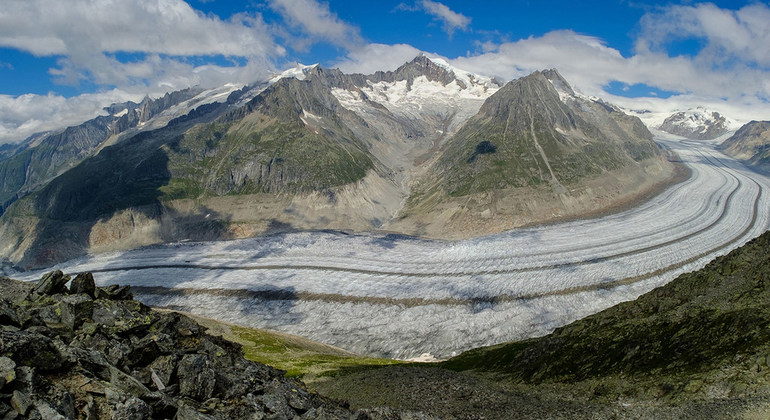
Top climate scientists issued a report on Sunday showing that over the last several years, sea-level rise, planetary warming, shrinking ice sheets and carbon pollution have accelerated; a sobering call to action for political leaders headed to New York for summit-level climate change talks tomorrow at the United Nations.
The landmark new report, which will be presented to the UN Climate Action Summit, underlines the glaring – and growing – gap between agreed targets to tackle global warming and the actual reality.
Compiled by the UN World Meteorological Organization (WMO), the report, United in Science, includes details on the state of the climate and presents trends in the emissions and atmospheric concentrations of the main greenhouse gases.
More Read

Among other findings, the report says that accelerating climate impacts from melting ice caps to sea-level rise and extreme weather were to blame for the record as the global average temperature increased by 1.1°C above pre-industrial (1850-1900) times and 0.2°C warmer than 2011-2015.
It highlights the urgency of fundamental socio-economic transformations and carbon-curbing actions in key sectors such as land use and energy to avert dangerous global temperature increase, with potentially irreversible impacts. It also examines tools to support both mitigation and adaptation.
The assessment from the world’s top climate experts and scientific organizations comes not just ahead of the UN summit, but also against the backdrop of last week’s global ‘climate strike,’ which saw millions of students across the world take to the streets to demand real action from politicians and big corporations to reverse the impacts of what UN Secretary-General António Guterres has called a “climate emergency.”
Swedish teen activist Greta Thundberg told hundreds of young people gathered at UN Headquarters on Saturday for the first-ever Youth Climate Summit that “young people are unstoppable” and echoed her young compatriots who vowed to keep up the pressure on governments to make serious policy course corrections towards green energy and planet-friendly agriculture to seriously tackle climate change .
Mr. Guterres told the young activists that he feared “there is a serious conflict between people and nature, between people and the planet.” Saying that there is no time to lose, with so many people around the world already suffering from the impacts of climate change, the UN chief has been bluntly telling world leaders “don’t come to the Summit with beautiful speeches … come with concrete plans,” including carbon neutrality plans for 2050, options to tackle fossil fuel subsidies, taxing carbon and a possible end to new coal power sources after next year.
Climate insights
The findings presented by the report’s experts spotlight the sense of urgency. Amid growing recognition that climate impacts are hitting harder and sooner than climate assessments indicated even a decade ago, there is now a real risk of crossing critical tipping points, according to the scientists.
For example, the report shows that the average global temperature for 2015–2019 is on track to be the warmest of any equivalent period on record. It is currently estimated to be 1.1°Celsius (± 0.1°C) above pre-industrial (1850–1900) times.
Widespread and long-lasting heatwaves, record-breaking fires and other devastating events such as tropical cyclones, floods and drought have had major impacts on socio-economic development and the environment. Moreover, as climate change intensifies, cities are particularly vulnerable to impacts such as heat stress and can play a key role in reducing emissions locally and globally.
Against this backdrop, meeting the targets set under the 2015 Paris Agreement requires immediate and all-inclusive action encompassing deep decarbonization complemented by ambitious policy measures, protection and enhancement of carbon sinks and biodiversity, and effort to remove CO2 from the atmosphere.
“Strategies for mitigation and for upscaling adaptive risk management are necessary going forward. Neither is adequate in isolation given the pace of climate change and magnitude of its impacts,” says the report, which warns that to stop a global temperature increase of more than 2 degrees Celsius above pre-industrial levels, the level of ambition needs to be tripled.
The scientists say that “only immediate and all-inclusive action encompassing: deep de-carbonization complemented by ambitious policy measures, protection and enhancement of carbon sinks and biodiversity, and efforts to remove CO2 from the atmosphere, will enable us to meet the Paris Agreement.”
“The scientific data and findings presented in the report represent the very latest authoritative information on these topics. It highlights the urgent need for the development of concrete actions that halt the worst effects of climate change,” said the Science Advisory Group to the Climate Action Summit, co-chaired by WMO Secretary-General Petteri Taalas and Leena Srivastava, former Vice Chancellor of TERI School of Advanced Studies.
Source: UN News Centre