

In simultaneous attacks launched on Saturday, April 25, 2026, an alliance of al Qaeda-linked militants and separatist rebels killed Mali’s defence minister, hit the capital’s airport, and drove Russian soldiers out of a desert town over a thousand kilometres away.
The scale and the scope of the offensive on multiple sites around the capital Bamako and at least three towns across the vast West African country demonstrated an unprecedented ability to coordinate fighters from different groups with different goals and strike at the heart of the military government.
Having cooperated loosely for years, the militants affiliated with al Qaeda known as JNIM, and Tuareg rebels who want to carve out an independent desert state in northern Mali are now openly talking about their alliance for the first time.
More Read
“It demonstrates reach,” said Justyna Gudzowska, executive director of The Sentry, an investigative and policy group. “(It) tells every Malian, every regional capital, and every foreign partner that JNIM can operate at will inside the supposedly secure heart of the state.”
But by killing Defence Minister Sadio Camara with a car bomb that flattened his home, JNIM has removed a key leader, created a power vacuum, and raised the prospect of a broader national implosion, one senior diplomat said.
Mali’s military government has said the situation is under control, though its head, Assimi Goita, has not been seen in public or made any statements since the attacks on Saturday.
Corinne Dufka, an expert on the Sahel region, said the weekend offensive had moved the needle on JNIM’s military and political demands, exposed Mali’s intelligence failures and the efficacy of its partnership with Russia, and also demonstrated the formidable military capacity of JNIM and its Tuareg allies.
It is far from clear how long the groups will be able to work together, nor how they might govern areas they want to control. But with Burkina Faso and Niger also fighting interlinked insurgencies inspired by al Qaeda and Islamic State, governments across the Sahel are severely weakened.
“After nearly 20 years of military interventions by the U.S., French, European, African, and Russian partners, the jihadists have only multiplied their areas of operation,” Dufka said, adding that if the situation were to deteriorate and the jihadist groups veered from their current local agenda, they might eventually threaten Europe and the United States.
PLANNING, MONEY, AND LOGISTICS
Tuareg separatists and al Qaeda-linked militants first swept across Mali in 2012, triggering a French military intervention that drove them back to their desert bases – at least at first.
Thousands of U.N. peacekeepers were deployed to Mali, and the U.S. set up a $100 million drone base in Niger to monitor the desert.
However, the Islamists regrouped, carrying out hit-and-run attacks in Mali and expanding into Burkina Faso and Niger.
Frustrated by losses, military officials seized power in all three countries and promised to restore security. They expelled U.N. and Western forces and sought military help from Russia.
But over the last year, Islamists have imposed a siege around Bamako, controlling the flow of fuel to the capital.
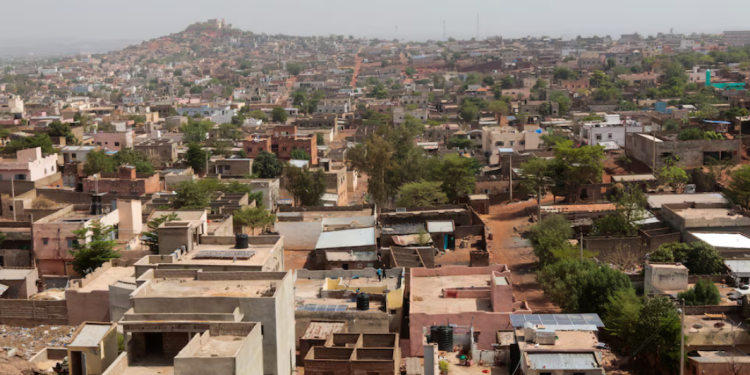
On Saturday, Bamako residents reported seeing jihadists on motorbikes moving freely on the outskirts of the capital in broad daylight for the first time. They left hours later, but the damage had been done, and the message was clear.
“This is a massive operation, both in terms of the kind of scope and size and the extent of the coordinated attacks across the country,” said Andrew Lebovich, research fellow at Clingendael’s Conflict Research Unit.
“This took a lot of planning, a lot of money, a lot of logistical support.”
Yvan Guichaoua, a Sahel specialist at German research centre bicc, said the attacks on military and government targets were intended to “decapitate” leadership and paralyse the chain of command and decision making.
While the military was scrambling to defend Bamako, the insurgent alliance launched simultaneous attacks on at least three other towns, leaving security forces thinly spread.
Military bases in Sevare, in the middle of Mali, and Gao, the north’s biggest town, came under attack for hours.
And by Saturday afternoon, the Tuareg separatist group the Azawad Liberation Front (FLA), had raised its flag in Kidal, a town near the border with Algeria, considered the spiritual home of the Tuareg dream to carve out a state in the Sahara.
The seizure of Kidal reversed one of the few tangible gains the government made in 2023, when it drove the FLA rebels from the town with Russian military backing.
Since expelling French and U.N. troops, Mali has leaned heavily on Moscow for military support, initially from Wagner and more recently with troops from Africa Corps, a force more closely linked to the Russian government.
There are currently about 2,500 Russians deployed across 20 bases in Mali, according to Investigations with Impact (INPACT), a group that examines Russian operations.
Russian troops deploy alongside Mali’s army, although there have been tensions between the two forces, and the attacks over the weekend showed the limitations of this support.
The FLA said on Sunday that Russian troops were withdrawing from the city after they reached an agreement. Videos on social media showed a convoy of trucks carrying foreign soldiers driving through the town’s sandy streets.
INPACT said about 200 Russians had left Kidal.
Russia’s foreign ministry said Saturday’s attack had been repelled and efforts to eliminate the insurgents were ongoing. But it remains unclear where the fighting leaves Russia’s commitment to Mali.
‘NO MILITARY SOLUTION’
After maintaining an ambiguous relationship for years – cooperating at times despite their contradictory ambitions – the FLA and JNIM have now publicly joined forces.
“They are 100% together, at least on a tactical level,” said Guichaoua. “Attacks perpetrated in the north are led by the FLA and attacks in the centre and the south are carried out by JNIM.”
The cooperation, built largely on pragmatism, combines their pool of firepower and men and ensures representation from a wide range of ethnic communities across Mali.
In 2012, the movements also worked together before clashing, with the jihadis routing the separatists. Guichaoua says JNIM remains the dominant force in the relationship.
“The alliance remains structurally fragile,” said Djenabou Cisse, research fellow at the Foundation for Strategic Research think-tank in Paris. “The two actors pursue distinct, and in some respects incompatible, political projects.”
The FLA has long stressed it is a secular organisation seeking an independent state in the north and has previously worked with French forces fighting jihadists. As an al-Qaeda franchise, JNIM has pushed a jihadist agenda.
Dufka said JNIM appears increasingly inspired by Syria’s transformation and is seeking to distance itself from its al Qaeda core and “terrorist” label by governing with parallel systems of justice, taxation and policing in areas it controls.
As a result, she urged international actors to find ways of engaging in some kind of dialogue. “There appears to be no military solution to this conflict,” she said.
Source: Reuters