

Commonwealth heads of government are preparing to defy the United Kingdom and agree plans to examine reparatory justice for the transatlantic slave trade, the BBC has learned.
Downing Street insists the issue is not on the agenda for the summit of 56 Commonwealth countries, which begins in the Pacific island nation of Samoa on Friday.
But diplomatic sources said officials were negotiating an agreement to conduct further research and begin a “meaningful conversation” about an issue which could potentially leave the UK owing billions of pounds in reparations.
More Read
Frederick Mitchell, foreign minister of the Bahamas, told BBC Radio 4’s Today programme: “Once you broach the subject it may take a while for people to come around but come around they will.”
Reparatory justice for slavery can come in many forms, including financial reparations, debt relief, an official apology, educational programmes, building museums, economic support, and public health assistance.
The current text of the draft summit communique – made known to the BBC – says: “Heads, noting calls for discussions on reparatory justice with regard to the transatlantic trade in enslaved Africans and chattel enslavement… agreed that the time has come for a meaningful, truthful and respectful conversation towards forging a common future based on equity.”
It says the heads of government would play “an active role in bringing about such inclusive conversations addressing these harms” and that they agreed “to prioritise and facilitate further and additional research on the transatlantic trade in enslaved Africans and chattel slavery that encourages and supports the conversations and informs a way forward”.
The text – which could still change once Commonwealth leaders arrive – has been hammered out by diplomats ahead of the summit. British officials succeeded in blocking a plan for an entirely separate declaration on the subject.
The UK did not want any language in the communique about reparatory justice, but at the moment it is having to accept it will include three full paragraphs setting out the Commonwealth’s detailed position.
Officials from Caricom, the body that represents Caribbean countries, have sought to broaden the issue so that it encompasses not just the slave trade across the Atlantic but also the Pacific.
The draft communique says a majority of member states “share common historical experiences in relation to this abhorrent trade, chattel enslavement, the debilitation and dispossession of indigenous people”.
It also refers directly to practices known as “blackbirding”, where Pacific islanders were tricked or kidnapped into slave or cheap labour in colonies throughout the region.
Diplomats said the expectation now was that reparatory justice would be a central focus of the agenda for the next Commonwealth summit in two years’ time in the Caribbean, possibly Antigua and Barbuda.
In the run-up to this year’s summit, there have been growing calls from Commonwealth leaders for the UK to apologise and make reparations worth trillions of pounds for the country’s historic role in the slave trade.
A report published last year by the University of West Indies – backed by Patrick Robinson, a judge who sits on the International Court of Justice – concluded the UK owed more than £18tn in reparations for its role in slavery in 14 Caribbean countries.
Last weekend the prime minister of the Bahamas, Philip Davis, used a visit by Foreign Office minister Baroness Chapman to tell her the fight for reparations was far from over.
Bahamas foreign minister Frederick Mitchell told BBC Radio 4’s Today programme: “The word is apologise, that’s the word.”
He said for the Commonwealth gathering, “it’s a simple matter – it can be done, one sentence, one line.”
Asked how much reparations should amount to, Mr Mitchell said it was not just a matter of money but of “respect, acknowledging the past was a wrong that needs to be corrected”.
He said member countries “want the conversation to start” but “there appears to be even a reluctance to have the conversation”.
Culture Secretary Lisa Nandy said the UK had heard calls for slavery reparations “loud and clear” but that prime minister was “right” to “focus on the future”.
A UK government spokesperson said they would not comment on the leak to the BBC, but added: “Reparations are not on the agenda for the Commonwealth Heads of Government meeting. The government’s position has not changed – we do not pay reparations.
“We are focused on using the summit at [the Commonwealth Heads of Government Meeting] to discuss the shared opportunities which we can unlock across the Commonwealth – including securing more economic growth.”
It is understood the Downing Street position – that reparatory justice is not on the agenda – while technically correct, has angered some Caribbean ministers when it was obvious the issue would be discussed at the summit.
BBC political editor Chris Mason said the tenor and tone of language from the UK government had contributed to “irritating even more” some members who might not have expected the UK to change its view and “suddenly start shelling out a lot of money”.
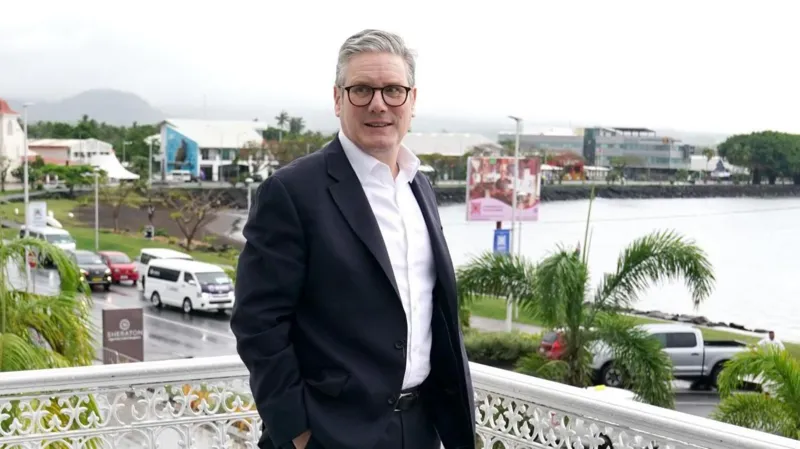
Sir Keir Starmer landed in Samoa late on Wednesday UK time, becoming the first sitting prime minister to visit a Pacific island nation.
Speaking to reporters en route, he said he wanted to discuss current challenges with Commonwealth leaders, especially climate change, rather than issues of the past.
“What they’re most interested in is, can we help them working with, for example, international financial institutions on the sorts of packages they need right now in relation to the challenges they’re facing,” he said.
“That’s where I’m going to put my focus – rather than what will end up being very, very long endless discussions about reparations on the past.
“Of course, slavery is abhorrent to everybody; the trade and the practice, there’s no question about that. But I think from my point of view… I’d rather roll up my sleeves and work with them on the current future-facing challenges than spend a lot of time on the past.”