Public Agenda NewsPaperPublic Agenda NewsPaper
  • General News
  • Politics
  • Business
  • Health
  • Development Agenda
  • World News
  • Features & Opinions
  • Election watch
  • Editorial
Font ResizerAa
Public Agenda NewsPaperPublic Agenda NewsPaper
Font ResizerAa
  • General News
  • Politics
  • Business
  • Health
  • Development Agenda
  • World News
  • Features & Opinions
  • Election watch
  • Editorial
Search
  • General News
  • Politics
  • Business
  • Health
  • Development Agenda
  • World News
  • Features & Opinions
  • Election watch
  • Editorial
Follow US
Breaking NewsGeneral News

78 percent of Ghanaians rely on traditional cooking fuels … Expert calls for departure

Latifa Carlos
Last updated: September 18, 2018 2:08 pm
Latifa Carlos
Share
4 Min Read
SHARE

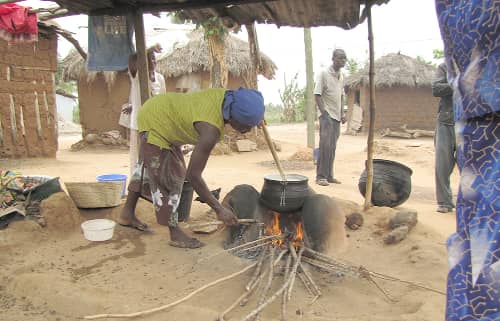
Majority of Ghanaians continue to rely on solid fuels (charcoal, Firewood) for cooking and heating purposes, a situation experts say is putting pressure, on the country’s forest cover, while derailing Ghana’s hopes of achieving the Sustainable Development Goals, especially goal 13.

Even though the use of improved cooked stoves is one of the cheapest means of cooking and has minimal effect on human health as well as the environment, the technology appears to have been neglected.

It is estimated that over 13,000 people, mostly women and children die annually in Ghana as a result of household air pollution coming from solid fuels such as charcoals, firewood among others.

More Read
From Trauma to Recovery: Strenthening Support for Victims of Torture
Drug networks infiltrating schools – NACOC warns
NDC renames National Headquarters after J. J Rawlings
GTMO Condemns Attack on Forestry Commission Checkpoint in Bono East Region
World leaders converge in Accra for high-level reparatory justice conference

According to Mr Dramani Bukari, Renewable Energy adviser at SNV, “only 21.7% of the Ghanaian population have access to clean cooking technologies and fuels. 22.1 million People in Ghana still rely on solid fuels for cooking and heating.”

Mr Bukari informed journalists recently at a workshop held in Elmina in the Central Region that relying on traditional cooking methods have serious health, environmental and economic consequences.

He stated that four million deaths occur annually globally and over 13000 in Ghana through exposure to HAP causing acute, pneumonia, lower respiratory infections, lung cancer, heart disease, chronic obstructive pulmonary disease and stroke.

This,he pointed out comes as a  result of  lack of clear policy direction and  clear strategy or programme for the attainment of improved cook stove targets of 2 million in INDC, 1.3 million draft  renewable  energy master plan  2.4 million by GHACCO.

Mr Bukari added, “We thinks that  improved cook  stoves remains an important transition  fuel or technology that  ought to be considered and that the marginalization of  the  improved  cooked stove  sector in Ghana is  something that ought to be  revised.”

He maintained that some level of action ought to be taken for the country to realize the growth of the improved cook stove sector.  He said there exist some target to get Ghanaians hooked onto improved cook stoves but these goals are nowhere yet to be realized.

“I think that we cannot just set target and leave them aloof, concrete and deliberate actions ought to be taken to realise them,” he added.

He bemoaned that a number of household in Ghana are unaware of the consequences of relying on traditional cooking fuel and “if we want to create a thriving cook stoves sector, we must provide incentives for manufacturers of improved cook stoves.”

He mentioned  that there ought to be market  for the manufacturers, while  emphasizing the need  to create awareness  and  let  people  know the consequences  of  using traditional cooking methods.

Going forward, he  said, “we want to see change, a change  that would ensure that consequences  of  the  over 13, 000  people  who lose  their  lives through household air  pollution would  be a thing of  the  past  or  would  be  reduced drastically.”

The media Training workshop was put together by SNV and  facilitated by Trans Media Network.

SNV Netherlands Development is a not-for-profit international development organization that has built a long-term local presence in 38 countries in Asia, Africa, and Latin-America. SNV Ghana implements projects to improve individual lives and contributes to solving global challenges in the areas of agriculture, energy, and water, sanitation & hygiene.


By Mohammed Suleman

Share This Article
Facebook Whatsapp Whatsapp Email Copy Link Print

Recent Posts

  • From Trauma to Recovery: Strenthening Support for Victims of Torture
  • Drug networks infiltrating schools – NACOC warns
  • NDC renames National Headquarters after J. J Rawlings
  • GTMO Condemns Attack on Forestry Commission Checkpoint in Bono East Region
  • World leaders converge in Accra for high-level reparatory justice conference
  • Mining, water supply and transport emerge biggest drivers of Producer Price Inflation
  • “Men’s Mental Health: Breaking the Silence, Saving lives
  • NADeF Micro-Credit beneficiaries seek increased funding amid business growth
  • Gbetsile: Six-year-old girl drowns in septic tank while searching for water
  • Recurring Floods Continue to Threaten Lives and Property in Oyibi Community
  • Africa poised to lead global digital finance evolution — MTN CEO
  • Ghana risks outsourcing economic sovereignty under IMF PCI deal — ISODEC
  • Accountability Labs Engage Birim North Assembly on Development Needs
  • How Africa can escape the debt trap
  • US lists travel, visa requirements for World Cup fans
  • Mahama to lead decisive Cabinet meeting over Constitution Review today
  • Ghana’s economy expands by 7.7% in February 2026 – GSS
  • President Mahama urges African leaders to unite in tackling healthcare challenges

You Might Also Like

Breaking NewsBusiness

Mining, water supply and transport emerge biggest drivers of Producer Price Inflation

June 18, 2026
Breaking NewsHealth

“Men’s Mental Health: Breaking the Silence, Saving lives

June 15, 2026
Breaking NewsBusinesstop stories

NADeF Micro-Credit beneficiaries seek increased funding amid business growth

May 31, 2026
Breaking NewsGeneral Newstop stories

Gbetsile: Six-year-old girl drowns in septic tank while searching for water

May 25, 2026

About Us

Public Agenda is fou­nded and owned by Pu­blic Agenda Communic­ations.

Public Agenda was founded as a public interest Me­dia entity. Its Visi­on is to contribute to building a well-i­nformed society where accurate informati­on dissemination is the cornerstone of a democratic, just and equitable society.

Its mission is to inform, guide and bui­ld responsible citiz­enship and accountab­le decision making and strive for excell­ence in the media in­dustry. Public Agenda Communications is managed by a Board of Directors.

  • Contact us
  • Advertise with us
Welcome Back!

Sign in to your account

Username or Email Address
Password

Lost your password?