

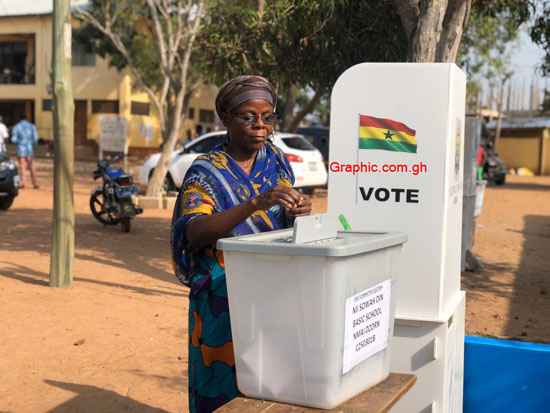
A clarion call has been made on the Ghanaian electorate to vote massively for women candidates who will be contesting tomorrow’s District Level Elections.
The proponents, Abantu for Development, a women’s rights Policy and Advocacy Organization says it considers tomorrow’s local government elections as another opportunity to deepen efforts to promote gender sensitivity in the electoral process and an invaluable possibility for the realisation of gender equality.
The Electoral Commission (EC) has indicated that all is set for the district-level elections, scheduled to take place on Tuesday, December 19, 2023.
Over 66,000 individuals are competing for assembly and unit committee positions in tomorrow.s local polls.
More Read

The Electoral Commission’s statistics indicate 18,755 assembly member candidates and 47,502 unit committee member candidates, totaling 66,257 candidates.
The electoral battleground spans 6,215 electoral areas across 216 metropolitan, municipal, and district assemblies.
Abantu holds the view that facilitating the election of more marginalized citizens, particularly women into district assemblies in tomorrow’s, election would not only be fair and just, but a mandatory national assignment as an extension of true democracy and equal citizenship.
In a statement put out recently to push for increased women’s representation in the upcoming Local Government Elections, Abantu lamented that even though local government is meant to democratize governance for a more equitable allocation of resources in the development process, “ women have been unable to make inroads over the years.”
It noted that women find themselves on the fringes and are still confronted by limited options and formidable social, economic, and cultural barriers that place them at a great disadvantage.
According to Abantu, since the inception of the decentralised system in Ghana, women have failed to attain the 30% UN recommended minimum threshold in representation in the district assemblies and now stands at less than 6%.Due to women’s inadequate representation and participation, they have been unable to contribute to defining policies and adding value with their own experience.
It indicated that many countries in including several in Africa are acting decisively to ensure women’s equal participation and representation in decision-making.
It observed that the highest number of elected women in the district assemblies was in 2006 when 478 women were elected out of a total membership of 4732. Following the 2015 local government elections, only 282 women got elected into district Assemblies out of a total of number of 6061 members nationwide
This scenario above represents the failure to take the required decisive initiative to address the multiple factors that make it difficult for women to contribute their own life experience and their voices.
“Therefore we would expect that within the upcoming electoral process, Ghana will focus on initiatives that would facilitate inclusion of expanded diversity of experiences in ways that are democratic.
“Abantu calls on the media to use their various platform to give priority to actions aimed at supporting women’s increased representation in district assemblies.
Gender equality is the surest path to sustainable development,” it stated.
Ghana’s Local Governance was created to provide centers of self-governance, inclusive local participation, equal decision-making, planning, and development. Yet, women’s presence in the governance structure remains low.
In 1998, there were 547 women contestants and 196 winners, while the highest number of women contestants and those elected were recorded in the 2006 Elections when 478 were elected as Assembly Members out of the 1,772 who contested.
Of the 909 women candidates for the 2019 Elections, only 216 won seats in the District Assemblies, compared to the 17,601 male contestants in the more than 6000 electoral areas countrywide.
By: Mohammed Suleman / Publicagenda.news