

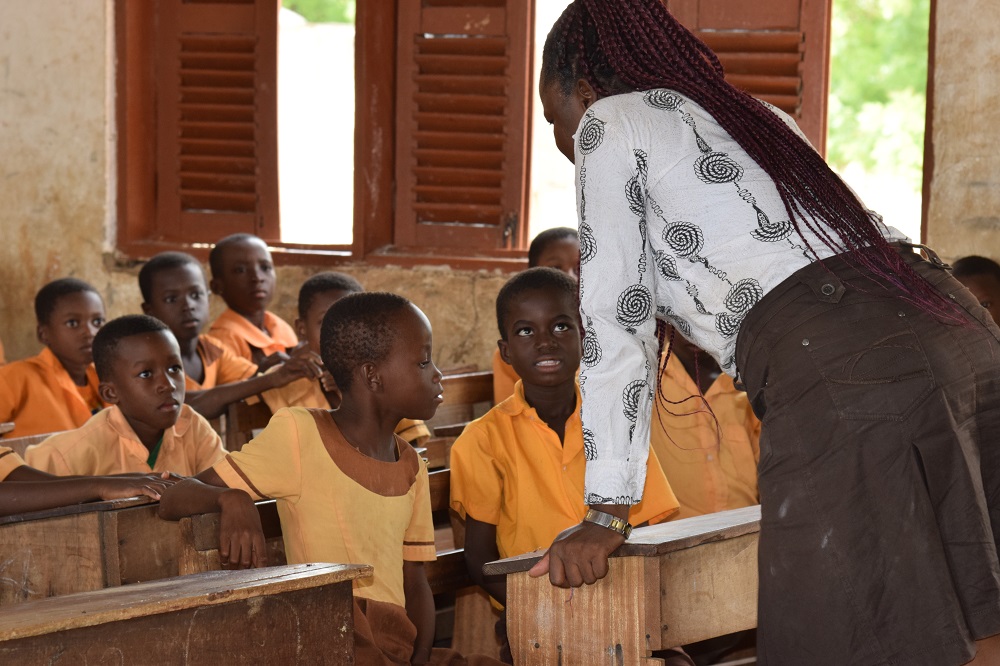
“The answer is four,” said Patricia, 10, smiling brightly before she walked to the chalk board with confidence to write the answer to the maths problem in class that morning.
Division was the topic of today’s primary 2 maths lesson at Afoko District Assembly School in Sandema, district capital of Bulisa North in Ghana’s Upper East region and Patricia Adeborinsa was listening closely to her teacher’s instructions.
At first glance this classroom setting looks like any other class in Ghana. But take a closer look and it becomes evident that some students have mild to moderate impairments.
More Read
Patricia is one such student. With mild cerebral palsy, Patricia has difficulties with movement, and struggles to use her motor skills. When she first arrived at Afoko District Assembly School at four years old, Patricia found it hard to use a pencil.
Patricia is the only pupil in the school with cerebral palsy. But her classmates don’t treat her differently because of it.
Her level of inclusion at school is due in part to the efforts of the staff – including Patricia’s teacher Sylvia Abagrimi, who encourages her classmates to interact with Patricia as they with would any other pupil. “I try to ensure she is not left out. Her other classmates check that she’s okay. I also sit her next to her classmate, Salamu. Sometimes he supports her with her writing.”
In class, Patricia sits next to her friend Salamu.
Patricia also received the support of the school’s headmistress Paulina Adekaldu who wanted to ensure Patricia could succeed. “When class was over, I would help Patricia learn how to write and hold her pencil. Now she can write and she participates in class like her other classmates.”
In Ghana, children with cerebral palsy or any other form of disability often are said to be hidden in their communities. According to Ghana’s 2010 Population and Housing Census data, one child in every three has a disability and is not in school because of it.
Without the support of the community or teachers, most parents conclude that their children would be rejected and that there would be no support mechanisms in place for them to attend school or live fulfilling lives.
Breaking down barriers
Two years ago, Sandema District sought to rectify these inequities and, in adopting the government’s recently launched Inclusive Education policy, the district made a concerted effort to enable children with mild to moderate disabilities to attend school and benefit from learning.
With the assistance of UNICEF in partnership with USAID, the district took on a community sensitization programme where parents were invited to hear about how all children – with or without disability – had a right to education.
“We talked openly about disability with parents and informed them that services are available in the school to support them,” said Kennedy Afagachie, Special Education District Co-ordinator in Sandema. The District Education Services guides teachers on how to carry out basic screenings, and then how to provide support all children – with or without disability – to benefit from learning.
Sight, hearing, physical and behavioural impairments have been identified in schools across the district and teachers have found solutions on how to ensure these children receive the best access to education possible.
Patricia (left) receives instruction from a teacher as she takes part in a mathematics lesson.
Today, more than 450 teachers in Sandema are trained in inclusive education, and children in Sandema with mild to moderate disabilities are able to go any of the 83 basic schools in the district.
Speaking to Patricia, it’s clear to see just how much she enjoys coming to school. Why is it so important to you, I ask. “Because I can get to learn,” Patricia replies with a twinkle.
Learning is a right afforded to all, yet still denied to too many children in Ghana with disabilities. However, for every child in Sandema, for children like Patricia, the basic rights to learn, to play and to experience school days, has become a reality. Patricia can attest to that.