The State of the Nation Address is the single most important national speech by the president every given year. The address is expected to give a report or account programs and projects announced in the previous year, account for the current state of the nation and offer plans, programs or ways to address current problems and issues affecting citizens.
The state of the nation address is also expected to inspire the nation, shape and appeal to national values, provide a broad vision for the nation, galvanize the nation into action or carry them along. Here are some brief takeaways from this year’s State of the Nation Address.
Broad Overview
More Read

This was a fairly straightforward state of the nation address. No grand rhetoric, no grand plans, just enough statistics, no sweeping policy except to declare 2020 as the year of roads. It was not excessively heavy on statistical detail but neither was it inspiring. The president did not sound divisive or partisan but definitely used the address to make a case for a second term.
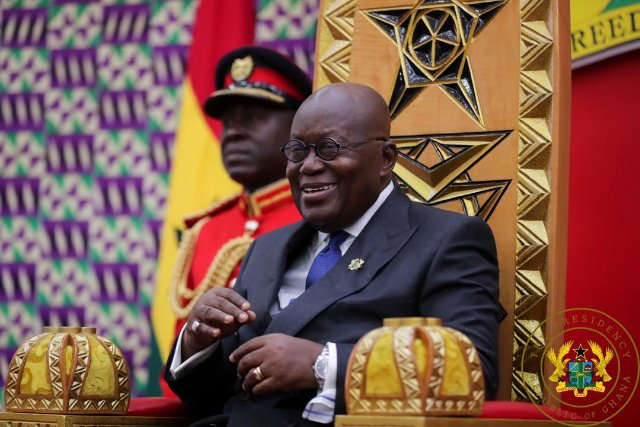
He seemed relaxed, confident and took things in good stride. His disposition was pleasant, cordial and sometimes, humorous. You can see a president who is confident of his achievements, buoyant in expressing them, hopeful about a second term but yet sparse on some of the most pressing concerns of the nation. Time will tell how well Ghanaians will receive this address.
6 Takeaways from President Akufo-Addo’s 2020 SONA Address
“Year of Return” and “Beyond the Return”
The President sees the Year of Return as one of his biggest accomplishments. President Akufo-Addo spent some considerable time touting the outcome of his Year of Return Initiative. He talked about the benefits in terms of tourism, the country’s image and economic returns. There’s no doubt that the Year of Return has generally been viewed as a massive success and it’ not surprising that the President led his address with this particular theme More details are still needed in terms of the specific monetary benefits and the country waits to see how the government builds on this achievement moving forward “Beyond the Return”.
“The Year of Roads”
Before the State of the Nation Address, the president signalled in his last Press conference that 2020 will be the “Year of Roads”. He lived up to the billing by boldly postulating that exact same theme in his address. Surely, having great roads has always been of huge concern for Ghanaians and would be very much welcome.
However, there’s still a bit this that sounds patronising almost to the point of being perceived as showboat politics. The state of our road is definitely a thing of great concern to Ghanaians but we also know the politics of roads especially in an election year. Going by what has happened in the past, we now know that fostering roads on the populace, while a great initiative, is not always a slum-dung election winner.
Agriculture
The President dedicated quite a considerable amount of time to the agricultural sector. It is indicative of the fact that the government feels this is one of their strongest areas of performance. Considering that agriculture forms a major part of our economy, the president was conscious of touting his achievements in this area in an area that Ghanaians are connected to in various ways.
Of course, he will have to be double-checked or fact-checked on whether food prices are indeed at “their lowest in decades” but this is a government that is feeling extremely confident in its performance with the Planting for Food and Jobs initiative and other such programs in the agricultural sector.
Absence of the minority
The absence of the minority didn’t give a nationalistic feel to the event. State of the Nation addresses are expected to national events and present an image of democratic growth. However, the undue partisanship characterised by chants and songs from the majority and minority protests and walkouts takes away that unifying, nationalistic or bi-partisan feel.
Relatively short, less dense speech and no mention of Ghana beyond Aid
Perhaps, the President wanted to avoid a SONA burdened by statistics or perhaps he wanted to try something different but this address felt quite free of “legalese”, technical language and winding statements capable of making the address boring. It also made it sound quite broad-based with less specificity. It was also quite short compared to other addresses. For instance, former President Mahama’s address in 2016 lasted for about three hours while President Akufo-Addo’s address this year did not last for more than two hours—about an hour and 40 minutes.
The president sounded confident when he spoke about the contributions to the police, security sector and digitization, excited when he spoke about the Ya-Na’s visit and the Vice-President’s work on the economy, less specific when he spoke about fighting galamsey and corruption and quite upbeat when he spoke about the Year of Return and agriculture. While
No mention of Ghana Beyond Aid
It is quite telling that for a policy which has come to characterise the government’s image both locally and nationally, there was no mentioned of Ghana Beyond Aid. There were no specific details regarding what has been achieved as far as this flagship policy is concerned and what the plan is moving forward as far as Ghana’s road to self-reliance or life beyond aid is concerned. There are a lot of Ghanaians who were perhaps also hoping to hear more concerning how to address unemployment head-on as well as very decisive actions to curb carnage on the roads.
Source: Center for Public Discourse Analysis (CPDA)