SEND-Ghana, a policy think tank has made a proposal to government to consider setting up an Agricultural Investment Fund to ensure the sustainability of the sector and to enhance Ghana’s quest to maximize its agricultural production.
The Organization indicated that “to ensure sustainability of the sectors growth, the investment or development expenditure allocation of the sector should be increased to support sector infrastructure. A proposed agriculture investment fund similar to GETFund should be set up to provide guaranteed financial resources to the sector.
Sources to the Fund, it suggests, should include yearly allocation from the budget, 2% levy on all agriculture output exported output of this country.
More Read
It said, given the limited fiscal space available in government budget, some incentives should be provided to attract private sector investment into large scale farming. This can be achieved by developing targeted policies such as input tax exemptions, subsidies on equipment’s for large scale sector activities etc.
These were among some key recommendations made in a study conducted by SEND-Ghana to assess government’s expenditure allocations in the agriculture sector between 2014 and 2017.
The study was part of a project christened,‘Promoting Smallholder Farmers’ Inclusion in Agricultural Modernization (PSFAM).’
The project, supported by TRUSTAFRICA aims to among other things promote smallholder farmers inclusion in the 5 components of Ghana’s Planting for Food and Jobs Campaign in the 2018-2019 plans, increase capacity to implement the project, increase knowledge of smallholders on the PFJ campaign, Track allocation, disbursement and expenditure on the components of PFJ campaign.
The study also assessed the functional breakdown of government expenditures on both allocations and actuals in the sector for the period between 2014 and 2017.
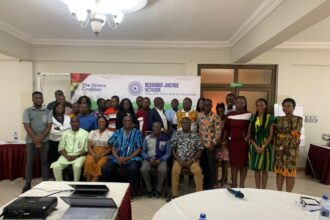
Presenting the finding of the study at a National Dialogue on Budget Tracking in the Agriculture Sector in Accra on Tuesday, Ms Rachel Gyabaah, Programme Officer at SEND-Ghana indicated that from the data collected, it was observed that even though Ghana has signed unto the CAADP protocols, the country could not meet the 10% expenditure allocation and at least 6% growth for the period 2014-2017.
According to Gyabaah, the averaged allocation and actual expenditures for the period 2014-2016 was about 3% allocation whilst actual is 2.5% which reflected in the low average growth rate of 3%. This situation however changed in 2017 with an increase of the allocation and actual to average of 5.1% and 5.4% of allocation and actual respectively and the correspondent growth of 8% in the sector.
“The inability to meet the CAADP goals of 10% expenditure allocation and at least 6% growth is attributable to nonexistence of a formula to facilitate strategic, systematic and consistence allocation, no sector experts to analyze the sector and negotiate for more resources. In addition, there is no sector dedicated funding as it is with GETFund for education to provide guaranteed funding and low investment of private sector in agriculture infrastructure, “she added.
She told participants that key lesson from 2017 showed that, with high investment and right target, the sector all things being equal, is likely to increase its growth as was observed (from average 3% in 2014-2016 to 8.4% in 2017) in the period under the Planting for Food and Jobs (PFJ).
She observed further that the PFJ policy even though was targeted at small holder farmers however, there are no data to show that the right farmers received the support, thus it require stakeholder census to generate the required data to facilitate policy targeting for maximum impact.
As part of the recommendation the Ministry of Finance was advised to take steps to develop a formula to facilitate strategic, systematic and consistent allocation to the sector towards achieving the CAADP 10% budget allocation and the correspondent 6% sector growth.
“In addition, MOF engages sector experts for all sectors including agriculture expert who will undertake analysis of the sector financial need, as well as engage the sector stakeholders to negotiate for adequate funds to achieve strategic targets of the sector.”
Mr. Kwame Asafu-Agyei, Chairman of Food, Agriculture and Cocoa Affairs Committee of Parliament, encouraged Ghanaians to adopt the PFJ Programme as it has the potential to improve Ghana’s agriculture sector.
He observed that the Programme has increased the annual growth of Ghana’s agriculture and brought employment.
On his part, Mr George Osei-Bimpeh, Country Director of SEND-GHANA,
underscored the need for civil Society to come together in order to have a strong voice to address issues of accountability.
Mr Osei-Bimpeh pointed out that, “We cannot develop a country if we do not work on our agriculture. We must get people to contribute and turn ourselves to monitors to support farmers.
He also urged politicians to allow the agricultural technocrats to steer the affairs of the sector for a better outcome.
By Mohammed Suleman