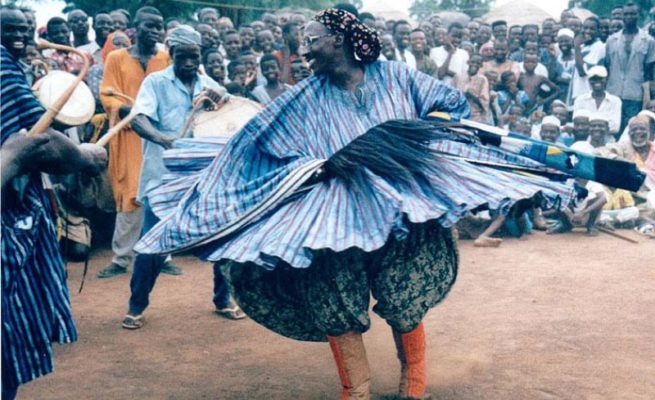
Each year, around May, the Gonjas people of Ghana’s Northern Region celebrate the Damba festival, where Islam and indigenous customs come together. Three days of events and celebrations. To remember the past but also to discuss currents issues.
Bole is a small town and is the capital of Bole district, in the Northern Region of Ghana. The town is only 30km from the border with Cote d’Ivoire to the west but over 600km northwest of the capital Accra. Bole is the capital of the Gonja people.
Although the Damba is an annual celebration, the dates for the festival are decided according to the lunar calendar and the decrees of the Gonja king, the Yagbumwura, who is the paramount chief of the Gonja people. The current Yagbongwura, Tuntumba Sulemana Jakpa Bore Essa, has held his position since 2010. He wields executive and judicial powers and is assisted in the administration of the Gonjas community by the Council of State Elders which meets periodically to deliberate on issues of great importance.
More Read

The Gonjas are one of the largest ethnic groups in Ghana. Their language is a Tano language within the Kwa language family, closely related to the Akan languages. The Gonjas are a Guan people who have been influenced by the Akan, Mande and Hausa.
One of their important features is the political system of chieftaincy which has the ‘rotation principle’ that the Gonjas have adopted amongst their chiefs. Not only do the chieftaincies rotate between the different families or gates that make up the royal lineage, but the chiefs themselves rotate and relocate. This, it is thought, has enabled the Gonjas’ chieftaincy system to function with less internal conflict than most. As the chiefs move up the ladder that has the paramount chief Yagbumwura at the top, they physically relocate to the next seat of power they inherit.
Each move is seen as training for the next, bigger job to come and encourages interaction between the different families or gates and enables power to be diffused between all. In all the paramountcy rotates between seven gates or families. Local history has it that these are seven families created by the seven brothers of the original ‘father’ of the Gonjas, a man called Jakpa. However, none of the gates is more formidable than the power of the elders themselves.
For example, the elders have excluded two of the seven gates from the rotation system after they failed to resolve their internal squabbles. Three generations ago, according to local history, an argument over chieftaincy led to a standoff with the paramount chief himself. The gates of Kung and Kandia were promptly banned from the rotation system to teach them that the answer to such disputes should never have been found in violent means, and furthermore that none of the gates should ever raise arms against the paramount chief.
The Damba has its origins closely tied to the roots of the Gonjas themselves. The three-day festival begins with a rice picking ceremony, though it is some generations since the Gonjas of Bole fanned rice in any quantity. Today the fields around Bole are filled with yams and cassava, but there is no yam festival here. The rice picking harks back to the early history of the Gonja’s and their ancestry, which can be traced back to the kingdom of ancient Mali.
The Mandes conquered and spread the traditions of the people of the Sahel. Warrior horsemen pushed the boundaries of ancient Mali south into present day northern Ghana. They brought with them not only rice cultivation, but their own language, traditions and of course religion – Islam. While some explain the importance of the Damba in terms of a celebration of this early migration, a festival to give thanks for finding a new settlement, for having conquered, others see it as a purely Muslim festival, because of the celebration of the birth of the Prophet Muhammad. One thing is certain and that is that the Damba is a fusion of indigenous and Islamic tradition, an opportunity for chiefs to meet and discuss local affairs.
Chiefs assemble according to rank under the tree outside of the Bole-wura’s palace. The Bole-wura himself sits in the centre, fanned by a priestess and protected by his armed warriors. The second day of the festival begins with a ritual slaughter of a bull. In the morning, the Muslim chiefs and their disciples come to the palace where a bull is slaughtered according to Islamic ritual. Those present form a circle around the bull and walk or jump over it three times. During this exercise verses of the Holy Quran are recited. The bull is slaughtered and the meat is distributed for feasting.
Afterwards the assembled chiefs are called upon to dance one by one in front of the Bole-wura as a sign of their respect and allegiance. However, the real dancing goes on late into the night. While the Bole-wura sits in state in his palace, villagers and chiefs are expected to dance through the night in the courtyard outside. A hail of gunfire announces the return of the chief at dawn who then comes to inspect the dancers and bring the evening’s revelry to a close.
After a little sleep, on the third day, the village drummers call everyone back to the chief’s palace for the final ceremony of the Damba. Each of the clans assembled is given a share of the meat and a portion of the local hot maize paste tuo zafi or ‘TZ’ to take back with them. It is important that none are left out for fear of causing insults. Even the blacksmiths, wizards, witches and thieves are not forgotten, with the children of the village scrambling to take these symbolically dedicated scraps. Chiefs again dance one by one to show their allegiance to their Bolewura, before finally gathering in a circle and prostrating face down on the ground before their chief.
The festival is the occasion for most people to purchase new clothes and gifts, as everyone wants to be dressed as beautifully as he or she can be. The males dress in colourful, handwoven smocks that are designed for dancing while women wear traditional handwoven cloth wrapped around their waists and expensive jewellery.
The Damba festival is in effect a thanksgiving festival and a time for families to meet, and socialise. It is also for auditing and evaluating the past and planning for the future.
– Adwin Kojo Labi