

Countries belonging to the International Energy Agency have agreed to release 400 million barrels of emergency oil reserves to stabilise global markets amid supply disruptions caused by the escalating Middle East war.
Member countries of the International Energy Agency (IEA) have unanimously agreed to release 400 million barrels of oil into the global market as a strategic measure to cushion crude supply disruptions caused by the escalating war in the Middle East.
“IEA countries will be making 400 million barrels of oil available… to the market to offset the supply lost through the effective closure of the Strait (of Hormuz),” CNN reported Mr Birol as saying via the agency’s website.
More Read
“This is a major action aiming to alleviate the immediate impacts of the disruption in markets. But, to be clear, the most important thing for a return to stable flows of oil and (natural) gas is the resumption of transit through the Strait of Hormuz,” the official added.
Mr Birol had earlier said on Monday that IEA member countries currently hold over 1.2 billion barrels of public emergency oil stocks, with a further 600 million barrels of industry stocks held under government obligation
The agreed release far exceeds the 182 million barrels of oil that countries placed on the market in two tranches in 2022 when the Russia-Ukraine war was at its peak. In the same year, the United States also sold an additional 180 million barrels from its Strategic Petroleum Reserve.
Despite the unprecedented scale of the latest release, analysts believe the measure may have a limited impact in addressing what they describe as a much larger supply shock.
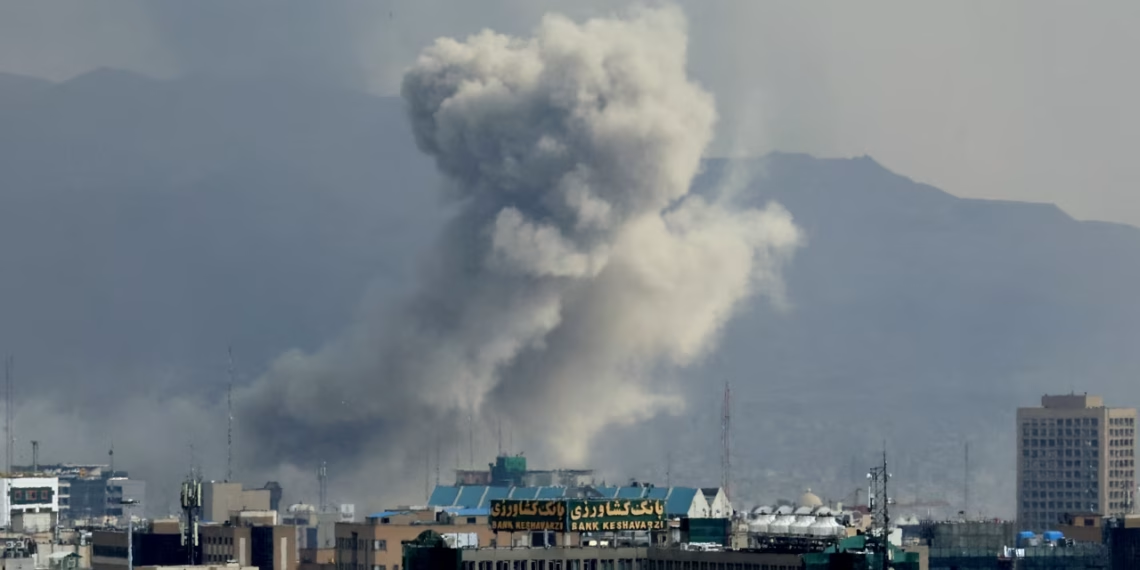
The move comes amid persistent disruptions caused by the near-shutdown of the Strait of Hormuz — the gateway for about a fifth of the world’s daily oil supply — which has become largely impassable for oil tankers due to security concerns.
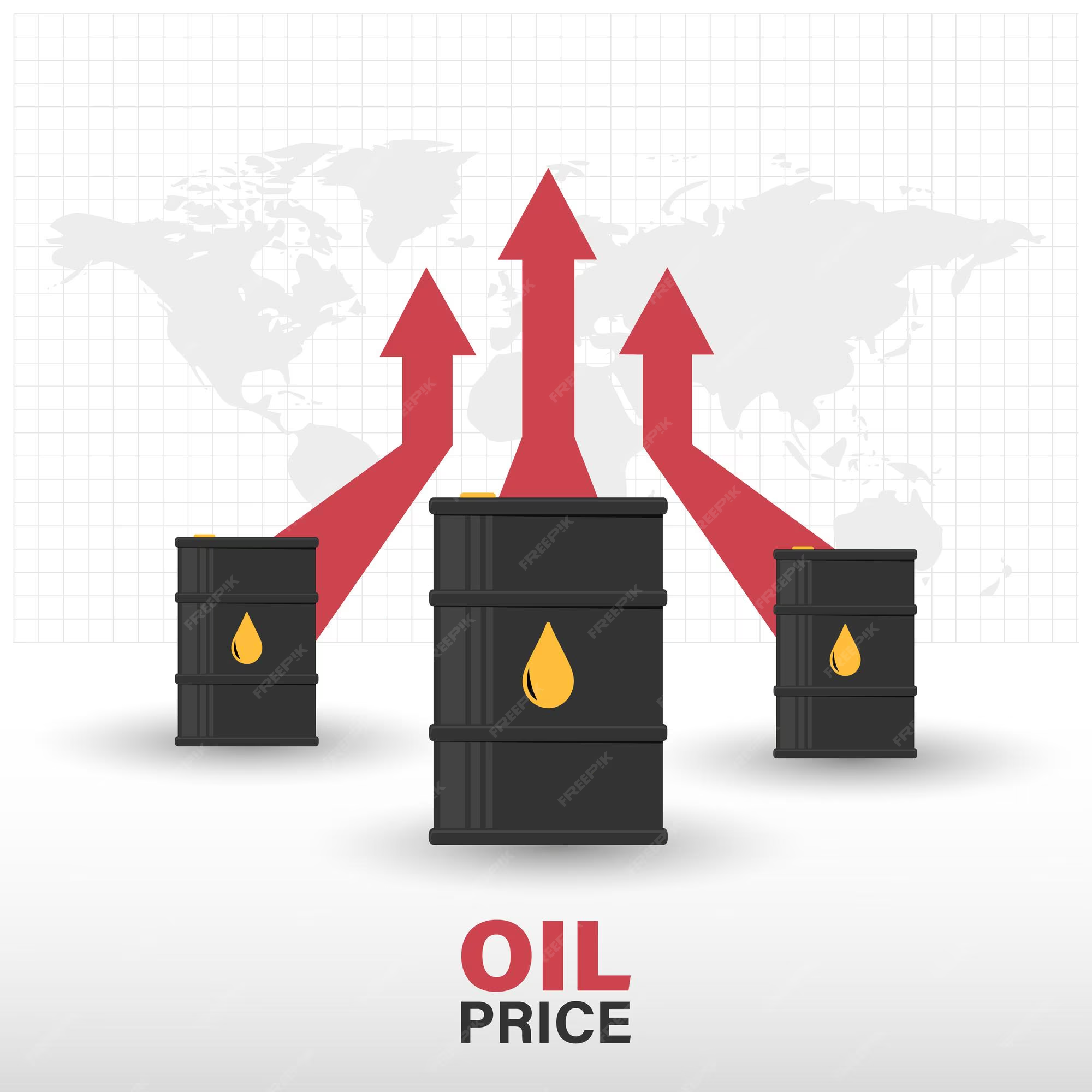
Since the conflict began over a week ago, oil prices surged to nearly $120 per barrel on Monday amid fears of prolonged supply disruptions, triggering declines in global stock markets.
However, the crisis continues to have significant economic consequences globally and locally.
Impact in Nigeria
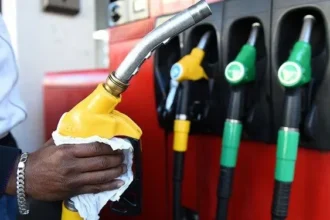
In Nigeria, consumers are already feeling the impact of the supply shock caused by the conflict. Petrol prices have increased by more than 25 per cent across major cities, worsening the cost-of-living crisis many Nigerians have faced since the removal of fuel subsidy in 2023.
Fuel prices jumped from about N870 per litre to nearly N1,400 per litre in Abuja within a week after the war broke out.
PREMIUM TIMES observed that major filling stations across the city are currently selling petrol at about N1,261 per litre and above. AFDIN filling station sells at N1,310 per litre; AA Rano at N1,330; NIPCO at N1,285; MRS at N1,267; while NNPC Retail outlets sell at N1,261 per litre.
The price adjustment intensified after the Dangote refinery adjusted its gantry prices for petrol and diesel twice within 48 hours as Brent crude crossed the $100-per-barrel mark earlier in the week.
Although the refinery has since announced a price reduction as Brent crude prices eased, pump prices across filling stations have largely remained unchanged.
The impact of the hike in petrol prices is already telling on many Nigerians, as the prices of transportation, goods and services are already adjusting to the new reality.
Analysts say the 400-million-barrel release may still fall short of addressing the scale of the supply disruption.
The release would “pale” in comparison with the approximately 15 million barrels a day of crude and other oil products “trapped within the Strait of Hormuz,” Amrita Sen, the founder of market intelligence firm Energy Aspects, wrote in a note before the IEA announcement, which was telegraphed in media reports earlier.
Other estimates place the blockaded supply at about 20 million barrels per day.
Ms Sen added that 400 million barrels “would be absorbed in just 25 days,” falling short of compensating for lost supply and “leaving few options to tame prices.”
Indeed, the IEA announcement has done little to immediately cool oil prices.
Brent crude, the global oil benchmark, rose nearly three per cent to around $90 per barrel after Mr Birol’s announcement. West Texas Intermediate (WTI), the U.S. benchmark, gained more than 2.3 per cent to trade around $85 per barrel.
The release of oil reserves would be “a temporary measure, and only military de-escalation can drive crude sustainably lower,” Francesco Pesole, a strategist at Dutch bank ING, wrote in a note.
Rising tensions
The prospects for reopening the vital Strait of Hormuz appear increasingly uncertain. This is because Iran has reportedly begun laying mines in the strategic waterway, according to two people familiar with U.S. intelligence reports cited by CNN.
Although the mining activity is not yet extensive, Iran is believed to possess around 6,000 naval mines, according to a U.S. Congress report published last year.
“Iran’s success in laying mines in the Strait has taken the crisis into a new dimension,” Ben Emons, the chief investment officer at FedWatch Advisors, wrote in a note.
“With a material military campaign shift, Iran’s chokehold on the Strait will intensify, with potentially more mines, given its capabilities. That is why the oil market views the IEA’s 400 million-barrel release as a water pistol, not a bazooka,” he added.
Volatile oil market
Oil prices have experienced sharp swings over the past 48 hours.
On Monday, both Brent and WTI crude surged above $100 per barrel for the first time in almost four years, only to plunge the following day.
Brent crude settled more than 11 per cent lower on Tuesday at $87.80 per barrel — its largest one-day drop since March 2022.
The decline was partly driven by comments from U.S. President Donald Trump that the war would be over “very soon,” as well as an announcement by Saudi Aramco, the world’s largest oil producer, that it would increase crude flows through its pipeline to the Red Sea port of Yanbu, allowing it to resume about 70 per cent of its usual shipments.
However, tensions remain high.
Iran said early Wednesday that it had launched its “most intense and heaviest operation” since the start of the war, according to state media, while Israel announced an additional wave of strikes on Tehran.
On Wednesday, three vessels were reportedly hit by unknown projectiles near the Strait of Hormuz, according to the UK maritime agency.
Source : allAfrica.com