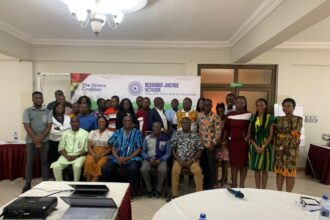


Tactical advocacy and empowerment of people in communities were identified as vital to stop the creeping incidence of land grabbing in the country and secure community lands for domestic agriculture.
To this end, a number of Faith Based Groups in the country led by the Catholic Church, in collaboration with some communities affected by land grabbing, Traditional Leaders, Civil Society Organisations, as well as state agencies have mapped out ways to nip the occurrence of land grabbing activities in the bud.
These were part of outcomes of a two-day Annual Learning and Review Meeting (ALARM) on Land Grabbing in Ghana organised recently at the National Catholic Secretariat (NCS) in Accra.
More Read
Very Rev. Fr. Lazarus Anondee, Secretary General of NCS, observed that there are severe consequences on the economic condition of communities when they lose their agricultural lands, adding that the church will not relent in its efforts to solidarise with communities threatened by land grabbers.
He echoed the concerns raised by the Catholic Bishops’ in their 2016 Communique issued in Tamale, on the subject, after Caritas Ghana’s survey on the situation in the country in 2016.
With the biting effects of land grabbing on family life, including the stresses on marriages, Fr. Anondee reiterated the commitment of the Church to continue speaking for the affected families and communities for state actors to address the issue.
In the light of the theme of the meeting: Securing Community Lands For Domestic Agricultural Production and Food Security in the Context of SDGs 2, Mr. Samuel Zan Akologo, Executive Secretary of Caritas Ghana, noted that the dialogue was to demand policy attention for the issue which is critical in the economic and livelihood condition of the rural poor.
He noted that the dialogue also seeks to understand what avenues were available to land owners when their interests were under threat.
The Queen Mother of Bole Traditional, Kansawurdu Bukai, shared the unfairness in the acquisition of large tracts of lands at Babator, in the Northern Region by a multinational company.
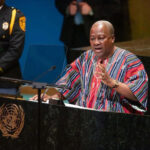
Mr John Peter Amewu, Minister of Lands and Natural Resources, in a speech read for him, noted that the plight of peasant farmers who have lost their lands and thrown into abject poverty as a result of land grabbing.
He also expressed displeasure about how illegal mining ‘galamsey’ activities, was affecting commercial agriculture, which posed great threat to food security and water bodies.
Commenting on the Policy dialogue, he said meeting which aimed at charting a path that would put community interest above parochial ones and help make progress in addressing the issue of land grabbing in the country.
Mr. Amewu stated Government’s readiness to tackle issues confronting land grabbing in Ghana in line with National Development Goals and the SDG’s.
He said the Ghana Enterprise Land Information System- (GLIS) is being developed,under the Land Administration Project II, to fully automate services rendered by the Lands Commission to the public.
Besides, the Minister mentioned Government’s intention to implement the Multilateral Mining Integrated Project (MMIP) targeting ‘galamsey’ areas, to among others things, roll-out pragmatic measures to provide alternative livelihoods, reclaim galamsey sites and restore arable lands to boost food security.
He noted that as part of initiatives to curb the practice of land grabbing in the country, the Lands Commission was also developing detailed guidelines on large scale land acquisition in the country.
Mr. Amewu, cited a recent World Bank Report on securing land for Africa, and said the report painted a distressing contrast between the availability of vast land resources and extreme levels of poverty.
The report questioned why Africa with vast arable land yet has the highest productivity gap globally.
The Minister commended the critical Caritas Ghana was playing to ensure the efficient, equitable, judicious and sustainable use of land resources within Ghana and across Africa.
He said assured that Government would continue to collaborate with stakeholders to muse over a suitable solution to put lands to optimum use.
A Principal Land Administration Officer at the Land Commission, Dr. Stanislaus Adiaba, observed that most lands in Ghana were held by traditional leaders, who do not have adequate legal and technical know-how to deal with land grabbing.
He said stakeholders are working on policy harmonisation and reengineering to consolidate the merger the four land sector agencies, which includes the establishment of Client Service Access Unit (CSAU) in Accra, Koforidua, Sekondi, Tamale and Bolgatanga.
Among participants were Most Rev S. Joseph Osei-Bonsu and Gabriel A.A. Mante, Bishops of Konongo Mampong and Jasikan Dioceses respectively.
By Kwesi Yirenkyi Boateng