

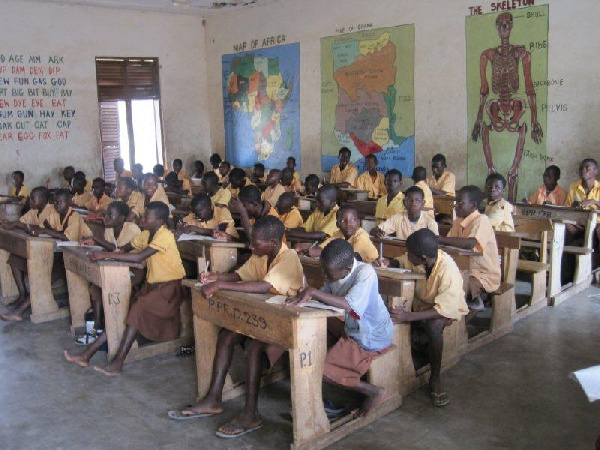
Though education enrollment rates are high compared to other countries in the region, the quality of education is still far from ideal. Per the Human Capital Index for Ghana, out of the average years of schooling in Ghana (11.6), the number of quality-adjusted learning years is just 5.7—meaning that children are in school but not learning for nearly six years.
Children from hard-to-reach and low-income households must make challenging daily commutes to get to school, and in some cases, children lack access to formal classroom settings (there are some schools under trees). Other issues include limited infrastructure for gender and disability needs, barriers preventing pregnant, parenting, and working students from continuing their education, limited access to media and technology, and the opportunity cost of schooling, especially if students help their parents in generating income.
More Read
To tackle challenges like those faced in Ghana, and achieve the United Nations Sustainable Development Goals, developing countries must not only use existing resources more effectively, but also look to additional resources. Results-based financing (RBF), an innovative funding approach focusing on the achievement of actual results can contribute to narrowing the funding gap, both by increasing the cost-effectiveness of existing funding and by unlocking additional financing from the private sector.
The World Bank’s Global Partnership for Results-Based Approaches (GPRBA) recently approved a $25.5 million grant to harness outcome-based financing—a form of RBF that ties payments to the achievement of measurable outcomes—to help out-of-school children (OOSC) reintegrate into Ghana’s formal education system and improve learning outcomes. The United Kingdom’s Department for International Development (DfID) is providing this grant through GPRBA’s recently launched Education Outcomes Fund (EOF). The government of Ghana will contribute an additional $4.5 million to the program. The primary focus will be to support marginalized OOSC, including girls, children with disabilities, and children from lower-income households.
This GPRBA grant builds on the ongoing work of the IDA-funded Ghana Accountability for Learning Outcomes Project (GALOP) a results-based operation. The GALOP aims to improve the quality of education by supporting teaching and learning. With greater focus on equity andefficiency, GALOP supports improved learning, improved accountability for learning, technology-based, in-service teacher training, and provision of learning materials. GALOP’s additional financing is also supported by the Global Partnership for Education, which recently approved an additional $15 million for Ghana as part of its response to the education emergency triggered by the COVID-19 pandemic.
With GPRBA’s grant, the government will work with social investors and non-governmental organizations (NGOs) as service providers to implement the EOF program. Social investors will provide the upfront financing in cases where service providers are unable to do so. Payments will be made based on agreed-upon outcomes, transferring the financial risk away from the government and onto the implementers. Technical assistance will help build government capacity to contract and manage outcomes.
The operation will target approximately 75,000 OOSC in areas with the highest absentee and dropout rates, in districts historically deprived of a strong educational infrastructure, and in the Greater Accra and Kumasi Metropolitan districts. In addition, approximately 120,000 students already enrolled in selected GALOP-beneficiary schools will benefit from strengthened interventions supported by service providers.
Since its approval by the World Bank in 2019, GALOP has seen considerable progress, including the completion of a revised curriculum training for all basic education teachers in the country and the establishment of a point-based sustainable professional development framework for teachers. Approximately 10,000 schools have been targeted to receive support, management, and resources. In addition, the process for strengthening the accountability systems for learning is underway.
The GPRBA grant is supporting Ghana’s commitment to reduce the number of OOSC in the country, bring more children to school, and increase sector resources by engaging social investors and NGOs. The first of its kind in Africa, this financing will help strengthen the ecosystem for outcomes-based funding in Ghana, spurring a shift from activity-based funding to outcomes-based financing.
Source: Publicagendagh.com