


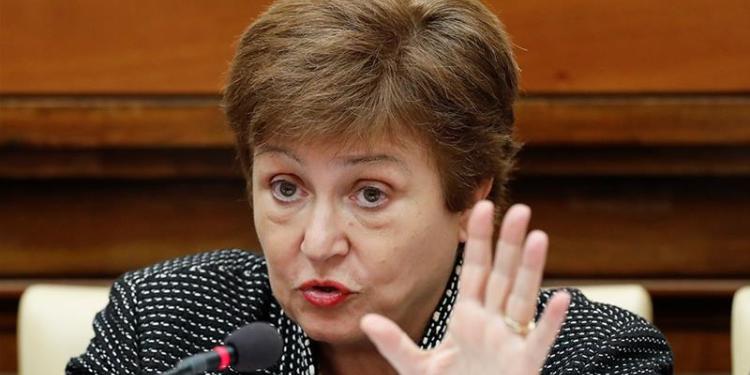
Kristalina Georgieva, the Managing Director of the International Monetary Fund (IMF), has asked world economies to prepare for deep rescission this year following the impact of the COVID-19 on the economy.
In an article, she suggested that having in place strong capital and liquidity positions to support fresh credit will be essential part of the economic recovery process.
“After the 2008 financial crisis, global regulators required banks to increase their prudential buffers of high-quality capital and liquidity. That significantly strengthened the resilience of the financial system. Many observers now cite those buffers as a bulwark against the adverse effects of the Covid-19 pandemic.
More Read

“But as we brace ourselves for a deep recession in 2020, and only partial recovery in 2021, this resilience will be tested. Having in place strong capital and liquidity positions to support fresh credit will be essential. One of the steps needed to reinforce bank buffers is retaining earnings from ongoing operations. These are not insignificant. IMF staff calculate that the 30 global systemically important banks distributed about $250bn in dividends and share buybacks last year. This year they should retain earnings to build capital in the syste,” she said.
She added : “Of course, this has unpleasant implications for shareholders, including retail and small institutional investors, for whom bank dividends may be an important source of regular income. Nonetheless, in the face of the abrupt economic contraction, there is a strong case for further strengthening banks’ capital base. Here are the reasons.
“Building stronger buffers is aligned with the array of actions undertaken to stabilise the economy. Governments are deploying fiscal measures in trillions of dollars, including financing that provides a backstop for borrowers who are tapping bank loans. Central banks have innovated and provided extraordinary liquidity support to a wide range of markets. Bank supervisors have exercised flexibility to the fullest possible extent by encouraging banks to restructure loan repayments, easing regulatory requirements, and allowing banks to draw down their buffers temporarily.
“The interests of bank shareholders are aligned with those of bank supervisors and customers. All stakeholders will ultimately benefit if banks preserve capital instead of paying out to shareholders during the pandemic. Protecting the banking sector’s strength now means that, once the recovery picks up, shareholders can expect large payouts — indeed the more profits retained now, the larger the eventual payout.
“The need to preserve capital is already being recognised and needs to be so more widely. In some countries, banks have voluntarily decided to collectively suspend shareholder payouts and buybacks. In others, supervisors have had to push. In March, the Bank of England asked banks to suspend plans to pay dividends and cash bonuses to executives, indicating it was ready to use its supervisory powers if anyone refused. Eventually the banks all complied. In Brazil, supervisors have had to use their authority to suspend payouts in a collective manner.
“Collective decisions are vital. Banks that take action on their own could be penalised by investors who fail to understand the need to restrict payouts. All banks should be covered — whether state-owned or private, whether commercial or investment. But no bank can do it alone, and if banks’ collective will is not there, then supervisors should take the decision for them.
“Today, supervisors in many countries use stress tests to determine whether — and by how much — payouts should be restricted. Pioneered by the IMF more than 20 years ago, these tests quantify the additional capital needed to keep banks resilient in the face of crisis, and are a vital guidepost helping us now to traverse an unfamiliar territory.
“It is time to update these tests to take into account the increased likelihood of more adverse economic scenarios caused by the pandemic. To ensure global consistency, international co-ordination is key. The IMF and the Financial Stability Board can help achieve this.
“Memories from the last global crisis still linger. The public sector is doing what it can to help prevent another banking crisis from happening again. Shareholders have both an interest and an obligation to do the same.”
Source: Laudbusiness.com