

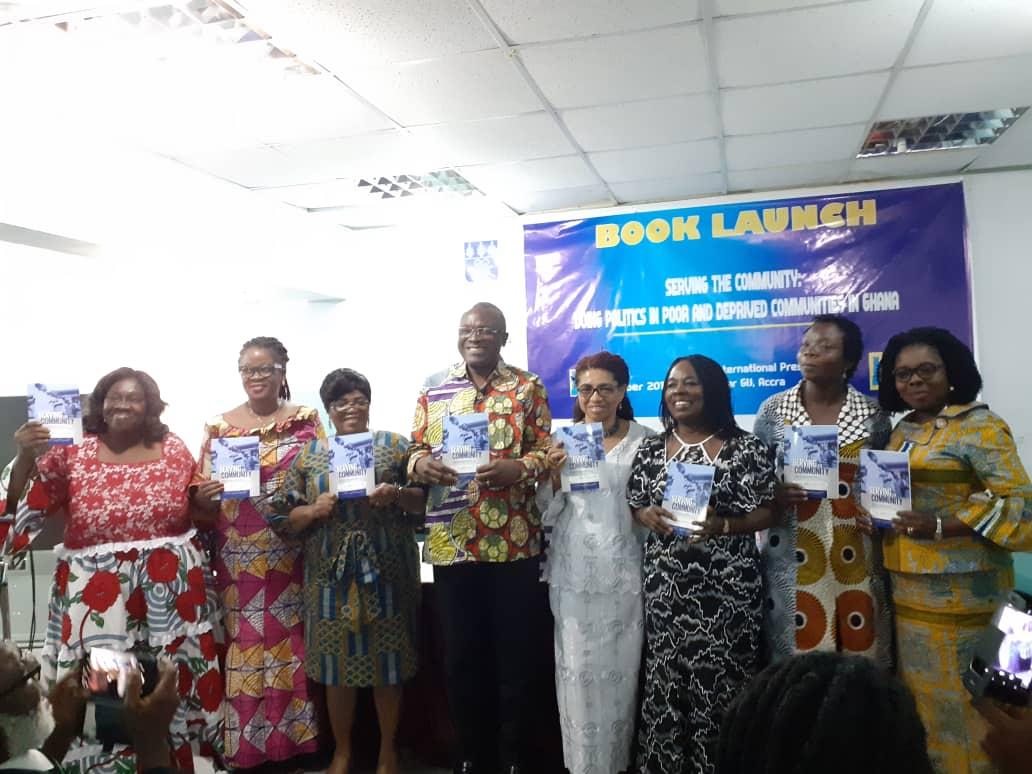
The quest for increased women’s participation in political space, particularly in local governance has been given a boost following the launch of a book christened, serving the Community – Doing Politics in Poor and Deprived Communities in Ghana: A Dialogue with Selected District Assembly Women in Ghana.
The 80- page book which was authored by five astute gender advocates, including Madam Takyiwa Manuh, Akua K.Darkwah, Dzodzi Tsikata, Akosua Adomako Ampofo and Dr Rose Mensah Kutin, discusses the decentralization process in Ghana with a focused analysis on the participation of women in representative politics.
In particular, the book explores the pathways to political powers of a sub-set of women in District Assemblies in Ghana as well as the implications of political power for themselves and their communities.
More Read

It also examines the spaces that provide opportunities for women’s political engagement and how these influence women’s experiences and practice of politics and conception of their roles as well as the kinds of power that women can claim, and what they do with it when they are in power.
The book draws in-depth on the experiences of twenty-eight (28) women who participated in local governance, either elected to assemblies, were appointed or sought election but did not win their bids. Eighteen (18) of the 28 women were elected; four were appointed, having all run for office and not been elected; and six having offered themselves, but not elected.
It further shares the experiences of women who had their unmarried status used against them, depicting how social status circumstances are used to constrain women’s participation in public life or political office.
Reviewing the book at the International Press Centre in Accra last Thursday, Dr. Esther Ofei-Aboagye, Chairperson of Star-Ghana Foundation, noted that the book intended to provide a grounded account of the influencing factors.
Dr Aboagye said it was clear that assembly membership and political activism could play a critical role in preparing the next generation of women for public office.
She described the book as a very valuable addition to the literature on Ghana, women, gender, decentralization and local governance, participation and pathways for growth and empowerment. “It does, indeed, augment the earlier literature and fills a critical gap. It has also provided insights into how creatively women have used the resources available to them including education,” she added.
For his part, Prof Joseph R. A. Ayee, Professor and Independent Scholar who was tasked to Chair the launch, stressed the need to devote more time to scholarship at the local level and described the book as a challenge for future research, the results of which could be factored in a second edition.
Prof. Ayee called for a national debate on how to deal with the low representation of women indecision-making processes and recommended proportional representation.
The initiative was supported by ABANTU for Development, the Centre for Gender Studies and Advocacy (CEGENSA) in partnership with the Institute for Development studies at the University of Sussex.
By Mohammed Suleman