

Public Agenda NewsPaperPublic Agenda NewsPaper
  • General News
  • Politics
  • Business
  • Health
  • Development Agenda
  • World News
  • Features & Opinions
  • Election watch
  • Editorial
Font ResizerAa
Public Agenda NewsPaperPublic Agenda NewsPaper
Font ResizerAa
  • General News
  • Politics
  • Business
  • Health
  • Development Agenda
  • World News
  • Features & Opinions
  • Election watch
  • Editorial
Search
  • General News
  • Politics
  • Business
  • Health
  • Development Agenda
  • World News
  • Features & Opinions
  • Election watch
  • Editorial
Follow US
Breaking NewsGeneral News

Ghana loses out on 2019 Telecoms Maturity Index

Latifa Carlos
Last updated: July 10, 2019 4:31 pm
Latifa Carlos
Share
4 Min Read
SHARE

BuddeComm’s Telecoms Maturity Index for this year indicates that from a second position last year, Ghana has been completely displaced from the top three and even not listed among the market challengers.

The rankings for 2019 showed Mauritius still maintained its lead from last year, as the most matured telecom market on the continent with a 49 score, while Algeria displaced Ghana for the second position with 43 points and South Africa also kicked Tunisia off the third place with a 34-point score.

BuddeComm’s Telecoms Maturity Index analyses the broadband, mobile & fixed line markets of a country on top of a range of economic parameters to rank it on a scale of 1 to 100 and compare it to its region.

More Read

NDC renames National Headquarters after J. J Rawlings
GTMO Condemns Attack on Forestry Commission Checkpoint in Bono East Region
World leaders converge in Accra for high-level reparatory justice conference
Mining, water supply and transport emerge biggest drivers of Producer Price Inflation
“Men’s Mental Health: Breaking the Silence, Saving lives

The 2019 market leaders: Mauritius remains the top-ranking country in Africa with a Telecoms Maturity Index score of 49, followed by Algeria (43) and South Africa (34).
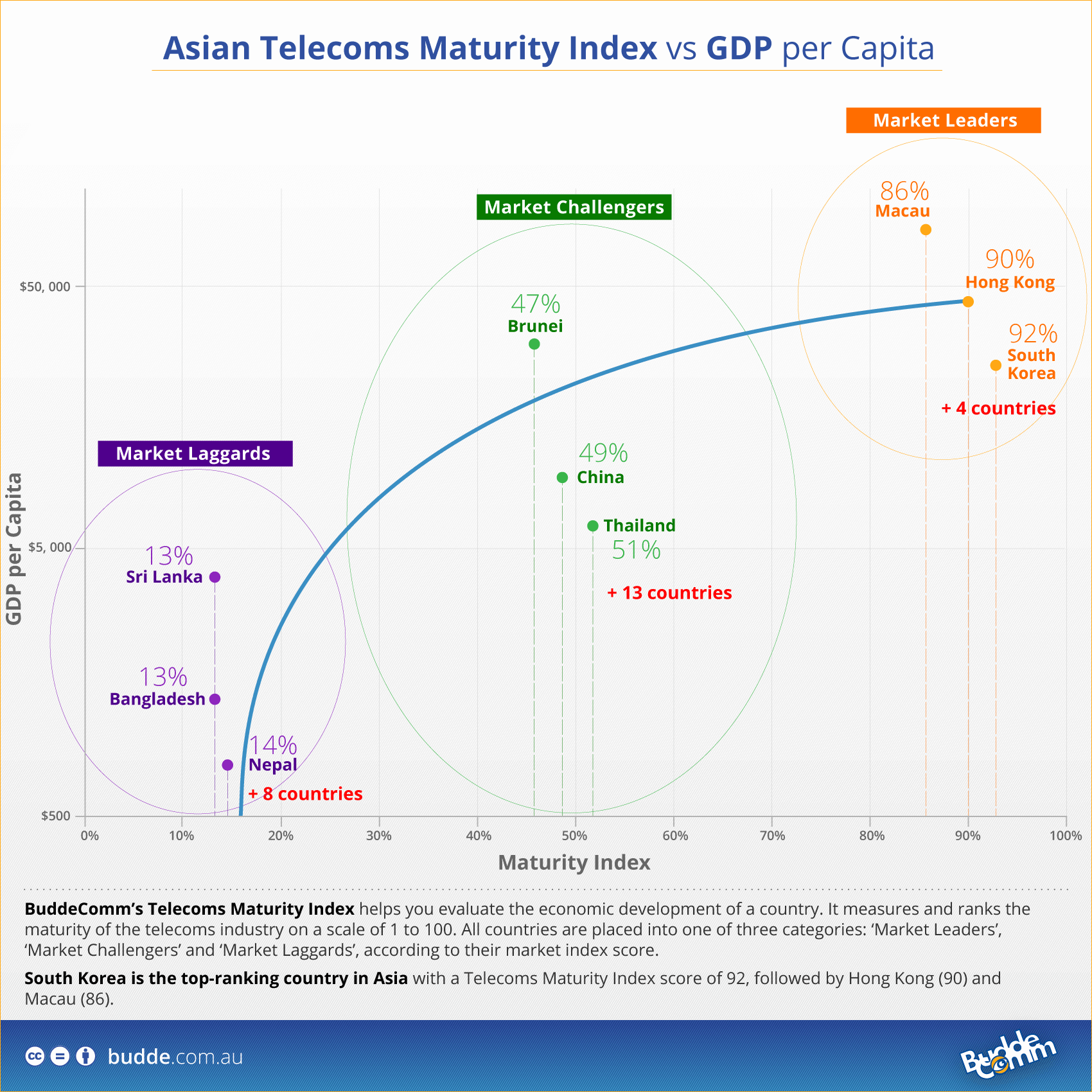
Asian Telecoms Maturity Index example

BuddeComm’s Telecoms Maturity Index measures and ranks the maturity of a country’s telecoms industry on a scale of 1 to 100. All countries are placed into one of three categories: ‘Market Leaders’, ‘Market Challengers’ and ‘Market Laggards’, according to their Market Index score.

In Mauritius, the thriving tourism market has stimulated the broadband sector. There is an extensive DSL infrastructure and operators have deployed fibre-based services in a number of localities. Mauritius Telecom invested Rs5.1 billion to roll out fibre across the island. Fibre is available to about 85% of the company’s fixed broadband customer base.

In Algeria, Mobilis, one of the 3 major mobile operators, has contracted Huawei as a partner for its network migration to 5G. Mobile penetration approaches 116% and mobile internet accounts for about 92% of all internet connections in the country.


 In South Africa, mobile penetration by early 2019 approached 169%, driven partly by the popularity of multiple card use as also by the take-up of mobile broadband services. Mobile internet accounts for about 95% of all internet connections

Market challengers: The top 3 market challengers are Libya with a score of 23, Lesotho (20.5) and Zimbabwe (20.2). Last year, the top challengers were Mauritania (13), Uganda (13) and Kenya (12).

Developing nations: Among the developing markets, the top three countries are Burundi (9.4) Uganda (9.3) and Nigeria (9.1). Last year, the developing markets were Angola (7) Chad (7) and Cameroon (6).

Mobile telephony remains by far the dominant telecom service across Africa, accounting for more than 90% of all telephone lines on the continent. Given the very poor condition of fixed-line infrastructure in most markets, mobile internet access as a consequence also accounts for between 95% and 99% of all internet connections.

The size and range of the diverse markets within Africa have contributed to varied market penetration rates between countries. By early 2018 the highest mobile penetration was found in countries including South Africa (169%), Botswana (160%) and Mauritius (147%). To some degree high penetration reflects the popularity of consumers having multiple SIM cards despite efforts among most regulators to enforce measures by which operators must register SIM card users.


Source:  Adom News

Share This Article
Facebook Whatsapp Whatsapp Email Copy Link Print

Recent Posts

  • NDC renames National Headquarters after J. J Rawlings
  • GTMO Condemns Attack on Forestry Commission Checkpoint in Bono East Region
  • World leaders converge in Accra for high-level reparatory justice conference
  • Mining, water supply and transport emerge biggest drivers of Producer Price Inflation
  • “Men’s Mental Health: Breaking the Silence, Saving lives
  • NADeF Micro-Credit beneficiaries seek increased funding amid business growth
  • Gbetsile: Six-year-old girl drowns in septic tank while searching for water
  • Recurring Floods Continue to Threaten Lives and Property in Oyibi Community
  • Africa poised to lead global digital finance evolution — MTN CEO
  • Ghana risks outsourcing economic sovereignty under IMF PCI deal — ISODEC
  • Accountability Labs Engage Birim North Assembly on Development Needs
  • How Africa can escape the debt trap
  • US lists travel, visa requirements for World Cup fans
  • Mahama to lead decisive Cabinet meeting over Constitution Review today
  • Ghana’s economy expands by 7.7% in February 2026 – GSS
  • President Mahama urges African leaders to unite in tackling healthcare challenges
  • Chinese mining firm targets Ewoyaa lithium takeover in $210m deal
  • Ghana now 8th biggest economy in Africa

You Might Also Like

Breaking NewsBusinesstop stories

NADeF Micro-Credit beneficiaries seek increased funding amid business growth

May 31, 2026
Breaking NewsGeneral Newstop stories

Gbetsile: Six-year-old girl drowns in septic tank while searching for water

May 25, 2026
MTN Group CEO & President, Ralph Mupita
Breaking NewsBusinesstop stories

Africa poised to lead global digital finance evolution — MTN CEO

May 20, 2026
Breaking NewsBusinesstop stories

Ghana risks outsourcing economic sovereignty under IMF PCI deal — ISODEC

May 20, 2026

About Us

Public Agenda is fou­nded and owned by Pu­blic Agenda Communic­ations.

Public Agenda was founded as a public interest Me­dia entity. Its Visi­on is to contribute to building a well-i­nformed society where accurate informati­on dissemination is the cornerstone of a democratic, just and equitable society.

Its mission is to inform, guide and bui­ld responsible citiz­enship and accountab­le decision making and strive for excell­ence in the media in­dustry. Public Agenda Communications is managed by a Board of Directors.

  • Contact us
  • Advertise with us
Welcome Back!

Sign in to your account

Username or Email Address
Password

Lost your password?