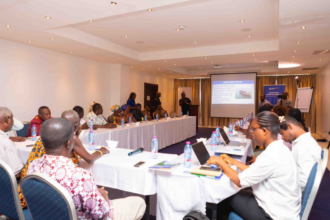
The United Nations Secretary General’s Special Representattive for West Africa and the Sahel, Dr Mohammed Ibn Chambas, is championing campaign on a new technology aimed at improving rice production in the country and the Africa continent.
Known as the System of Rice Intensification (SRI), the technology which focuses on the small-scale farmer, has the potential to double or even triple rice production in the country.
How it works
More Read

Unlike the usual system of farmers scattering rice seeds, the new technology involves nursing the seeds which are later transplanted onto the field.
The technology, developed by a renowned Cornell University researcher, Prof. Norman Uphoff, has been successfully adopted by rice farmers in Mali.
Dr Chambas, a promoter of the technology in Africa, paid a courtesy call on the Minister of Food and Agriculture, Dr Owusu Afriyie Akoto in his office last Wednesday to sell the idea on the new technology to the ministry.
After a closed-door meeting, the two — Dr Chambas and Dr Akoto — jointly briefed journalists on their discussion, the focus of which was to consider the new technology to boost rice production under the Planting for Food and Jobs (PFJ) programme.
Impact of technology
Dr Akoto expressed his satisfaction with the discussions he had with Dr Chambas and said that the technology would boost rice production under the PFJ programme.
He said the meeting also discussed what the government was doing to ensure food sufficiency in the country, especially with regards to rice production and further expressed his interest in the technology which could prove advantageous to small-scale farmers.
Rice production
Dr Akoto expressed his regret that an estimated USD 1.5 billion worth of rice was imported into the country in 2017, despite Ghana having been endowed with enough land and water suitable for rice cultivation.
He said for instance, that there were areas in the forest belts of the Ashanti, Bono, Central, Volta and Eastern regions with perfect soils for rice cultivation and that when production was intensified in those places the country could feed the whole of Africa.
“Unfortunately, Ghana has done nothing with this attribute that places it at an advantage to feed the whole of Africa with rice,” he said.
Why rice is in PFJ
Dr Akoto said the government was not happy that the country imported so much rice and that was why “rice was made one of the five crops chosen for the ‘Planting for Food and Jobs’ programme”.
He described importation of rice into Africa as a threat that must be of concern to the regional community.
Prof. Uphoff
For his part, Dr Chambas described efforts the country was making to achieving food sufficiency as “tremendous” when compared to other countries on the continent.
He described Prof. Uphoff as a mentor, whose research on rice cultivation was targeted at small-scale rice farmers.
“He is a renowned researcher in rice cultivation targeting small rice producers especially to help them attain higher yields and efficiency and to raise their incomes for improved livelihoods.
“His work is consistent with the Sustainable Development Goals of the UN, which targets the poorer sections of the population,” Dr Chambas said.
Source: Graphic.com.gh