


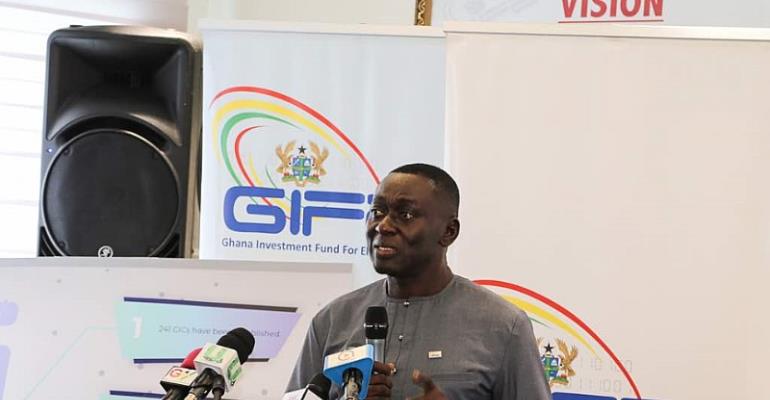
The Ghana Investment Fund for Electronic Communications{GIFEC} has set a target to achieve a 95 per cent universal access to telephone services in rural communities by 2019.
The target, according to the fund, is being set on the back of successes made within the unserved and underserved communities in the country through its Rural Telephony Project (RTP).
The Chief Executive Officer of the GIFEC, Mr Abraham Kofi Asante, told journalists in Accra that the successes made under the RTP over the years showed that with increased effort, more could be achieved.
More Read

“By the end of 2019, we hope to do 95 per cent. I can assure you that we will not compromise on that one. We should be able to cover more communities. If we are able to even do more, the target can even go up,” he said.
Currently, there are about 1,020 communities within the country that have been identified to be without mobile signal as of 2017 and the government, he said, intended to cover all the communities through GIFEC in close collaboration with the telecom operators in the country.
He said about 100 RTP sites were constructed in 2017 and this covered 900 communities, and GIFEC was also looking at constructing another 100 sites to cover 900 more communities by the end of 2019.
“We have already covered 900 communities and we are left with another set of 900 to cover and this we plan to do by the end of 2019. Most of these communities have an average population of about 1,000 so it gives you an idea of the reach,” he explained.
Through the implementation of the Universal Access to Telephony Programme (UATP), the fund has extended coverage of mobile telephone services where existing licensed mobile operators have proven unwilling or unable to expand their networks due to commercial or other constraints.
The objective of the UATP is achieved through the implementation of the RTP through close collaboration with mobile network operators.
Community Info Centres
The Community Information Centers (CIC) is a hybrid profit-making tele-centre and a non-profit community resource centre intended to provide business services and community development information to remote communities.
Mr Asante said these centres, which were built by the Ministry of Communications and managed by GIFEC, functioned as information hubs, provided connectivity to ministries, departments and agencies, private businesses, educational institutions, as well as individuals in beneficial rural communities.
He said so far, 241 CICs had been established out of which 182 were equipped with computers, scanners, printers and photocopiers.
GIFEC, he ,however, explained had targeted to activate all the 241 CICs by the end of this year.
Capacity building
GIFEC, he explained, was also committed to building the capacity of people to be able to use ICT in unserved and underserved communities to deliver services.
“It aims at reinforcing and expanding the use and benefits of ICT for the general public by supporting a range of capacity building, education and awareness projects.
He said one of the newly introduced projects, ‘Coding for Kids Project’ was launched to give the opportunity to kids and the youth to explore the world of technology through the creation of websites, computer games, interactive arts, mobile applications, among others.
According to him, 150 teachers had been trained as of June 2018 and it was expected that 1,500 schoolchildren would be trained by the end of the first phase of the project.
Source: Graphic.com.gh