

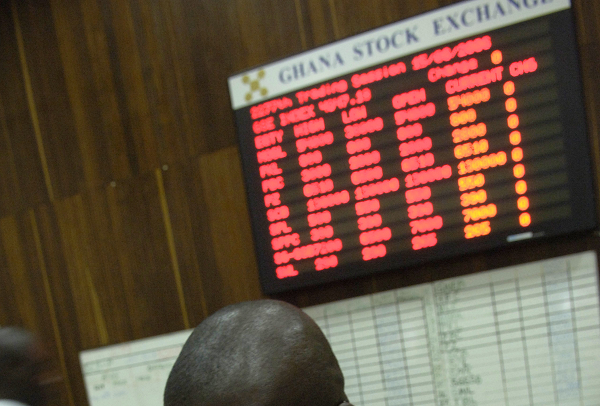
The Ghana Stock Exchange (GES) has taken its bullish run to another level, with the composite index registering a 35.26 per cent year-to-date (YTD) return on investment in the first quarter of this year – far above returns recorded on some of its African peers within the same period.
Data released by the Fidelity Bank showed that apart from the Egypt Stock Market (EGX), which registered a year-to-date of 21.67 per cent in April, all the other six stock exchanges in the continent reviewed by the Market Research and Insights Data Analytic unit of the bank registered returns below 10 per cent, with three of the exchanges even recording losses.
The data showed that the Botswana Stock Exchange (BSE), the Johannesburg Stock Exchange (JSE) of South Africa and BVRM of Cote d’Ivoire all registered negative YTD as of April this year.
The monthly bulletin reviewed economic activities in eight African countries in April as part of measures to help inform decision making and ensure smooth predictability.
More Read

Below is the update by country
Botswana
A new president, regarded as more business-friendly than his predecessor, was sworn in and S&P maintained its credit outlook for Botswana in April, largely based on stable diamond demand in large economies such as the US and China. The precious metal is the southern African nation’s key export and, together with other gemstones, accounts for 40 per cent of all government revenues. Despite low interest rates and stable exchange rates, a recent slowdown in the mining industry affected GDP growth and caused a steady decline in the equities market.
Outlook:
Lower diamond reserves place the resource-dependent economy at long-term risk, but opportunities in the banking and tourism sectors, as well as political stability, provide scope for growth and support Botswana’s investment case. Key risks include high unemployment and over-dependence on the diamond sector.
Kenya
Kenya is less exposed to the commodities cycle than its peers, and has strong banking and tech sectors. Recent political upheavals, drought conditions and a lending rate cap have constrained government spending, food production and private sector lending respectively and dampened economic growth.
Outlook:
The political issues appear to have been resolved, and recent signals imply a likely removal of the rate cap both of which should be positive for growth. Likewise, an improved weather situation will provide support for the Agric sector. A rebound in consumer spending and business investment is likely in the current environment. Key risks include a high public debt level and threats of terrorist attacks.
Nigeria
President Buhari announced his intentions to run for President in 2019, pointing to a potential continuation of the current economic policy through 2022. The monetary policy committee was finally approved by the Senate, and held the rate at its first meeting in April, citing inflationary pressures and risks to the current account.
Outlook
A rebound from recession has been driven by rising oil prices, which will support the budget and economic growth. However, the outlook for oil remains bearish in the medium term and make the efforts to diversify from oil into agric and other mineral resources even more pressing. Key risks include high NPLs in the banking sector, the effect of delayed policy implementation on public spending, the impact of US shale on oil prices and security concerns.
South Africa
Mr Ramaphosa’s government continues to enjoy positive sentiments from the global investing community, with lower bond yields and a fairly stable rand. GDP growth for 2017 came in higher than expected; however, legacy political issues remain and net FDI remains negative.
Outlook
The new government’s efforts at fiscal consolidation, including the VAT rate hike, should weaken consumer demand and slow economic growth in the short term, but supports the longer-term outlook for SA. The stable rand is somewhat bearish for resource and mining firms, although the ongoing rise in global commodity prices will provide crucial support to growth and government revenue. Key risks include unresolved political concerns in the ruling ANC, sharply deteriorating infrastructure framework and the implementation of a proposed land reform programme. — GB/Fidelity Market Research
Source: Graphic.com.gh