

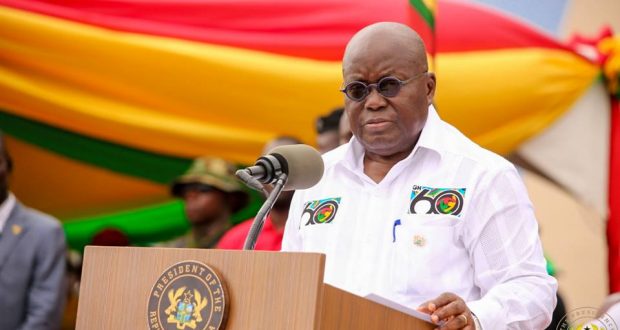
Ghana’s President, Nana Addo Dankwa-Akufo Addo has touted the significance of the private sector, insisting that the country’s solution to the current unemployment crisis lies with small and medium size enterprises that employ three, seven, fifteen and fifty people, and with large-scale industrial enterprises that employ people in their hundreds and thousands.
According to the President, the government is “creating the atmosphere for the private sector to grow quickly, and to encourage our young people to look for opportunities in areas other than the public sector.”
He made the pronouncement last Wednesday during a media encounter held at the Flagstaff House in Accra.
More Read

The president bemoaned the grim story of youth unemployment that has been a tragic part of the country and on the lives of Ghanaians for far too long. “When I became President, therefore, I knew my work was cut out. We had to do things differently, if we were going to banish the spectre of desperation, and restore hope to our youth.”
The President informed the gathered press, “We are concentrating our efforts to grow the SME sector,” adding, “under the National Entrepreneurship and Innovation Plan, with a seed fund of $10 million, five modules are being implemented, targeted at helping young people who want to set up businesses. It is no secret that our private sector often lacks the expertise that would enable it to operate competitively. Practical help is being offered to SMEs by way of advisory services, access to finance and access to market.”
He indicated that the government had set for itself five main priority areas, which it believes should rapidly transform Ghana’s agriculture, energy, industry, education and health sectors.
The President, Nana Akufo- Addo pointed out that the planting for food and jobs campaign, which registered over two hundred thousand (200,000) farmers in the 2017 crop season, has been a big success. He said he was particularly excited about the institutional sub–programmes, where 20 Senior Technical High Schools, National Service Scheme and the Prison Services were supported to cultivate their own farms. Also, he said, under the Youth in Agriculture programme of Planting for Food and Jobs, 10,000 youth were supported to cultivate 800 hectares 10,320 hectares of rice and maize, respectively.
“Under the campaign, average yields of maize and rice have increased, and our warehouses are filling up. Whilst the full picture of this success is yet to emerge, it is noteworthy that many farmers have expressed their satisfaction that, for the first time in a long while, a deliberate government policy has helped to boost their harvest. We are doing things differently, and we are getting results,” he boasted.
Touching on the energy sector, the President submitted that “we have brought stability in the place of the erratic power situation that we inherited. Adequate power supply is critical to the operation and success of the industry, especially small and medium scale enterprises, which provide the bulk of employment. Not only is regular supply important, but competitive rates of power are equally important.”
He reiterated that tariff rates for non-residential users of electricity, which embrace many SMEs, have been reduced by an average of 14% to boost their competitiveness.
Furthermore, an Industrial Development Tariff has been approved for industry to enhance its competitiveness. A new rate of US$6.50 per Million British Thermal Units (MMBtu), as against the previous rate of US$8.84 per Million British Thermal Units (MMBtu), has been established – a 26.5% reduction. In addition, a review of 24 power purchase agreements, which has led to the termination of 11 power deals and the rescheduling of 8 others, has enabled us to save the government treasury about $7 billion in excess capacity charges over a 13-year contract period.
“We also issued 7 year and 10 year cedi-denominated bonds, totaling GH¢4.7 billion, which have halved the $2.4 billion energy debt we inherited, and have helped improve the liquidity of the banks, and the balance sheets of the SOEs in the energy sector. This year, we will consolidate these gains, and ensure the flow of regular, affordable power to support the economic development of our country,” he assured.
By Mohammed Suleman