

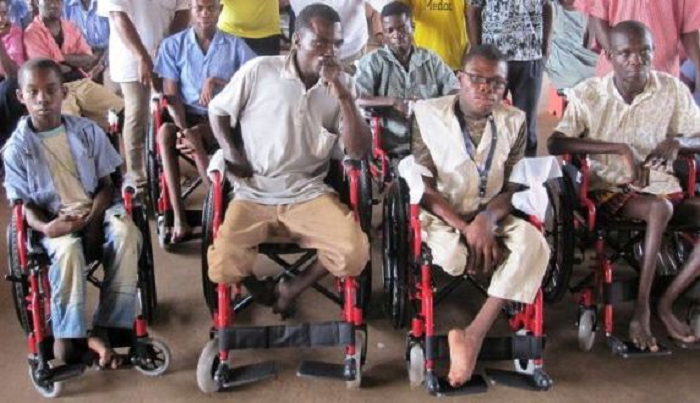
The Ghana Human Rights NGOs Forum , KASA Initiative Ghana in Partnership with the Universal Periodic Review (UPR) and InfoAfrica-Kenya have added their voices to calls on government to amend the Persons with Disability Act 715 of 2006 to conform to the United Nations Convention on the Rights of Persons with Disabilities( UNCRPD).
The Ghana Human Rights NGOs Forum expressed serious concern on the fact that the country’s Disability Act has no provisions for children and women with disability in disaster situations as well as political participation.
The absence of these provisions in the law continues to contribute to the neglect of a number of issues affecting persons with disabilities. Even though Ghana passed the Persons with Disability Act in 2006, the implementation of the law has not received the needed attention by government.
More Read
Mr Jonathan Osei Owusu, the Vice Chairman for Ghana Human Rights NGOs Forum, during an interview said, the Persons with Disability Act 2006,(Act 715) gave a moratorium of ten years for all public buildings to be made accessible and available to persons with disabilities. Eleven years later public buildings and places are still not accessible.
Persons with Disability constitute about 15percent of Ghana’s population hence the lack of access to the public facilities denies a large number of the population the right to participate in various human endeavors including employment and education.
Mr Owusu noted that, children with disabilities are unable to go to school due to inaccessible school environment. Children with cerebral palsy, autism, Down syndrome, persons with albinism and little people face huge discrimination and marginalisation.
Even though Ghana is implementing inclusive education policy, gaps exist between theory and practice. The school infrastructure is not accessible, teaching and learning materials are not in an accessible format.
An inaccessible school building has contributed to the increase in the illiteracy rate among persons with disabilities in Ghana.
The uneducated persons with disability find it difficult to participate in the informal sector because their opportunities are limited. Apart from becoming a cobbler or a musician, the illiterate person with disability cannot engage in transport business, construction, hawking in traffic, truck pusher and head porter popularly known as kayayo.
Lack of access to public space has also resulted in the underrepresentation of persons with disabilities in the socio-political and economic arenas.
Mr Owusu pointed out that that a huge number of persons with disabilities live in poverty, unable to make ends meet, driving a number of them to beg on the streets for money.
What is disheartening is that parents go to the streets with their children who assist them by pushing their wheelchairs or holding their white canes.
He noted that lack of empowerment programmes for persons with disabilities which results in their inability to earn their own income makes them a permanent burden on their families and friends which is a social liability.
He further added that, the government has embarked on a few interventions such as recruiting over 80 persons with disabilities to operate tollbooths and increased the Common Fund for Persons with Disability from 2 percent to 3 percent. There is also a special concession of 30 percent of all local contracts to be given to persons with disability in Ghana.
By: Latifa Carlos