

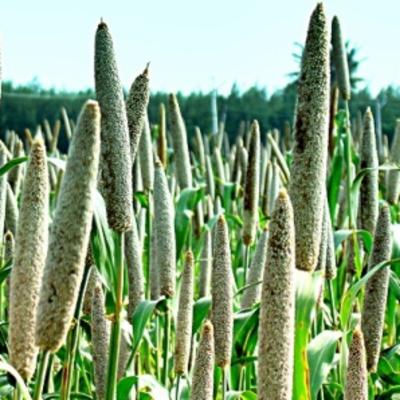
Millet, an indigenous savanna cereal, has been a staple in most parts of northern Ghana for centuries. In recent times however, the cultivation of the crop is being threatened by competition from one of its closest substitutes, maize. Peasant farmers who have been the main growers of the nutritious, ancient crop, are opting for maize, due to diverse factors.
Across the Savanna- Sahel within Zones of the West African Sub-region, peasant farmers are amongst the world’s oldest cultivators of millet, mainly for household consumption.
In northern Ghana and other parts of the sub-region, millet, has since time immemorial , remained the main raw material for the production of Tuo Zaafi (TZ), a native pap which forms part of the major daily dietary of several ethnic groups within the sub-region, including the Hausas, Moshies, Frafras, Dagombas, Kusasis and the Dagabas.
More Read

Millet has several varieties and species. Pearl millet, commonly referred to as early millet in northern Ghana, matures in a little over two months after planting. It is normally the first food relief for peasants and their households after the rather long, lean season that characteristically precedes the raining season in the Savannah-Sahel zones. Millet is cultivated organically, and like the savanna grass, can be grown perennially on the same piece of field without the use of chemical fertilizers. The crop relies exclusively on organic matter for its nutrient requirements.
Surpluses from the harvests of the peasants who cultivate the crop are then sold on the open market for supplies to the brewers of ‘Hausa Kooko”, one of Ghana’s most popular, cereal-based porridge, mainly consumed as breakfast across the country. It is common to find people of all walks of life – public servants, students, pupils, industrial workers and traders queue every morning at the vending points of the kooko seller, to buy a hot brew of the nutritious breakfast, meal.
The cereal has high prospects for large scale, commercial cultivation, as ‘Kooko’ is gaining nationwide, if not global, acceptance for its high, nutritional values.
It has been established by nutritionists that in every hundred gram serving, raw millets contains between 300 and 400 calories and provides up to 20% of the daily value of protein, dietary fibre and minerals; as well as several minerals and B vitamins. Though high in carbohydrates (78%) millet is very low in fat (4%) with an appreciable protein balance of about 12%.
The crop’s cultivation is however being threatened in recent times. The peasant farmers who have been cultivating the crop are switching their preference towards maize. Should this trend continue there may soon be shortages or scarcity of millet on the market, and one of Ghana’s most consumed local breakfast, ‘Hausa kooko’, may soon be substituted with other competing generics.
Delays in the arrival of the early rains for the planting of millet, (perhaps due to climate change), market forces, its vulnerability to pests (birds), as well as ignorance of its dietary values, may be some of the factors militating against the cultivation of the crop.
In Ghana, maize, one of millet’s closets substitutes, has been used over the years for the preparation of a wide variety of local dishes like Kenkey, Banku, TZ as well as porridge. Millet on the other hand has for a long time been limited to only TZ, and Hausa Kooko, and “furra”, another millet flour-milk mixed beverage.
Raw millet flour, stirred in a calabash of water, has also been the drink offered to the ‘gods’ and ancestors during traditional rituals, performed by many tribes in northern Ghana. Today, that ancient practice, seems to be giving in to the proliferation of Churches and Mosques. So millet’s spiritual relevance, over the years, has been also been dwindling as its cultivation.
These factors, or mix, tend to offer maize a stronger, competitive advantage over millet, thereby compelling peasant, as well as commercial crop growers in northern Ghana to, though gradually, switch their attention and efforts towards the cultivation of maize.
Ghana’s 2017 crop season, has however caused many peasant farmers in the northern part of the country, to rethink their decisions to cultivate more acreages of maize than their ancestral cereal crop, millet. The surprise being that millet fields, to a large extent, happen not to be on the menu of the prolific and voracious fall army worms, which have been ravaging several acres of maize farms across the country. ” Our ancestors must be angry!!”, cries a peasant Farmer whose entire maize field has been devoured by the merciless worms.
Unlike the proverbial bee and its honey comb, these greedy pests have no time to construct their own combs, let alone produce honey for their gluttonous off springs. They find the broad leaves of every maize crop a safer incubator and nursery for their dozens of eggs and off springs. Upon hatching, their worm-babies with sharp teeth, have to feed exclusively on the leaves of their habitat, till they develop wings to fly to the next greener pasture. Miraculously however, millet does not provide this cover, hence, several millet fields are being spared by these fierce ‘soldiers’.
It is about time bodies like the Savanna Accelerated Development Authority (SADA) , the Council for Scientific and Industrial Research (CSIR) and their allied agencies, made their research findings on this precious and nutritious cereal, known to players in the food industry, as well as to our local farmers, in order to encourage its cultivation in commercial quantities.
Millet deserves an augmented level of consideration in government’s current and future interventions within the Crop sub-sector. The Planting For Food and Jobs program, must highlight and promote millet, alongside its sister cereal sorghum, as a raw material for the food, beverages and breweries industry, both locally and global.
Further, government’s One-District-One-Factory Policy, with specific reference to northern Ghana, must consider the nutritionally rich cereal, for processing, at least by way of value addition.
Well packaged, Hausa kooko, Ghana’s most delighted, locally brewed breakfast from millet, should soon be found on the shelves of many super markets and malls, countrywide and globally.