
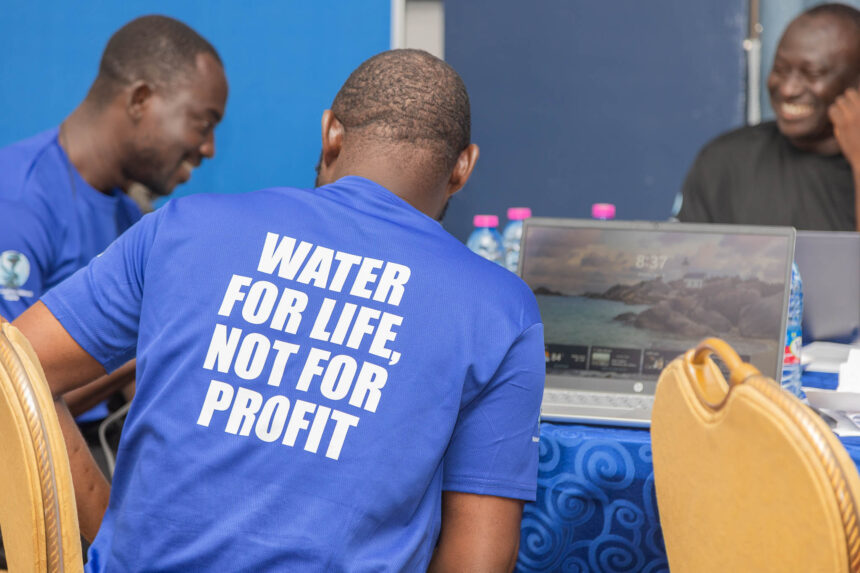
The Ghana Water Justice Network (GWJN) is raising alarm over growing inequalities in access to clean and affordable water, urging governments and stakeholders to take immediate, people-centered action to protect one of life’s most essential resources.
The Ghana Water Justice Network specifically calls for “immediate measures to make water affordable, particularly for low‑income and vulnerable households, including an end to water disconnections due to inability to pay. Such disconnections violate the human right to water and disproportionately affect women and children. Instead, we advocate for inclusive, humane service delivery that prioritises dignity and access.”
These were contained in a communiqué issued at the Official Launch of the Ghana Water Justice Network in Accra recently.
More Read
The Network also highlighted persistent funding gaps in water infrastructure, warning that without urgent financial commitment, millions will remain underserved. It is urging authorities to fully honor existing budget commitments and channel investments toward expanding water services in marginalized and hard-to-reach communities where access is still limited or entirely absent.
In addition, the Water Justice Network is pushing for gender equality to be embedded at every level of water governance. The group stresses the need for women to be actively included as leaders and decision-makers in water management, noting that women and girls often bear the heaviest burden of water scarcity. By elevating their voices and addressing gender-specific challenges, the Network believes more sustainable and equitable solutions can be achieved.
Please read the full Communiqué below…
COMMUNIQUÉ FROM THE LAUNCH OF THE GHANA WATER JUSTICE NETWORK
Theme: Water for People, Not for Profit
Date: 16th April 2026
Venue: Tomreik Hotel, Accra
PREAMBLE
The Ghana Water Justice Network (GWJN), established in April 2025 was officially launched on 16th April 2026 with a clear mandate to mobilize citizens and advocate sustainable long-term solutions to Ghana’s escalating water crisis.
For countless communities across Ghana, access to, affordable, and reliable water remains out of reach. In rural areas, peri‑urban settlements, and low‑income urban neighbourhoods, daily realities are marked by long queues, inconsistent supply, and rising costs. At the heart of this crisis are women and children, who bear the heaviest burden when water systems fail. This situation leaves far too many people behind and threatens to derail progress toward SDG 6 – universal and equitable access to safe and affordable water for all by 2030.
In response, we, Civil Society Organisations (CS0s), community leaders and residents, academia, and technical experts – have convened to launch the Ghana Water Justice Network and its campaign under the banner “Water for People, Not for Profit.” We reaffirm that water must be treated as a human right in Ghana, mindful of the deteriorating water situation, the impacts of climate change, and the persistent lack of sustained investment in the water sector.
WE NOTE WITH CONCERN THE FOLLOWING:
- Chronic underfunding of the water sector– Persistent gaps in national budget allocations for water and sanitation continue to undermine progress. In 2025, only about 50% of the Government’s capital expenditure allocations were actually disbursed, and an even lower percentage was utilised to deliver water infrastructure.
- High non‑revenue water losses– Significant volumes huge volume of treated water lost are before reaching consumers, denying many, especially low-income households access to water they have paid‑for while placing an added burden on public resources.
- Poor performance of small‑town water systems– The Community Water and Sanitation Agency (CWSA) is critically underfunded, limiting its ability to support underserved communities. This has resulted in inadequate maintenance, stalled development and restricted access to reliable water services in small towns
- Climate change and extractive activities– Climate change increases vulnerability, and together with the rising impact of illegal mining (galamsey) and other extractive activities, water bodies are increasingly populated and made unavailable for all people, especially rural communities who rely on these water bodies for subsistence.
- Multiple pressures on water access– Climate change, rapid urbanisation, population growth, intensification of small‑scale illegal mining, and socio‑economic disparities continue to frustrate efforts to make water accessible and affordable for all.
- Disproportionate burden on women and girls– The growing problem of water access forces women and girls to spend hours each day fetching water, limiting their opportunities for education, work, and public participation, thereby reinforcing gender inequality in Ghana.
- Commercialisation and commodification of water– Framing water primarily as an economic commodity risk undermining its recognition as a fundamental human right. With the increasing participation and prioritisation of private water operators, marginalised and vulnerable populations risk losing this right altogether.
- Health risks from reliance on boreholes– The growing dependence on borehole water in urban and peri-urban communities, coupled contamination from illegal mining (galamsey) and household pollution, poses serious public health risks to our populations.
WE THEREFORE DEMAND
The Government of Ghana must take urgent, bold action to address persistent inequalities in water access and affordability. The Ghana Water Justice Network specifically calls for:
- Affordable water for all
Immediate measures to make water affordable, particularly for low‑income and vulnerable households, including an end to water disconnections due to inability to pay. Such disconnections violate the human right to water and disproportionately affect women and children. Instead, we advocate for inclusive, humane service delivery that prioritises dignity and access.
- Honouring budget commitments for water infrastructure
Address significant investment shortfalls by fully honouring budget commitments, especially to extend services to underserved communities where access remains limited or non‑existent.
- Embedding gender equality in water governance
Actively include women as leaders and decision‑makers in water management at all levels, and address the disproportionate impacts of water scarcity on women and girls.
- Protecting water bodies
Establish and enforce Water Protection Zones and integrate catchment protection plans into spatial planning schemes.
- Combating galamsey
Seize assets and prosecute financiers and equipment owners; support community‑based river guards; and deploy satellite and drone surveillance systems to combat illegal mining.
- Regulate borehole development
Introduce a national borehole drilling permit system, create a central groundwater database, and promote shared community borehole systems.
- Improving water quality
Upgrade treatment plants with advanced filtration, mandate public disclosure of water quality compliance audits, and rehabilitate the distribution network.
- Supporting community management
Develop a new concept of rural water provision that moves beyond piecemeal interventions by empowering communities with DA‑led support, rather than abandoning them to manage systems alone.
- Enabling citizen participation
Create decentralised, predictable platforms for citizens to engage in water governance at all levels.
- Strengthening key institutions
Improve the performance of the Community Water and Sanitation Agency (CWSA) on rural targets, and enhance the effectiveness of the Water Resources Commission in regulating water use.
- Addressing reliance on sachet water
Recognise and respond to the high reliance on sachet water and the resulting environmental concerns as a symptom of systemic failure in piped water supply.
CONCLUSION
The Network reaffirms its commitment to working alongside communities, civil society actors, and policymakers to advance water justice across Ghana.
Issued by the Ghana Water Justice Network
Accra, 16th April 2026