

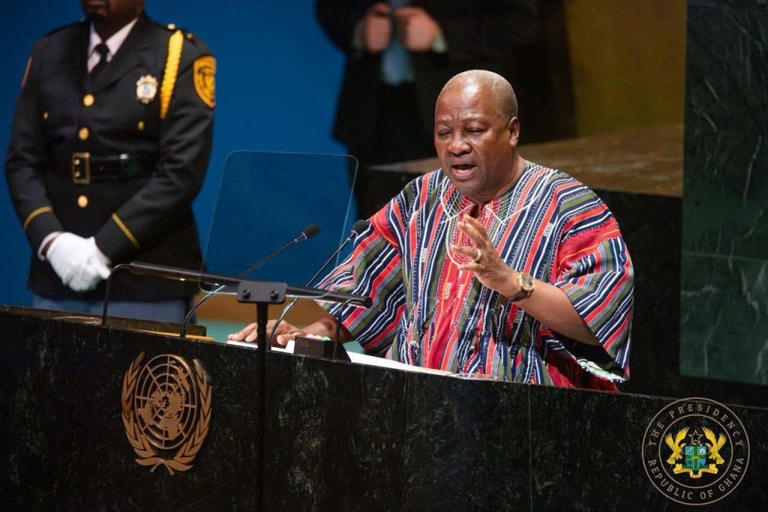
President John Dramani Mahama is set to table a landmark resolution at the United Nations General Assembly (UNGA) seeking to formally declare the transatlantic slave trade as the gravest crime against humanity.
The move has been described as a defining moment in the global pursuit of historical justice and reparatory action.
The Ministry of Foreign Affairs, in a statement, said Ghana, in its role as the African Union Champion on Reparations, was leading the initiative, in collaboration with the Caribbean Community (CARICOM) and people of African descent worldwide.
The draft resolution seeks to formally recognise the trafficking of enslaved Africans and racialised chattel enslavement as the gravest crime against humanity, citing its scale, duration, systemic brutality, and enduring global consequences.
The statement said the transatlantic slave trade constituted a definitive break in world history, the effects of which continued to shape socio-economic inequalities, development gaps, and structural imbalances across nations.
Once adopted, the resolution would mark the first comprehensive United Nations resolution on slavery and the transatlantic slave trade in the organisation’s 80-year history, underscoring its historic significance.
Analysts have explained that beyond symbolic recognition, the resolution is expected to provide a foundation for meaningful global engagement on reparatory justice, accountability, reconciliation, and healing.
They emphasised that naming the transatlantic slave trade as the “gravest crime against humanity” would mark the beginning of a broader reckoning with structural inequalities that continue to manifest in debt asymmetries, climate vulnerability, and global financial governance systems.
“Ghana will continue to pursue multilateral efforts on reparations within the framework of the African Union’s Decade of Action on Reparations and African Heritage (2026–2036) following the anticipated adoption of the resolution,” the statement said.
Ahead of tabling the resolution, a series of high-level commemorative and advocacy events have been scheduled in New York.
These include a solemn wreath-laying ceremony at the African Burial Ground on March 24, and a High-Level Event on Reparatory Justice at a United Nations conference venue later the same day.
The statement expressed appreciation to a broad coalition of institutions and experts who contributed to the drafting of the resolution, including the African Union Commission, the United Nations Educational, Scientific and Cultural Organization, CARICOM, and the Community of Latin American and Caribbean States.
It also acknowledged the contributions of Ghana’s diplomatic missions in Addis Ababa, Geneva, and New York, as well as legal experts, academics, civil society actors, and reparations advocates whose efforts helped to bring the initiative to fruition.
Key officials, including Mr Samuel Okudzeto Ablakwa, the Foreign Affairs Minister, Mr James Gyakye Quayson, the Deputy Minister, and Special Envoy for Reparations Ekwow Spio-Garbrah, are expected to engage the media and international stakeholders ahead of the General Assembly session.
The Ministry urged all United Nations Member States to support the resolution, describing the vote as a moral test of the international community’s commitment to justice and historical truth.
“Ghana urges all UN Member States to be counted on the right side of history and justice,” it said.
The Pan African Lawyers Union (PALU) noted that the resolution, if adopted, could significantly influence global legal and political discourse on reparations and historical accountability, particularly for countries and regions still grappling with the enduring legacy of slavery.
It said Ghana’s leadership in advancing the resolution reinforced its position as a key advocate for African interests on the global stage and reflected a broader shift towards confronting historical injustices through multilateral diplomacy.
The upcoming debate at the United Nations General Assembly is expected to attract widespread international attention, with many viewing it as a pivotal step towards acknowledging historical truths and fostering a more equitable global order.