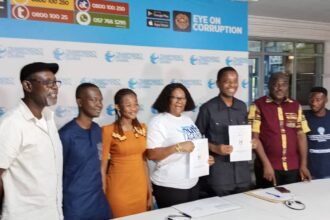



CoST Sekondi-Takoradi in collaboration with Transparency International Ghana have officially launched Ghana’s first-ever national Infrastructure Transparency Index (ITI), marking a significant step toward improving accountability and openness in the delivery of public infrastructure projects.
The results indicate significant progress for Ghana, achieving a score of 35.76, representing an almost 15% rise compared to the 2021 sub-national pilot.
According to CoST, the initiative builds on the success of an earlier pilot phase, which tested the framework across selected institutions and projects in Ghana.
More Read

ITI, developed in collaboration with key government agencies and transparency partners, is designed to assess how well public institutions disclose information related to infrastructure planning, procurement, budgeting, contracting, and implementation. By scoring institutions on these indicators, the index aims to strengthen public confidence, reduce corruption risks, and enhance value for money in public investments.
Speaking at the Launch of survey in Accra recently, the Minister of State for Public Sector Reforms, Lydia Lamisi Akanvariba, described the findings as a “turning point” for Ghana’s infrastructure governance.
According to her, the ITI provides the nation’s first comprehensive, national-level assessment of transparency and efficiency within the public infrastructure system.
To address the identified gaps, the Minister announced that a Value for Money Office will be created next year to enforce cost benchmarks, boost oversight, and enhance accountability in public infrastructure spending.
Madam Akanvariba emphasized that the value of the ITI lies in its ability to reduce corruption risks, prevent mismanagement, and strengthen public trust in government expenditure. “Accurate, timely, and comprehensive infrastructure data empowers oversight institutions, civil society, and citizens to demand better,” she noted. She encouraged stakeholders to use the report as a “working tool” to inform reforms, improve public spending, and enhance service delivery nationwide.
Samina Bhatia, Deputy Development Director at the British High Commission described the launch of Ghana’s first ITI as a major milestone that would strengthen the UK–Ghana development partnership and improve governance in the infrastructure sector.
According to her, the UK was pleased that infrastructure remains central to the Ghanaian government’s priorities, especially given the scale of investment anticipated under the “Big Push” agenda. “If significant public funds and public–private partnerships are going into infrastructure, we must ensure that every penny delivers real impact for Ghanaian citizens. The UK is a long-standing partner of Ghana, and we are keen to see the country make leaps and bounds in its progress. Infrastructure will be key to delivering that,” she said.
On her part, Mary Awelena Addah, Executive Director of Transparency International Ghana, thanked participants for their commitment to promoting transparency and accountability.
She explained the initiative is a collaborative effort between CoST Sekondi-Takoradi and the Transparency International-Ghana formerly Ghana Integrity Initiative (GII), aimed at fostering greater transparency, accountability, and participation in Ghana’s infrastructure sector.
The survey was commissioned in February 2025 and conducted by a three (3)-member independent Evaluation Team led by Matthew Kwaw Somiah (PhD), from the Faculty of Built and Natural Environment–Takoradi Technical University, Aziz Mahmoud (CoST Initiative) and Michael Boadi (Transparency International-Ghana). The survey ran for a period of six months, sampling 60 public infrastructure projects from 30 participating Procuring Entities (PEs).
The survey recommended, among other things, several key actions, including:
- Adopting a national lifecycle data publication framework and embedding its requirements in relevant laws.
- Developing a national manual to guide procuring entities in publishing data, detailing publication platforms, roles, and quality assurance processes.
- Integrating CoST’s data standard, creating a single national portal, and investing in digital tools and training.
- Promoting data publication audits and independent assurance reviews.
- Institutionalising civil society and community monitoring within the national framework.
By: Mohammed Suleman/ Publicagenda.news