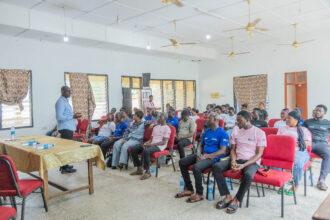

TAMA Foundation Universal, a Policy Think Tank based in Tamale, in the Northern Region of Ghana has trained over 300 Community members and Civil Society Organisations (CSOs) in natural resources governance across the five regions of the north.
The move was to equip them with the requisite knowledge to effectively engage with mining companies, regulatory agencies and other key stakeholders for their share of the benefits of mining and for reduced environmental impact.
So far, TAMA Foundation has trained about 50 CSOs leaders and 300 community members, including chiefs, women, youth leaders, Assembly Members, and other opinion leaders from 20 communities across the five regions of Northern Ghana
More Read
It has also begun processes to strengthen a Northern Ghana CSOs in Natural Resource Governance platform to serve as the avenue for collective efforts in demanding open, transparent, accountable, and responsible mining in the country.
Additionally, TAMA Foundation has collaborated with the Centre for Public Interest Law (CEPIL) and has begun training a cadre of paralegals who will provide paralegal support to community leaders for advocacy and effective engagements with duty bearers.
The paralegals will serve as receptors and gatherers of community-level intelligence on breaches of law and violations of the rights of citizens by mining companies and will reflect these at regional and national levels for a collective effort to redress.
Speaking recently at a forum on the role of the media in achieving transparent and accountable natural Resources Management in Northern Ghana, Dr. Chrys Anab, Co-Founder and Executive Director of TAMA Foundation explained that the Foundation was implementing a project dubbed the ‘Natural Resource Accountability In Northern Ghana (NaRAING), with support from FORD Foundation.
The Project according to Dr. Anab aims to ensure that the extraction and utilization of mineral resources is beneficial to mineral-rich communities and contribute to a balanced and sustainable development of society in general.
He indicated that the Foundation seeks to achieve this through building capacities of leaders of Civil Society Organizations and Community Leaders so that they can effectively engage with duty bearers to demand their share of the natural resources in their respective areas.
He pointed out that through a baseline survey, TAMA Foundation has gathered comprehensive data on mining and minerals resources in Northern Ghana, the number of companies licensed to conduct minerals exploration, recognizance, and mining activities in Northern Ghana, the laws, policies, and regulations on mining in Ghana, the various institutions, bodies, and agencies with the mandate to promote, regulate and protect mining activities in Ghana and the environmental, social and economic challenges of mining among others.
He said the survey findings were subsequently shared with stakeholders at a stakeholder forum on Natural Resources Management in Northern Ghana.
He stated that the survey showed an increasing social cost, child labour, human trafficking, sexual exploitation of women, tax evasion, and the use of illicit drugs.
It also found that 60 percent of impoverished people resided in the five regions of the north, arguing that the continued removal of economic trees like shea and dawadawa, as a result of mining, would further deprive communities of their livelihoods.
Dr Anab said the numerous unresolved chieftaincy and land disputes, coupled with unfair compensation for communities in the mining areas, were threats to peace and security.
He stated that mining has the potential to improve the social well-being of communities in the five regions in the north; adding that with the issuance of several licenses to extract mineral resources in those regions, the well-documented laws and regulations have to work to ensure future generations benefit from these resources.
Explaining the rationale of the Forum, Mr. Jonathan Adabre, Chief Operating Officer at TAMA Foundation Universal submitted that the media plays a critical role in helping citizens and civil society organizations to hold governments, companies, and decision-makers accountable.
Mr Adabre opined that in addition to keeping people informed, the media educates populations and citizens on social phenomena, values, the determination and construction of ideas and ways of thinking on political processes including environmental and natural resources.
The media is therefore critical in any efforts to champion transparency and accountability courses.
“The media is however challenged in several fronts. First, there are only a few journalists who are interested in natural resources governance and environmental issues.
“ Second, not many journalists have a good or specialist knowledge on matters of natural resources management and the linkages to the economic wellbeing of communities. Third editorial choices of media houses also limit how much space is created for natural resources governance education and information sharing.
“Fourth, there are also genuine difficulties in accessing information about natural resources governance. These challenges have resulted in an almost total absence of natural resources governance issues in the national press, superficial analysis of available information, loss of opportunities to influence and change practices in natural resources management, and to promote the environmental rights of the most vulnerable. He enumerated
He said the forum sought to address the aforementioned challenges to bring about transparent, accountable, and responsible exploitation of minerals resources in Northern Ghana.
By: Mohammed Suleman/ Publicagendagh.com