
Public Agenda NewsPaperPublic Agenda NewsPaper
  • General News
  • Politics
  • Business
  • Health
  • Development Agenda
  • World News
  • Features & Opinions
  • Election watch
  • Editorial
Font ResizerAa
Public Agenda NewsPaperPublic Agenda NewsPaper
Font ResizerAa
  • General News
  • Politics
  • Business
  • Health
  • Development Agenda
  • World News
  • Features & Opinions
  • Election watch
  • Editorial
Search
  • General News
  • Politics
  • Business
  • Health
  • Development Agenda
  • World News
  • Features & Opinions
  • Election watch
  • Editorial
Follow US
Breaking NewsGeneral News

Veep calls for more inclusive democracy in Africa

Latifa Carlos
Last updated: January 22, 2019 11:55 am
Latifa Carlos
Share
5 Min Read
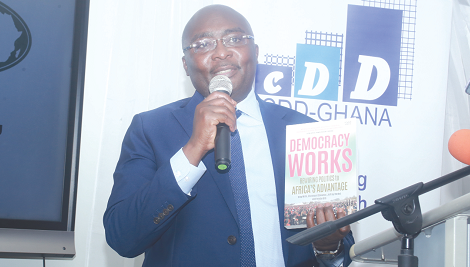
Veep Dr Mahamudu Bawumia
SHARE

If democracy will develop in Africa, we have to get more people included along the chain, the Vice-President, Dr Mahamudu Bawumia has said.

Explaining that democracy evolved from the Latin word ‘demos’, which meant self-rule, he said: “At the heart of democracy is inclusive government – people making decisions about their own well-being.”

Speaking as the special guest at the launch of a book titled: Democracy Works. Rewiring Politics to Africa’s Advantage, in Accra yesterday, Dr Bawumia stated that “at the end of the day, we need to make sure we include everybody in this development process.”

More Read

Chinese mining firm targets Ewoyaa lithium takeover in $210m deal
Ghana now 8th biggest economy in Africa
Mahama, appointees donate GH¢6.1m to Mahama Cares Fund
Mawuedem Solution Supports Communities in Volta Region with Relief Items
Callistus Mahama warns against early succession talks, urges discipline and focus on governance

“If you are developing a country or democratic institutions which are so important; to survive, inclusiveness must be there and that is why you have to educate the people. You have to make sure that the people have the right to information, so that they can participate effectively in the democratic process,” he urged.

The book

Praising the four authors of the 266-page book, who include a former President of Nigeria, Gen. Olusegun Obasanjo, the Vice-President said the book was very rich and cited a lot of practical lessons on how Africa could initiate development policy prescriptions to maximise the benefits from democracy.

The other authors are the President of the American Jewish University, Mr Jeffrey Herbst; a former Finance Minister of Zimbabwe, Mr Tendai Biti, and the Head of the Brenthurst Foundation, Dr Greg Mills.

Dr Bawumia said the book also challenged the orthodoxy that “democracy alone has what it takes to enhance economic progress” and argued that “democracy is not destined, neither is it cast in stone.”

He said from his assessment of the book, there was also “the sense that if democracy has to be inclusive, then to sustain democracy in Africa, we have to make sure that we try to get people more included as we proceed with the democratic spirit.

“Anytime people feel excluded, there is a threat to the survival of democracy and this is why we need to pay attention to education, health, agriculture, financial inclusion, giving identity to the right to information, to macroeconomic stability and to jobs. These are the sort of things that will produce more inclusive democratic development,” he posited.

Democratic dividends

Gen. Obasanjo, for his part, said “there must always be dividends of democracy for all citizens of a country, irrespective of position, affiliation, tribe or religion.”

Saying he appreciated the American definition of democracy as government of the people, by the people and for the people, he noted that although democracy was the first recognised system of governance for most African countries, there were no two countries where the democratic system was the same.

He said the premise of the book was that the economic challenges facing Africa were massive and needed an effective governance system to deal with them.

Best choice

Dr Mills said the book demanded an end to business as usual in terms of development decisions and politics, among others, which was why it was satisfying that Ghana had embarked on a journey beyond aid.

He explained that Ghana was chosen for the launch of the book because it had always been seen as the standard bearer for Africa, adding that the book illustrated the complexity of the democratic process and the making of different choices.

Dr Mills said empirical evidence showed that democracy was the best choice for Africa because it was better equipped to address the sort of challenges confronting the continent today “because it allows for peaceful change in leadership, the production of new ideas, checks and balances in the system, civil society and the media, respects human rights and values and reduces vulnerability and economic volatility”.

He, however, cautioned that democracy did not guarantee success but made it more likely to achieve, adding that an Afro Barometer poll report indicated that about two-thirds of Africans preferred democracy to other forms of governance.

Source: Graphic.com.gh
Share This Article
Facebook Whatsapp Whatsapp Email Copy Link Print

Latest News

Ghana rises to 39th in Press Freedom Index amid structural challenges
May 6, 2026
Water Justice Network Pushes for Affordable, Inclusive Water Systems
May 4, 2026
Overall cost pressures in construction are easing – Government Statistician
April 30, 2026
Ghana can’t industrialise without power, water – Nii Moi Thompson
April 30, 2026
Ghana walks away from US health agreement over sensitive data concerns
April 28, 2026
Mali at risk of splintering after jihadi and separatist attacks
April 28, 2026
Create ‘water markets’ to fix Ghana’s supply challenges — Former GWL MD
April 28, 2026

You Might Also Like

Breaking NewsDevelopment Agendatop stories

National Water Justice Campaign Launched to Tackle Inequality in Access

April 21, 2026
Breaking NewsGeneral Newstop stories

ISODEC Urges Collective Action to Secure Safe Water for All Ghanaians

April 21, 2026
Breaking Newstop storiesWorld News

Man kills seven of his children, and an eighth child, in Louisiana mass shooting

April 20, 2026
Breaking NewsPan Africa Politicstop stories

A decade of African politics: democratic gains and new pressures

April 20, 2026

About Us

Public Agenda is fou­nded and owned by Pu­blic Agenda Communic­ations.

Public Agenda was founded as a public interest Me­dia entity. Its Visi­on is to contribute to building a well-i­nformed society where accurate informati­on dissemination is the cornerstone of a democratic, just and equitable society.

Its mission is to inform, guide and bui­ld responsible citiz­enship and accountab­le decision making and strive for excell­ence in the media in­dustry. Public Agenda Communications is managed by a Board of Directors.

Welcome Back!

Sign in to your account

Username or Email Address
Password

Lost your password?