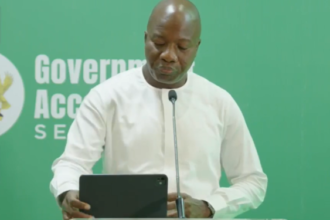
National Petroleum Authority (NPA) Chief Executive Officer Godwin Edudzi Tamakloe has offered a calming perspective amidst escalating Middle East tensions, asserting that Iran would face overwhelming international opposition if it attempted to close the vital Strait of Hormuz unilaterally.
Mr Tamakloe emphasised the significant geopolitical and economic interests at stake, suggesting a full-scale closure is highly improbable.
Iran vowed a decisive response, with its parliament backing a measure to close the critical shipping route in response to U.S. airstrikes on nuclear sites in Iran over the weekend.
More Read

The Strait of Hormuz, located between the Persian Gulf and the Gulf of Oman, is particularly important because it provides the only sea passage from the Persian Gulf to the open ocean for the supply of huge volumes of oil produced in that region to several parts of the world.
The Strait of Hormuz, a critical maritime chokepoint, is geographically bordered by Iran on one side and Oman on the other.
Nearly 20 million barrels of oil, about one-fifth of daily global production, flow through the strait every day, according to the US Energy Information Administration (EIA).
For Mr Tamakloe, there are too many interests at stake, and he believes Iran cannot solely decide to block the passage.
“Notice that Oman is on one side, and Iran is on the other side. So Oman will not permit it because it is income to those countries because the ships and others pay for the use of that end,” he explained to TV3 on Monday, June 23.
This financial incentive for passage, derived from tolls and services, aligns Oman’s interests with global trade flow.
Oman’s foreign policy is generally characterised by neutrality and mediation, further reducing the likelihood of its cooperation in any blockade.
Beyond regional players, Mr Tamakloe pointed to the immense global stakes, particularly for major economic powers.
“And so what is going to happen is that Oman is not going to allow for a unilateral decision to just close that end completely again, like I pointed out, the Chinese had a lot of interest in terms of movements of goods and other services, or, eh, movements of goods more or less to the Chinese and other South Asian countries. And so they also have an interest in ensuring that the passage is not closed,” he said during a discussion on TV3 on Monday, June 23.
China, as the world’s largest crude oil importer, relies heavily on this route, with roughly one-third of its oil imports originating from Gulf producers and 80% of flows through Hormuz destined for Asian markets.
“More importantly, the Europeans as well, because then beyond crude it’s easier for you to move liquefied natural gas and others into Europe to power households and others around our corridor, so completely; having it closed will be quite uninteresting,” Mr Tamakloe added.
Following sanctions on Russian energy, Europe significantly increased its reliance on Middle Eastern diesel, with approximately 850,000 barrels per day now transiting through the Strait of Hormuz to the continent. This shift makes Europe highly vulnerable to any disruption.
Mr Tamakloe also revealed that he closely monitored an emergency UN Security Council meeting held on Saturday evening.
“On Saturday evening, there was an emergency UN Security Council meeting; that’s right, I observed it because my mind is on these matters in recent times. From the US security council meeting, it does appear that there’s a greater call for diplomatic intervention than a full-blown, full-scale war within the region.”
He expressed optimism that regional actors are leaning towards de-escalation rather than military confrontation.
“Thankfully, Oman, Kuwait, Saudi Arabia and co., within the region appear to have adopted a strategy for less military intervention.”
The NPA boss cautioned that the real danger to global oil supplies would arise if the entire Gulf region were to be engulfed in war, thereby affecting oil production itself.
“The danger is if the whole Gulf region is engulfed in war, then production itself will be affected. Now, if production itself is affected, that is when the problem will become much more serious.”
Despite the underlying risks, Mr Tamakloe remains confident that diplomacy will prevail.
“So at this point, all we can pray for is the key leaders within the region to come together to de-escalate the current conflict and more or less find a more diplomatic solution to it. And I’m very confident that this one, there’s a higher possibility of it coming closer or down than what we are seeing, say, like Russia, Ukraine.”
Ghana, as a net oil importer, is particularly sensitive to global oil price fluctuations.
However, Mr Tamakloe previously assured the nation that Ghana maintains robust fuel reserves, with over 200 million litres of petrol and 150 million litres of diesel, sufficient to last beyond two months and mitigate immediate supply disruptions.
Source: Myjoyonline.