

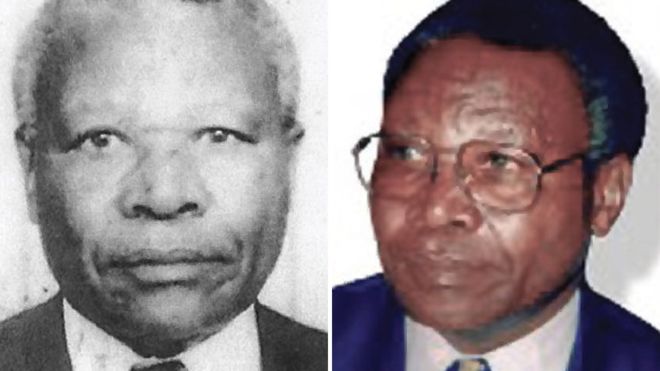
Félicien Kabuga, one of the most wanted suspects of the Rwandan genocide, has been arrested near Paris, the French justice ministry has announced.
Mr Kabuga was detained in a dawn raid in Asnières-sur-Seine, where he had been living under a false identity.
The International Criminal Tribunal for Rwanda has charged the 84-year-old with genocide and crimes against humanity.
More Read
He is alleged to have been the main financier of the ethnic Hutu extremists who slaughtered 800,000 people in 1994.
They were targeting members of the minority Tutsi community, as well as their political opponents.
The United States had offered a $5m (£4.1m) reward for information leading to Mr Kabuga’s arrest.
Who is Félicien Kabuga?
The businessman from the Hutu ethnic group is accused of being one of the main financiers of the Rwandan genocide, paying for the militias that carried out the massacres.
He also founded and funded the notorious Radio Télévision Libre des Mille Collines (RTLM), a Rwandan broadcaster that actively encouraged people to search out and kill anyone who was from the Tutsi ethnic group.
The fact that he has been found on the outskirts of Paris living under a false name is surprising.
For many years, Félicien Kabuga was thought to be living in Kenya, where powerful politicians were accused of thwarting efforts to get him arrested.
More than a quarter of a century after the genocide, he will go on trial at an international court.
How was he found?
The French public prosecutor’s office and the police said Mr Kabuga had been living under a false identity in a flat with the complicity of his children.
He was arrested at 05:30 (03:30 GMT) on Saturday in what the chief prosecutor of the International Residual Mechanism for Criminal Tribunals (IRMCT) at The Hague – which is handling outstanding war crimes cases for Rwanda and the former Yugoslavia – called “a sophisticated, co-ordinated operation with simultaneous searches across a number of locations”.
“The arrest of Félicien Kabuga today is a reminder that those responsible for genocide can be brought to account, even 26 years after their crimes,” Serge Brammertz said in a statement.
“For international justice, Kabuga’s arrest demonstrates that we can succeed when we have the international community’s support,” he added.
Mr Brammertz expressed his appreciation to France, but said essential contributions had also been made by Rwanda, Belgium, the UK, Germany, the Netherlands, Austria, Luxembourg, Switzerland, the US, Europol and Interpol.
Following completion of appropriate procedures under French law, Mr Kabuga is expected to be transferred to the custody of the IRMCT, where he will stand trial.
Mr Kabuga was indicted in 1997 on seven counts of genocide, complicity in genocide, direct and public incitement to commit genocide, attempt to commit genocide, conspiracy to commit genocide, persecution and extermination.
The leader of an association of genocide widows in Rwanda, Valerie Mukabayire, said every survivor was happy that he had been arrested.
There are now two people earmarked for trial by the International Criminal Tribunal for Rwanda who remain at large – Protais Mpiranya and Augustin Bizimana.
How did the genocide unfold?
On 6 April 1994, a plane carrying then-President Juvenal Habyarimana – a Hutu – was shot down, killing all on board. Hutu extremists blamed the Tutsi rebel group, the Rwandan Patriotic Front (RPF) – an accusation it denied.
In a well-organised campaign of slaughter, militias were given hit lists of Tutsi victims. Many were killed with machetes in acts of appalling brutality.
One of the militias was the ruling party’s youth wing, the Interahamwe, which set up road blocks to find Tutsis, incited hatred via radio broadcasts and carried out house-to-house searches.
Little was done internationally to stop the killings. The UN had forces in Rwanda but the mission was not given a mandate to act, and so most peacekeepers pulled out.
The RPF, backed by Uganda, started gaining ground and marched on Kigali. Some two million Hutus fled, mainly to the Democratic Republic of Congo.
The RPF was accused of killing thousands of Hutus as it took power, although it denied that.
Dozens of Hutus were convicted for their role in the killings by the International Criminal Tribunal for Rwanda, and hundreds of thousands more faced trial in community courts in Rwanda.
Source: BBC