
Public Agenda NewsPaperPublic Agenda NewsPaper
  • General News
  • Politics
  • Business
  • Health
  • Development Agenda
  • World News
  • Features & Opinions
  • Election watch
  • Editorial
Font ResizerAa
Public Agenda NewsPaperPublic Agenda NewsPaper
Font ResizerAa
  • General News
  • Politics
  • Business
  • Health
  • Development Agenda
  • World News
  • Features & Opinions
  • Election watch
  • Editorial
Search
  • General News
  • Politics
  • Business
  • Health
  • Development Agenda
  • World News
  • Features & Opinions
  • Election watch
  • Editorial
Follow US
Development Agendatop stories

Rural-Urban Migration has dual effects on migrants – Study reveals

benito
Last updated: July 18, 2017 2:15 am
benito
Share
3 Min Read
Rural-Urban Migration has dual effects on migrants – Study reveals
SHARE

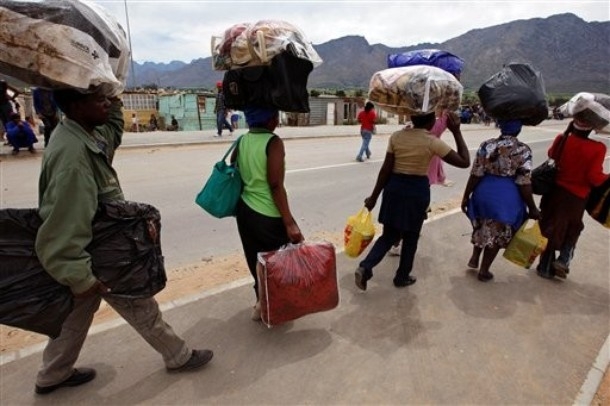
A research has indicated that rural-urban migration has both positive and negative effects on the migrants in terms of marriage, child birth and education.

According to the research, migrants gain the respect of their families and friends because of financial transfers and investments in their villages.

The research conducted by the Migrating out of Poverty, (MOOP) Research Programme Consortium, Centre for Migration Studies, University of Ghana, Legon, said travelling to the cities is enough to gain public recognition and respect in the originating communities.

More Read

Ghana, EU strengthen partnership to address Sahel security challenges
President Mahama links poor WASSCE results to neglect in basic education
Ghana needs strategic plan for critical minerals- Yao Graham
Congo mineral expert urges Ghana to adopt integrated Lithium strategy
Forestry Commission arrests 11 Chinese and 10 Ghanaians in an Anti – “Galamsey” Swoop at Yakombo Forest Reserve

The research, “Migration into Cities in Ghana: An Analysis of Counterfactuals” was conducted in five migrant sending regions of Ghana, namely, Brong-Ahafo; Upper West; Upper East, Northern and Volta Regions.

It examined how migrants would have fared in the absence of migration and the data used was based on semi-structured interviews conducted with 68 recent rural-urban in-migrants in Accra and in-depth interviews with 10 of these migrants.

“Nonetheless, migration to the cities can lead to delayed marriages and childbirth. Migrants suffer emotionally and psychologically as they miss their families back home.

“Migrants suffer a loss of respect in the cities but, to the contrary, are highly revered in their originating communities,” it added.

It said a total of 61 migrants interviewed on effects of migration on relationship with spouse, 59 per cent said it has no effect on them, 21.3 per cent said it has negative effect on their marriages while 19.7 per cent said migration has positively enhanced their marriage.

The study also revealed that in most cases, migration has positively affected the education of migrant’s household members.

“About 62 per cent of respondents believed that migration enhanced the level of education of their children and or household members.

“In a minority of cases migration may negatively affect education of the migrants themselves but at the same time migration may positively affect education of their household members left behind,” it said.

The research therefore called for more research on the relationship between internal migration and social benefits/losses to document not only economic differences but also social benefits for a comprehensive understanding of the relationship between migration and poverty reduction.

It also suggested the need to produce quality statistics and better information on the potential gains and losses to would-be migrants.

That, the research said, would play a key role in preventing a mismatch between would-be migrants’ perception of migration and migration’s actual realities.

“Additionally, potential migrants could receive education on how to manage communication and financial transfers with the spouse left behind at origin to maintain quality of marriage. GNA


Share This Article
Facebook Whatsapp Whatsapp Email Copy Link Print

Latest News

Ghana’s inflation drops to 6.3% in November, lowest since 2021 rebasing
December 3, 2025
Ghana Launches First National Infrastructure Transparency Index
December 2, 2025
Presidency forwards petitions for removal of EC Chair, Deputies & Special Prosecutor to Chief Justice
December 2, 2025
Reflecting on the UN Tax Negotiations: A New Chapter for Ghana and Africa in Global Tax Justice
December 2, 2025
Ghana can unlock major domestic resources through Structured Philanthropy
November 28, 2025
Global funding cuts devastating HIV prevention programmes says UNAIDS
November 27, 2025
Majority: 10% Lithium royalty deal violated mining law
November 25, 2025

You Might Also Like

Breaking NewsGeneral Newstop stories

Supreme Court directs Wesley Girls SHS to respond to Muslim Rights allegations

November 25, 2025
Breaking NewsDevelopment AgendaGeneral Newstop stories

Mahama extends IGP Yohuno’s tenure by two years

November 25, 2025
Breaking NewsGeneral Newstop stories

Forestry Commission Debunks Interdiction Claims, Clarifies GHS623,000 Revenue Issue

November 20, 2025
Breaking NewsBusinesstop stories

PIAC elects Richard Ellimah as new chair

November 18, 2025

About Us

Public Agenda is fou­nded and owned by Pu­blic Agenda Communic­ations.

Public Agenda was founded as a public interest Me­dia entity. Its Visi­on is to contribute to building a well-i­nformed society where accurate informati­on dissemination is the cornerstone of a democratic, just and equitable society.

Its mission is to inform, guide and bui­ld responsible citiz­enship and accountab­le decision making and strive for excell­ence in the media in­dustry. Public Agenda Communications is managed by a Board of Directors.

Welcome Back!

Sign in to your account

Username or Email Address
Password

Lost your password?