
Public Agenda NewsPaperPublic Agenda NewsPaper
  • General News
  • Politics
  • Business
  • Health
  • Development Agenda
  • World News
  • Features & Opinions
  • Election watch
  • Editorial
Font ResizerAa
Public Agenda NewsPaperPublic Agenda NewsPaper
Font ResizerAa
  • General News
  • Politics
  • Business
  • Health
  • Development Agenda
  • World News
  • Features & Opinions
  • Election watch
  • Editorial
Search
  • General News
  • Politics
  • Business
  • Health
  • Development Agenda
  • World News
  • Features & Opinions
  • Election watch
  • Editorial
Follow US
Breaking NewsGeneral Newstop stories

Cross-border action required to curb female genital mutilation

Suleman
Last updated: February 8, 2024 11:46 am
Suleman
Share
3 Min Read
SHARE

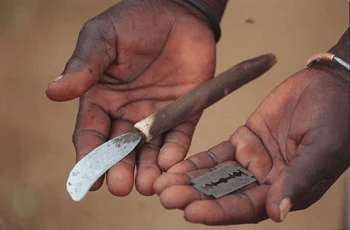
Despite it being outlawed in 1994, Female Genital Mutilation (FGM) is still practiced in Ghana and is prevalent among 5 in every 100 girls.

Kuurima Ibrahim is a victim and survivor of Female Genital Mutilation.

She was cut when she was a one-week-old baby but didn’t know until senior high school.

More Read
Ghana reaffirms commitment to women’s economic empowerment at Addis Ababa dialogue
Seven missing fishermen located in Togo’s waters – Western Regional Minister
Deploy more military, police to fight galamsey – Christian Council
Petrol, diesel prices set to fall from Oct. 16 as LPG faces 18.5% hike
IMF raises Ghana’s 2026 growth forecast to 5.7%, exceeding government’s target

“We had students from the South, and we saw that theirs was different from ours, so I asked one of my teachers, and she told me I had undergone FGM,” Kuurima revealed.

She said, the violation not only stripped her of dignity but also resulted in numerous health complications.

“I have had to undergo CS three times, because of the birth complications I will suffer due to the cutting”, she said.

She has gained the courage to disclose the heinous act.

“You can repair the clitoris, and now we want govt to help us with cost of the reconstructive surgery, and also take up the campaign again,” she pleaded.

The United Nations Population Fund (UNFPA) defines Female Genital Mutilation (FGM) as “a practice that involves altering or injuring the female genitalia for non-medical reasons.”

While the overall national prevalence rate of FGM in Ghana is 4%, studies have shown that the prevalence in the Upper East Region is 38%, with Bawku municipality recording the highest at 82%, in 2018.

Country Director of the UNFPA, Dr. Wilfred Ochan, laments the scarce resources in fighting the menace.

“We need to get those entrenched in the practice to denounce it and get them to understand that there’s no cultural value in it. Govt should provide resources to intensify the fight,” he added.

He has called for a cross-border action plan to tackle the matter.

According to him, “Probably, the practitioners take the women and girls to other countries to perform the rite on them, because it’s prohibited in Ghana, and then bring them back, so we need to increase collaboration at the borders and see how we can come up with a cross border action plan.”

An estimated 200 million women and girls worldwide have undergone FGM, and February 6 is designated as global day for zero tolerance against female genital mutilation every year.

Source: 3news

Share This Article
Facebook Whatsapp Whatsapp Email Copy Link Print

Recent Posts

  • Ghana reaffirms commitment to women’s economic empowerment at Addis Ababa dialogue
  • Seven missing fishermen located in Togo’s waters – Western Regional Minister
  • Deploy more military, police to fight galamsey – Christian Council
  • Petrol, diesel prices set to fall from Oct. 16 as LPG faces 18.5% hike
  • IMF raises Ghana’s 2026 growth forecast to 5.7%, exceeding government’s target
  • CSOs, Fisheries Stakeholders Demand Revocation of Offshore Gold Licences
  • ActionAid ‘deeply alarmed’ by US government’s sanctions on the International Criminal Court
  • Mental Health Alliance Calls for 5% Employment Quota for Persons with Disabilities
  • A call for GoldBod-Type Financing Model for NAFCO
  • ISODEC Forum Calls for New Thinking on Ghana’s Economic Management
  • 24-hour economy markets’ renamed District Economy Markets – Ayariga
  • Ghana’s tuna industry collapsing under high operating costs – NAFAG
  • Cocaine seizures: Parliament reconvenes today for emergency sitting
  • MEHSOG demands update on alleged sexual assault of 14-year-old Bolga Girls student
  • Food prices in Ghana remain largely stable – AGRA report
  • Mahama convenes high-level meeting to strengthen border security and narcotics control
  • Minority demands action on unemployment among graduates with disabilities
  • Mental Health Organisations Seek Improved Social Protection for Vulnerable Women and Girls

You Might Also Like

Breaking NewsGeneral Newstop stories

CSOs, Fisheries Stakeholders Demand Revocation of Offshore Gold Licences

October 13, 2026
Breaking Newstop storiesWorld News

ActionAid ‘deeply alarmed’ by US government’s sanctions on the International Criminal Court

October 10, 2026
Breaking NewsHealthtop stories

Mental Health Alliance Calls for 5% Employment Quota for Persons with Disabilities

October 10, 2026
Breaking NewsBusinesstop stories

A call for GoldBod-Type Financing Model for NAFCO

October 8, 2026

About Us

Public Agenda is fou­nded and owned by Pu­blic Agenda Communic­ations.

Public Agenda was founded as a public interest Me­dia entity. Its Visi­on is to contribute to building a well-i­nformed society where accurate informati­on dissemination is the cornerstone of a democratic, just and equitable society.

Its mission is to inform, guide and bui­ld responsible citiz­enship and accountab­le decision making and strive for excell­ence in the media in­dustry. Public Agenda Communications is managed by a Board of Directors.

  • Contact us
  • Advertise with us
Welcome Back!

Sign in to your account

Username or Email Address
Password

Lost your password?