

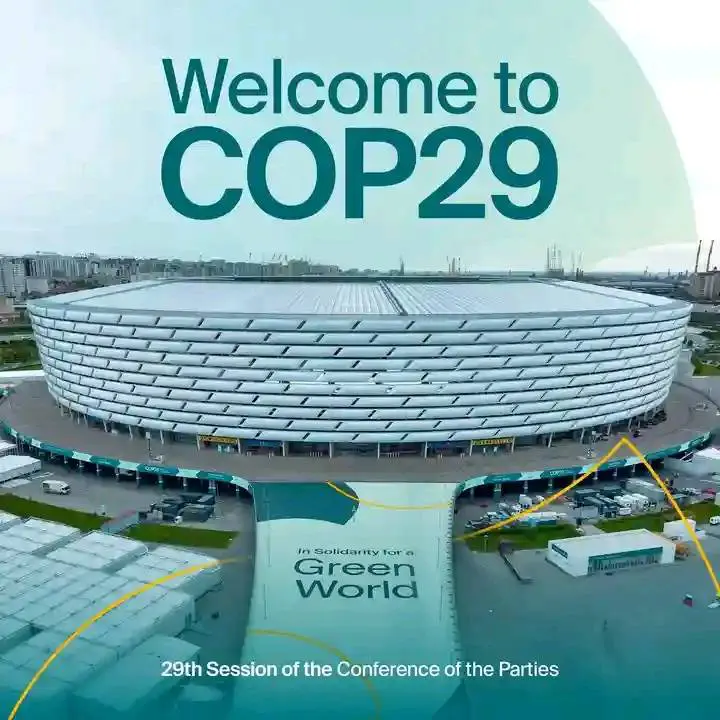
Another round of climate change talks is here again in Baku, Azerbaijan, to address the rampant climate crisis.
“This crisis is affecting every single individual in the world in one way or another,” acknowledged Simon Stiell, Executive Secretary of UN Climate Change at the opening of COP29.
The 29th Conference of Parties (COP29) in the climate change negotiations has been dubbed the “Climate Finance COP” as a new climate finance target is sought to help developing countries overcome their vulnerabilities to the climate crisis.
More Read
“We must agree a new global climate finance goal,” said Simon. “If at least two-thirds of the world’s nations cannot afford to cut emissions quickly, then every nation pays a brutal price”.
Civil society organizations like 350.org are making it clear that fair, equitable finance is the bridge to climate action.
At COP29, they are demanding countries pledge to an ambitious climate finance goal, or New Collective Quantified Goal (NCQG) of at least $1 trillion, which must be in the form of grants and based on the financial, climate and social needs of the Global South.
Countries are also to agree to put forward climate goals – Nationally Determined Contributions (NDCs) – in line with fairly tripling renewable energy capacity and phasing out fossil fuels by 2030.
According to Simon Stiell, if nations can’t build resilience into supply chains, the entire global economy will be brought to its knees, emphasizing that “no country is immune”.
“Let’s dispense with any idea that climate finance is charity. An ambitious new climate finance goal is entirely in the self-interest of every nation, including the largest and wealthiest,” he noted.
There is also an expected acceleration of the shift to clean energy and climate resilience.
African CSOs posture
African Civil Society leaders are urging a focus on the New Collective Quantified Goal (NCQG) to achieve substantial and equitable financing solutions for climate action.
Under the Pan African Climate Justice Alliance (PACJA), the CSOs highlighted the urgent need for global commitments on adaptation, just transition, critical minerals, mitigation, and transparency in carbon markets.
“We call for the establishment of an ambitious sub-goal for adaptation finance that prioritizes public, grant-based support for developing countries, responding to needs outlined in Nationally Determined Contributions (NDCs), National Adaptation Plans (NAPs), and other national plans,” reads the statement.
Dr. Mithika Mwenda, Executive Director of PACJA, emphasized that COP29’s NCQG negotiations must address Africa’s pressing adaptation needs as well as Loss and Damage.
“If the NCQG fails to consider the adaptation needs of vulnerable populations, COP29 will not meet the threshold to be a genuine Climate Finance COP,” he stated.
The adaptation finance gap for developing nations remains significant – currently 10 to 18 times greater than actual international financial flows, which amount to approximately USD 20 billion per year. This falls well short of the estimated USD 166-366 billion needed annually to meet adaptation demands.
Prof. Seth Osafo, Senior Legal Advisor at the African Group of Negotiators (AGN) said it’s had to talk about the NCQG leaving behind considerations of other dimensions.
“We must reimagine the quality of finance, moving beyond debt-based approaches—currently at 72%—to include concessional loans, grants, and innovative financing mechanisms. Additionally, funding must be accessible, predictable, and structured to prioritize essential sub-goals, including Loss and Damage, while aligning on whether a single-layer or multi-layer approach best serves the mobilization and provision of funds,” Prof Osafo stated.
As the COP29 discussions begin, African Civil Society wants world leaders to prioritize issues that meet the urgent needs of African communities on the frontlines of climate change.