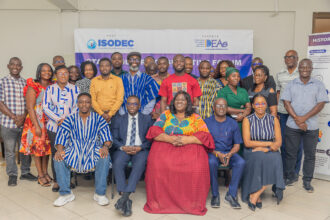



Abantu for Development, a women’s right advocacy organization has put together a dialogue session for state institutions intended to increase the effectiveness of women’s actions for inclusive, credible and a peaceful general elections in December 2020.
The Institutions include, the Electoral Commission (EC), National Commission for Civic Education (NCCE) and the Ministry of Gender, Children and Social Protection.
Held in Accra on Wednesday, the event formed part of a project being executed by Abantu for Development with support from STAR-Ghana. Titled, “Strengthening Women’s Capacities for Effective Participation in Election 2020, the Project, focuses on empowering marginalized groups specifically women and persons with disability to effectively participate, campaign vote and help secure wins for those women standing in the 2020 elections.
More Read
It also seeks to ensure that a higher level of national attention is directed towards addressing the perennial low representation of marginalized groups in policy making spaces in this year’s election and beyond.
Ghana is counted as a success story with an enviable background in conducting democratic elections. Nonetheless in all these elections, Ghana has failed to achieve an environment for equal political engagement between women and men for genuine consensus building.
Speaking at the event, Dr Comfort Asare, Director of Gender at the Ministry of Gender Children and Social Protection. indicated that it is the wish of the Ministry that more women are elected to Parliament.
According to her, the Ministry is doing a lot in trying to psych people up to understand that women are good leaders, thus, there is the need to vote for them whenever they put themselves up to be elected for. “We want to see more women in Parliament.
She held the view that “men have failed us” adding, “men are elected, they come to power and they don’t make any impact.”
On the Affirmative Action Bill Dr Asare informed participants that “the Bill is ready and very soon it will be seen in parliament.”The President, she said, is pushing for the Affirmative Action Bill to be passed.
She told participants that in as much as the ministry has some challenges, it is not relaxed at all, and only that it is seeking for more resources to make its work visible.
Mrs Abigail Nutakor, Head of Gender, Youth and Disability at the Electoral Commission indicated that the EC is concerned about women’s participation at all levels including polling agents, staff among others.
According to her, the EC engages a lot of stakeholders in the electoral process as well as build their capacities to let them know the electoral laws.
Mrs Nutakor said, “we engage women groups and advise them to vote for women…; but we are careful not to be seen as been bias.”
She said every aspect of what is done at the Commission is gender sensitive and there has always been a special dispensation for women.
She urged stakeholders to collaborate with the EC by bringing more researched information on board for discussion.
The representative of the NCCE, noted that the Institution’s primary function is to educate the citizenry on the Constitution, “so we tell women they must participate in the voting process and particularly to put themselves up to be voted for.”
Mrs Joana Apare of Gender Planning Consult Ltd, who spoke on theme, ‘Increased advocacy and Support for Women Candidates and conflict- free General Elections, maintained that Ghana’s situation relative to women’s representation in parliament looks bleak in a world where other countries are advancing in promoting women’s participation in politics.
She indicated that with a 275- member Parliament, women accounts for only 38, less than 14 percent and far below the UN recommended threshold of 30 percent, a situation she described as not encouraging.
On her part, Mrs Hamida Harrison, convener of the Women’s Manifesto Coalition (WMC) said gender equality and women’s empowerment are not only human right; they are also imperative for achieving inclusive, equitable and sustainable development .
According to her women’s political participation is central to these goals, and the state and political parties are among the most important institutions for promoting and nurturing such participation.
The issue of parity in women’s participation in policy making structures should be a core concern to the desire to strengthen democratic culture and help build ideas of good governance.
She advised that more robust initiatives should be undertaken in terms of facilitating equal opportunities to participation, inclusion of the marginalized especially women in power sharing and control of national and local initiatives.
Source: Publicagendagh.com