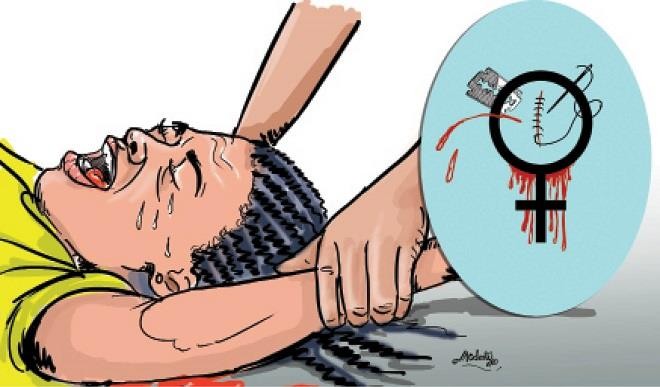
In spite of existing legislation criminalizing the practice of Female Genital Mutilation (FGM), Children and adolescent still suffer from the harmful cultural practice.
The Parliament of Ghana strengthened the law against FGM by increasing maximum penalty from five (5) to 10 years imprisonment for persons involved in the practice of FGM.
Article 26 (2) of Ghana’s constitution prohibits “customary practices which dehumanize or are injurious to the physical and mental well-being of a person”.
More Read

However, according to a report released recently by Perfector of Sentiments (POS) Foundation, during the 3rd Cycle Universal Periodic Review, over 126 females including infants, adolescents, and teenagers who were recent victims of FGM have been found in almost all the villages and communities in the North Nkwanta District Hospital and other health facilities in the district by NGOs such as Women in the Lord’s Vineyard (WITLOV).
In addition, more than 200 new victims of FGMs have been found in the Bawku municipality and its environs by BEWDA NGO and over 50 victims from WA municipality and its environs by PAWLA NGO. All these discoveries were made between 2013 and 2017, more than 20 years after FGM was criminalized by the State.
The incidence of FGM in these catchment areas has increased from about two to three cases per week to about four to five cases a week. This clearly indicates that women and children are abused daily through the practice of FGM.
Female genital mutilation (FGM) comprises all procedures that involve partial or total removal of the external female genitalia, or other injury to the female genital organs for non-medical reasons.
This practice is mostly carried out by traditional circumcisers, who often play other central roles in communities, such as attending childbirths and are mostly nonprofessional health workers.
Article 26 (2) of Ghana’s constitution prohibits “customary practices which dehumanize or are injurious to the physical and mental well-being of a person”.
Although these steps and prosecutions by Ghana have helped, pockets of FGM practice are still ongoing in several parts of Ghana in the Volta Region and Upper East Region.
Even though the law had been passed but the legislation has not provided any mechanisms for monitoring and protecting vulnerable children and women against the practice of FGM which has led to impunity and cross border activities that encourage the practitioners to move from one end of Ghana to neighbouring countries to avoid prosecution.
It is, therefore possible that many of such cases occur at homes, healing camps and elsewhere which are not reported or found at the health facilities.
The report further added that, some mothers have begun circumcising their children as early as eight days after birth or during child naming. These children grow up with complicated health issues mostly affecting their reproductive health system and some of the victims end up as school drop outs due to stigmatization.
According to the report, few donors, both local and international are interested in FGM issues. Unlike malaria, TB, cholera and HIV/AIDS issues where support is provided. Government and politicians have gone quiet on the issue of FGM and little or no provision is made in the annual budgetary allocation from the annual Government subvention.
Lack of medical examination on victims of FGM and appropriate recommendation for relevant treatment still remains absent from the government’s health for all agenda over the years. Healthcare in Ghana is not supposed to be discriminatory; therefore efforts must be made to improve this area of reproductive health.
Due to lack of funding from government for anti-FGM programmes, the practice is on the increase under the cover of darkness. Practitioners who sometimes claim they practice for economic reasons will only stop when there is adequate program on sensitization of the dangers and prevailing laws on the practice.
To end FGM, Parliament should further strengthen the law on FGM with special attention to monitoring and protecting vulnerable victims to ensure their safety from the practitioners and parent practitioners the report recommended.
Government must provide the statutory funding and other resources to support efforts at ending FGM and establish an authority to perform its work as mandated under the Statutory Fund.
Also, government and civil society and human rights organizations should embark on sensitization and public education on the harmful effects of FGM and make it a high risk activity.
By: Latifa Carlos