

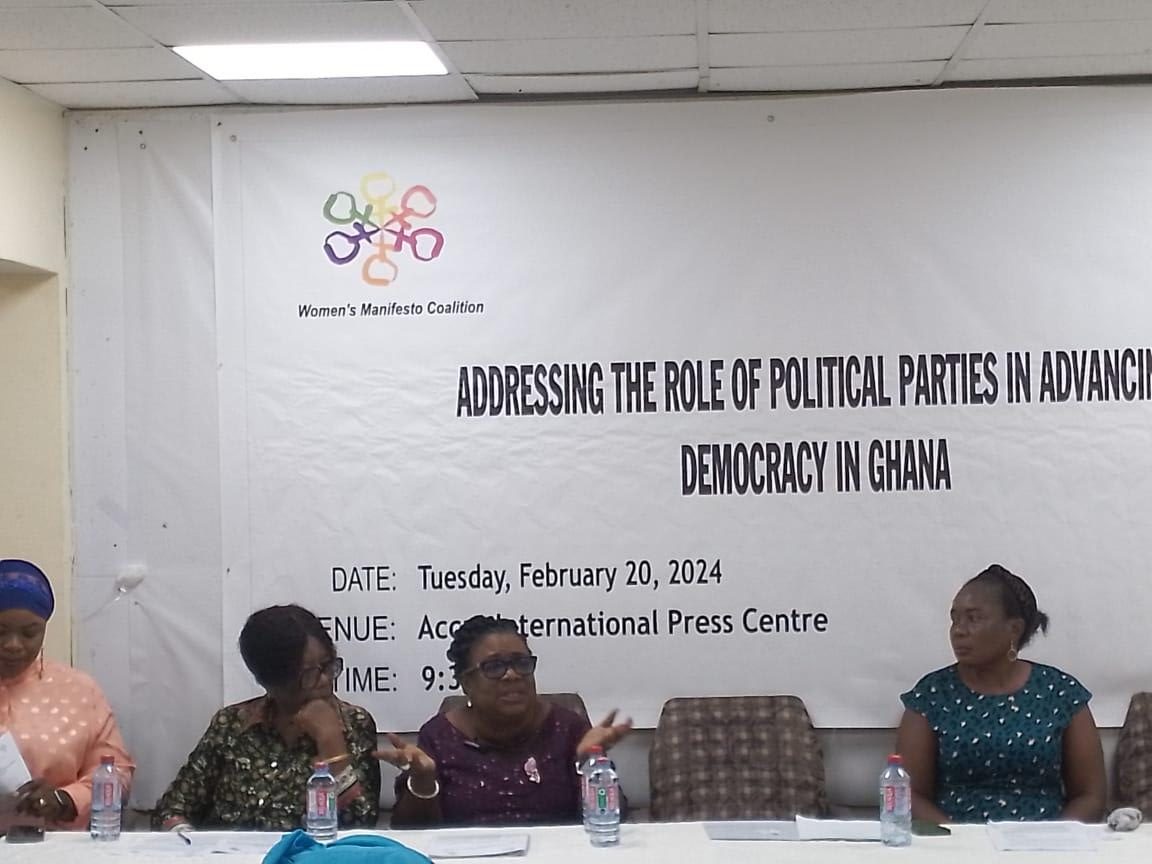
The Women’s Manifesto Coalition (WMC) has raised concerns about political party cultures that are failing to include gender equality and women’s rights as salient issues in the process of building a democratic Ghana.
The Coalition argues that the continuous underrepresentation of women in decision–making positions does not augur well for women’s ability to contribute to critical decisions that have implications for their socio-economic well-being.
“The Women Manifesto Coalition want to make an ardent call to political parties in the country to ensure the inclusive representation of both women and men in equal measure, and to expand their role not only as “gatekeepers” of democratic ideals but also facilitate through internal mechanisms the participation of the marginalised, especially women in the parties as well as in government.”.
More Read
These were made known at a press conference organized by the Coalition in Accra on Tuesday to highlight their concerns.
It observed that recent internal political party Primaries of the two major political parties in Ghana that hold 100% of the seats in the national Parliament, the National Democratic Congress (NDC) and the New Patriotic Paty (NPP), show that women have lost ground quite significantly.
Globally, the consensus is that political parties are a critical element in the building of participatory democracies. the UN Resolution of the General Assembly 66/130 on Women and Political Participation urges States among others: “To strongly encourage political parties to remove all barriers that directly or indirectly discriminate against the participation of women, to develop their capacity to analyse issues from a gender perspective, and to adopt policies, as appropriate, to promote the ability of women to participate fully at all levels of decision-making within those political parties”.
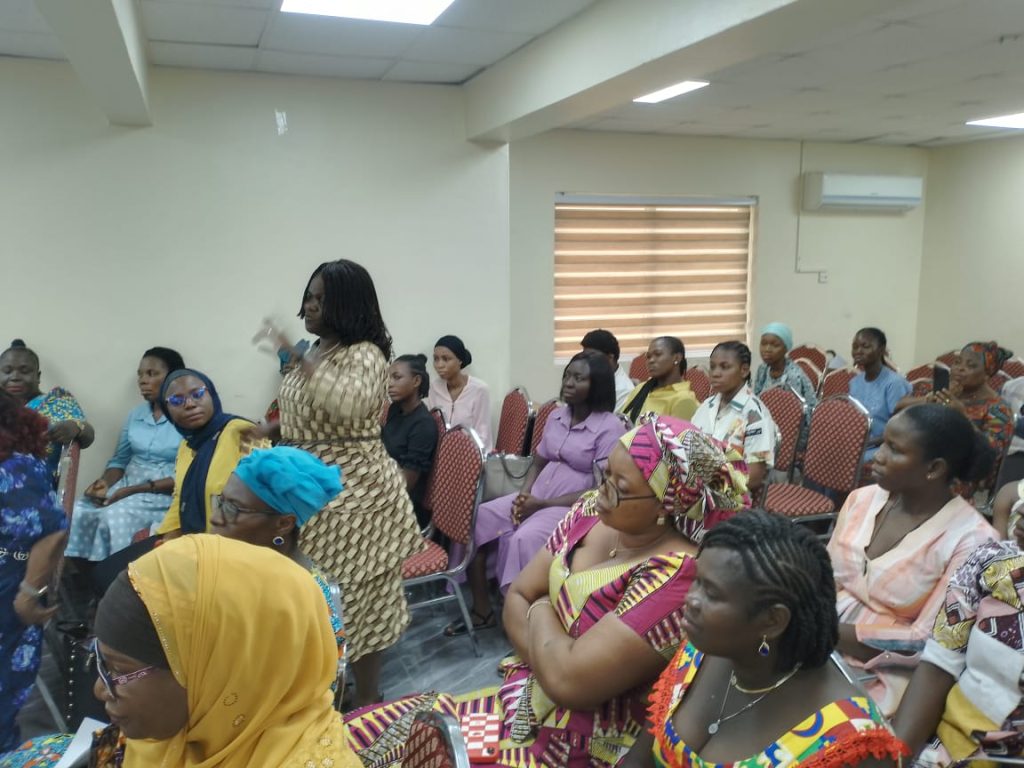
A section of the participants at the event
Addressing the press, Convener of the Women’s Manifesto Coalition Madam Hamida Harrison lamented that despite the International Resolutions, political parties are not gender neutral and they have not been women- Friendly, – so far as their internal rules and culture have tended not to favour women’s equal political participation.
Madam Harrison pointed out that “Political parties have grown to become rigid structures favoured by the dominant wealthy and more powerful male groups. Therefore, women are unable to make inroads in the fiercely competitive platforms for political; party positions in their parties because they lack the financial resources associated with the pursuit of political power.
She observed that traditionally, political parties provided little encouragement to women’s political empowerment, adding that the parties often tended to approach gender issues from a strong instrumental perspective, employing topics related to women’s political representation only to attract female votes during elections.
She lamented,” the number of women represented in parties internal hierarchies and in elected position is invariably small as consequence o political failing to take the issue of women’s under-representation, both in their internal leadership and in elected position as a serious issue of political concern.”
In a presentation on Advancing Women’s Presence In Political Decision Making: The Role Of Political Parties Madam Pauline Adobea Dadzawa, Consultant and a former Commissioner at the Electoral Commission of Ghana emphasized the need for political parties to pay attention to issues relative to women.
She indicated that the country needed to make gendered laws so the women’s issues would be addressed, adding “Let’s promote inclusive political cultures.”
On her part, Ms Evelyn Borlabi senior programme officer at the Department of Gender, Ministry of Gender Children and Social Protection submitted that political parties must always incorporate te principles of gender equality in their political structure to ensure that women are at the forefront in the decision-making processes.
She told participants, “We need deliberate efforts geared toward gender equality”.
By: Mohammed Suleman/Publicagenda.news