
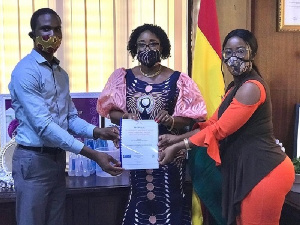
Gender Advocacy NGO, Bridge for Equity Ghana, has presented a petition to the Ministry of Gender, Children and Social Protection, to nudge government to scrap taxes on sanitary pads and enable local production across the country.
In a six-month campaign dubbed ‘No Pad Tax’, the NGO believes that scraping the 20% tax on sanitary pads, also termed as luxury items by the Ghana Revenue Authority will go a long way to address issues related to period poverty.
The 24-page petition document, which gives a background to the problem, statistics, effects and recommendations, is attached with 2,000 signatories from concerned citizens across the country.
More Read

According to the founder of the NGO, Lilipearl Baaba Otoo, the campaign is also to create awareness on menstrual hygiene as well as expose citizens to the challenges that young girls go through during their period. She cited absenteeism, teenage pregnancy and school dropouts as the major consequences of menstruation to schoolgirls in Ghana especially in rural Ghana.
“It is really strange that something as normal and regular as menstruation could be a major contributing factor to messing up the future of young girls in Ghana. Schoolgirls especially in rural Ghana cannot afford sanitary pads because they are expensive and almost inaccessible to them,” she said.
“The goal is to get government to distribute these pads for free at least for Basic and Secondary school girls however we need to start from somewhere and that place is to petition government to scrap the 20% tax on sanitary pads and enable local production,” Ms. Otoo added.
On his part, Coordinator for Bridge for Equity Ghana, Patrick Fynn, noted that enabling local production will not only fall in line with the agenda to encourage made-in-Ghana goods, but it will also go a long way to address issues of unemployment, poverty, school drop outs, absenteeism and even teenage pregnancies.
He also cited the importance of educating men on the nature of menstruation and the psychological effects it has on women especially when they are period-shamed.
Receiving the petition, the Minister for Gender, Children and Social Protection, Cynthia Morrison commended the NGO for the efforts they have taken on their initiative. She said her Ministry has been working assiduously to get the taxes on sanitary pads scrapped and assured that they will work in collaboration with the Finance Ministry for the way forward.
The No Pad Tax campaign is supported by Plan International Ghana, in collaboration with other like-minded NGOs such as Standout Care, Global Youth Network, CAMFED Association, Future Friends, Fanthonio Foundation, Pad a Girl, Girl Child Concern Ghana, Stay Free, The Kyereh Foundation, Plan Ghana Alumni Network, Future Leaders Advocacy Group and the Organisation for Inclusion and Empowerment (OFIE).
Source: B&FT Online