Public Agenda NewsPaperPublic Agenda NewsPaper
  • General News
  • Politics
  • Business
  • Health
  • Development Agenda
  • World News
  • Features & Opinions
  • Election watch
  • Editorial
Font ResizerAa
Public Agenda NewsPaperPublic Agenda NewsPaper
Font ResizerAa
  • General News
  • Politics
  • Business
  • Health
  • Development Agenda
  • World News
  • Features & Opinions
  • Election watch
  • Editorial
Search
  • General News
  • Politics
  • Business
  • Health
  • Development Agenda
  • World News
  • Features & Opinions
  • Election watch
  • Editorial
Follow US
Uncategorized

Gold purchase alone won’t solve Ghana’s exchange rate challenges – IMANI

Suleman
Last updated: November 5, 2024 2:51 pm
Suleman
Share
3 Min Read
SHARE

IMANI Africa has expressed concerns over the feasibility of the New Patriotic Party’s (NPP) proposed Gold Purchase Programme as a solution for stabilizing the cedi, arguing that it may be insufficient to address Ghana’s currency and economic challenges.

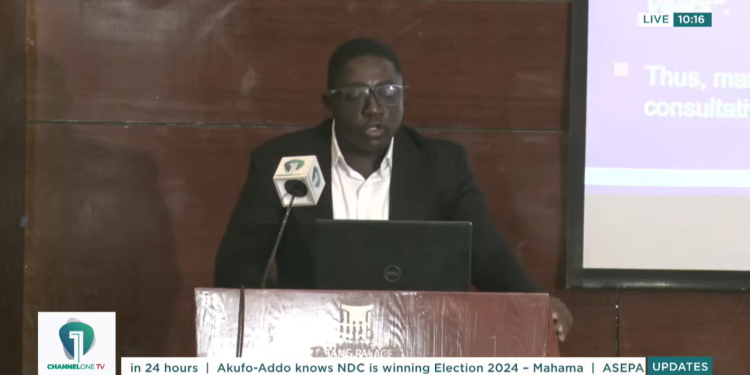
Speaking at IMANI’s “2024 IMANIfesto,” Dennis Asare, a senior research associate at IMANI Africa, outlined key issues with the programme, which has been highlighted in the NPP’s manifesto by flagbearer Dr. Mahamudu Bawumia.

The initiative involves the Bank of Ghana purchasing gold from the local market, particularly from small-scale mining operations, to strengthen national reserves and support the cedi.

More Read
Ghana’s economy records 5.5% growth in Q3 2025 — GSS
King’s Baton Relay arrives in Ghana on August 8 ahead of 2026 Commonwealth Games
Ghana secures $370M from IMF after successful review
Mfantseman Youth Trained to Strengthen Local Governance Participation 
We’ll excel beyond IMF programme – Dep. Min. Finance

While the programme aims to stabilize the cedi by backing it with gold reserves, Asare questioned its efficacy, pointing out that initial implementation only reduced the exchange rate by a modest 3%.

He suggested that without additional structural reforms, the programme alone would likely have minimal long-term impact on currency stability.

“They want to continue the Gold Purchase Programme to shore up our country’s reserves, which we see that other countries are doing the same thing. What the Bank of Ghana does is that they buy about 20% of gold from the market.

“Now they also want to look at sustainable small-scale mining, buy a lot of that gold and ensure that they are able to shore up our forex reserves. What we are saying is that, if you look at this promise alone, this year, there was an increase in terms of small-scale mining. But in periods where small-scale mining output does not grow. If this is going to be one of the anchor promises for addressing our exchange issues, how then does the BoG get more gold to address that?

“Another challenge is that if we buy gold from large-scale miners in cedis because some of their capital expenditure is in dollar denomination, they will still have to then convert the cedi to the dollar; what we paid in cedis, they will have to convert some of them to the dollar so that they can finance their operations.

“Those underlying dynamics must be worked out so well that we can control our exchange rate. What we think is that since they started doing this, the exchange rate in terms of depreciation has dropped by just 3% and year by year, it has been depreciating more than 20%.

“So, this programme may not be effective because what will make this programme effective is that gold prices must be so high that you can buy a lot more to shore up your forex reserves, which we don’t think is possible within the shortest possible time looking at the global market,” he stated.

Source: CNR
Share This Article
Facebook Whatsapp Whatsapp Email Copy Link Print

Latest News

13 new Mpox cases confirmed; total reaches 993
February 3, 2026
Ghana suspends citizenship process for people of African descent
February 3, 2026
IGP reshuffles top Police Command
February 3, 2026
Raw commodity exports undermining Africa’s growth – Mahama
January 28, 2026
Ayariga accuses NPP minority of hypocrisy over certificates of urgency
January 27, 2026
Every cedi lost to corruption is a loss to national development – Deputy Finance Minister
January 27, 2026
ISODEC Introduces Whistleblower Policy to Strengthen Transparency and Accountability
January 27, 2026

You Might Also Like

Breaking NewsGeneral Newstop storiesUncategorized

Energy Ministry traces 2,637 ECG containers after audit

May 27, 2025
Breaking NewsGeneral Newstop storiesUncategorized

Ghana shuts down Embassy in Washington D.C. over corruption scandal

May 26, 2025
Uncategorized

Lower-income countries commit record US$250 million towards immunisation   

May 20, 2025
Uncategorized

Mahama’s new Code of Conduct for Ministers: 10 key rules

May 7, 2025

About Us

Public Agenda is fou­nded and owned by Pu­blic Agenda Communic­ations.

Public Agenda was founded as a public interest Me­dia entity. Its Visi­on is to contribute to building a well-i­nformed society where accurate informati­on dissemination is the cornerstone of a democratic, just and equitable society.

Its mission is to inform, guide and bui­ld responsible citiz­enship and accountab­le decision making and strive for excell­ence in the media in­dustry. Public Agenda Communications is managed by a Board of Directors.

Welcome Back!

Sign in to your account

Username or Email Address
Password

Lost your password?